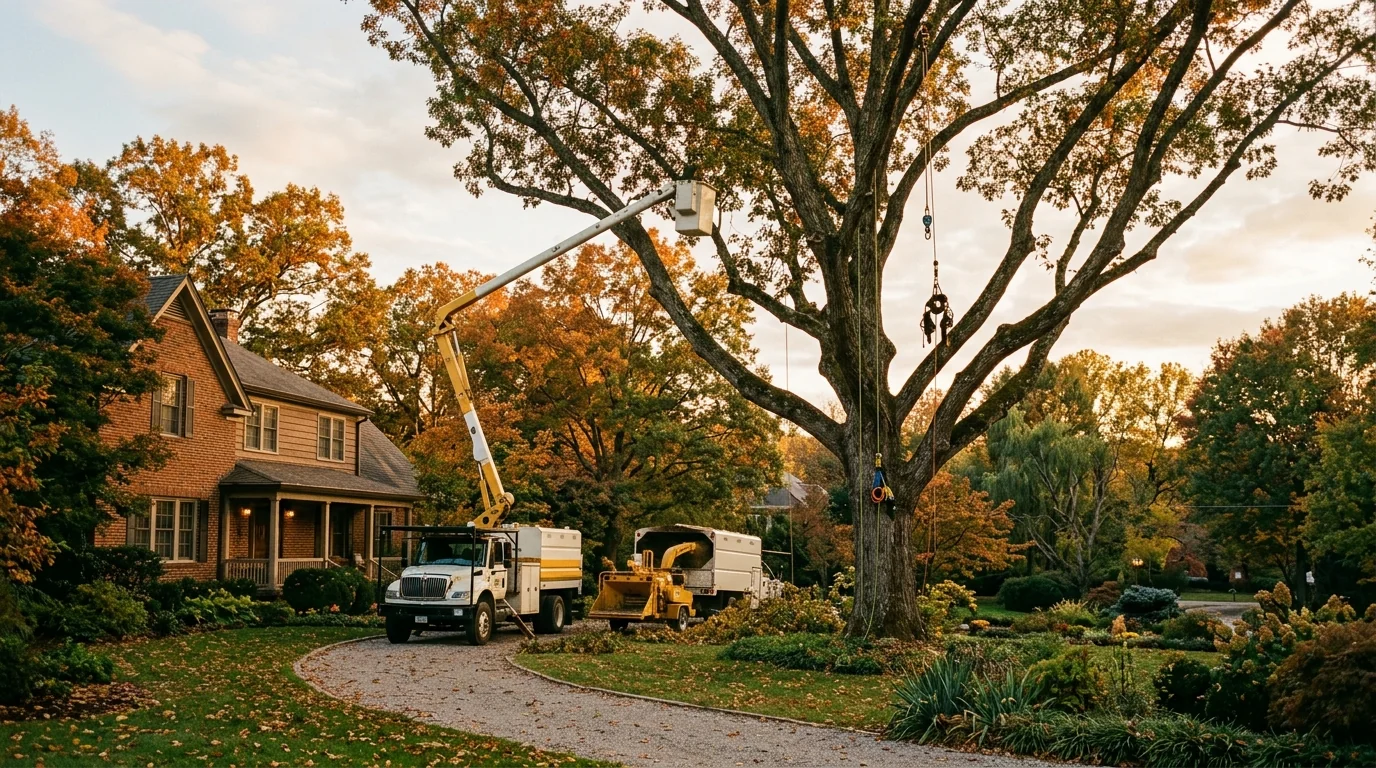
Filing an Insurance Claim for Tree Damage in Knoxville TN
Homeowners insurance typically covers tree removal when a fallen tree damages a covered structure such as your house, garage, or fence. If a tree falls but causes no structural damage, most policies will not pay for removal. Limits, deductibles, and cause-of-loss exclusions vary widely, so review your policy before you assume coverage applies.
Updated Jul 11, 2025 · 6 min read
Homeowners insurance covers tree removal when a fallen tree damages a covered structure on your property. Wind, lightning, hail, and ice are typically covered perils under a standard HO-3 policy. If the tree falls without hitting a structure, most carriers will deny the claim entirely. According to the Insurance Information Institute, your policy pays for debris removal and the structural repair, but debris-removal payouts are usually capped well below the actual cost of the job.
Step-by-Step: How to File a Tree Damage Claim in Knoxville
Follow these steps in order. Skipping early steps, especially documentation before cleanup, is the most common reason claims are reduced or denied.
-
Make the scene safe first. If the tree has brought down power lines, stay back and call KUB (Knoxville Utilities Board) at their outage line before anyone touches the tree. Do not let a crew cut a tree that is in contact with an energized line.
-
Photograph everything before any cleanup begins. Shoot wide establishing shots that show the full tree and structure, then close-ups of every point of contact and every piece of visible damage. Date and time stamps from your phone’s camera are useful evidence. Store photos in a cloud folder you can share with the adjuster.
-
Make emergency temporary repairs to prevent further damage. Your policy typically requires you to mitigate additional loss. Tarping a damaged roof or boarding a broken window is both smart and often required to preserve coverage. Save every receipt.
-
Call your insurance carrier and open a claim. Most major carriers have 24-hour claim lines. Have your policy number, your address, and the date and approximate time of the storm or event. Ask specifically what your debris-removal sublimit is and what your named-storm deductible is (a separate, higher deductible that some Tennessee policies now carry for wind events).
-
Request a written estimate from a licensed Knoxville tree service. An itemized written estimate that separates tree removal, debris hauling, and stump grinding carries more weight with an adjuster than a verbal quote or a single lump-sum number. See what a full removal typically costs before you assume the insurance payout will cover everything by reviewing the Knoxville tree removal cost breakdown.
-
Meet the adjuster on-site. Walk the damage with them. Point out every area of concern, including secondary damage such as gutters, siding, fence sections, and landscaping. Adjusters move quickly; you are your own best advocate for making sure nothing is missed.
-
Review the settlement offer before you sign. The first offer is not always final. If the estimate you received from your tree service is significantly higher than the adjuster’s number, you can negotiate or hire a public adjuster. Keep all receipts for work you authorize.
-
Schedule the removal promptly. Most carriers expect the debris removed and the structural repair completed within a reasonable timeframe. A tree still resting on your roof weeks after the storm can complicate the claim. Contact a Knoxville tree service as soon as the claim is opened so you are on the schedule.
What Homeowners Insurance Typically Covers vs. Does Not Cover
| Situation | Usually Covered | Usually Not Covered |
|---|---|---|
| Tree falls on house, garage, or fence | Yes, for removal and structural repair | |
| Tree falls in yard with no structural damage | No, in most standard policies | |
| Dead or diseased tree falls on house | Disputed, insurer may deny as maintenance failure | Likely denied if pre-existing condition is documented |
| Neighbor’s healthy tree falls on your house | Yes, claim under your own policy | Neighbor’s policy (absent proven negligence) |
| Tree removed proactively before it falls | Not a covered loss | |
| Stump grinding after a covered removal | Sometimes included in debris-removal sublimit | Often excluded or over the sublimit |
Why Knoxville Has a Specific Insurance Risk Profile
Knoxville’s climate and tree canopy create a claims environment that differs from most other Southeast metros.
Ice storms are the overlooked hazard. East Tennessee’s elevation and valley-and-ridge terrain make winter ice events a recurring and destructive hazard. The February 2021 ice storm caused widespread limb breakage across Knox County hardwoods and white pines (NWS Morristown KMRX climate records). Ice-loaded limbs fail silently overnight and land on roofs, cars, and fences without the advance warning a severe thunderstorm provides. Ice damage is typically a covered peril, but document the event with a local NWS weather record to give the adjuster clear cause-of-loss evidence.
Hurricane remnants reach East Tennessee. Remnants of Hurricane Helene in September 2024 caused catastrophic flooding and widespread saturation-driven tree failures across Knox County. Flood damage itself is a separate policy (NFIP), but wind and tree damage from a tropical system’s remnants is typically covered under your standard homeowners policy. The distinction matters when you file.
Dead trees are a growing, uninsured liability. Knox County is dealing with three active tree-kill threats right now. Emerald Ash Borer has been confirmed in Knox County and is pushing native ash trees toward near-total mortality. Thousand Cankers Disease was first detected in the eastern United States in Knoxville in 2010 (Tennessee Department of Agriculture) and continues to threaten black walnut trees in the area. Hemlock Woolly Adelgid has devastated eastern hemlocks across East Tennessee. Dead trees from these infestations are exactly the kind of pre-existing hazard that insurers point to when denying a claim. If you have a dying ash, walnut, or hemlock on your property, removing it proactively costs far less than fighting a denied claim after it falls. A tree health assessment by a local arborist can tell you which trees are in decline before a storm makes the decision for you.
Knox County’s 47.9 inches of annual rainfall (NWS Morristown KMRX, 1991-2020 Climate Normals) keeps the ground saturated for long stretches. A waterlogged root zone weakens anchorage in the residual clay soils of the Valley and Ridge province, so trees that look healthy can topple in winds that would not move them in drier conditions. This is one reason adjusters in this market see more whole-tree failures and fewer simple broken-branch claims than in drier metros.
What This Means for Your Removal Decision
Insurance rarely covers the full cost of tree removal even when a claim is approved. Debris-removal sublimits frequently fall short of actual prices, especially for large trees, crane-assisted removals over a structure, or multi-tree storm events. Before you assume the insurer will handle it, get a written estimate and compare it against your sublimit. That gap is your out-of-pocket cost regardless of fault or coverage.
If a tree on your property is already dead or visibly declining from EAB, Thousand Cankers Disease, or another documented problem, act now. An insurer that finds evidence of pre-existing disease will deny the structural damage claim and leave you paying both the removal and the repair. Proactive removal is almost always cheaper than a denied claim on top of a repair bill.
Review the full range of tree services available in Knoxville to understand what the job may involve, then request a written quote so you have real numbers to bring to your adjuster or to plan your out-of-pocket budget before a storm forces the decision.
Free written estimate
Worried about a tree? Get a free estimate.
On-site assessment and a written estimate. Same-day for emergencies. No obligation.
Questions
Filing an Insurance Claim for Tree Damage in Knoxville TN FAQs
Is tree removal covered by homeowners insurance after a storm?
What if my neighbor''s tree falls on my house?
How much will insurance pay for tree removal in Knoxville?
Does insurance cover removal of a dead or diseased tree?
What documentation does an insurance adjuster need for a tree claim?
Will filing a tree damage claim raise my homeowners insurance premium?
Do I need a permit to remove a storm-damaged tree in Knoxville?
Free estimate
Talk to a Knoxville tree pro
On-site assessment and a written estimate, often same day. No obligation.