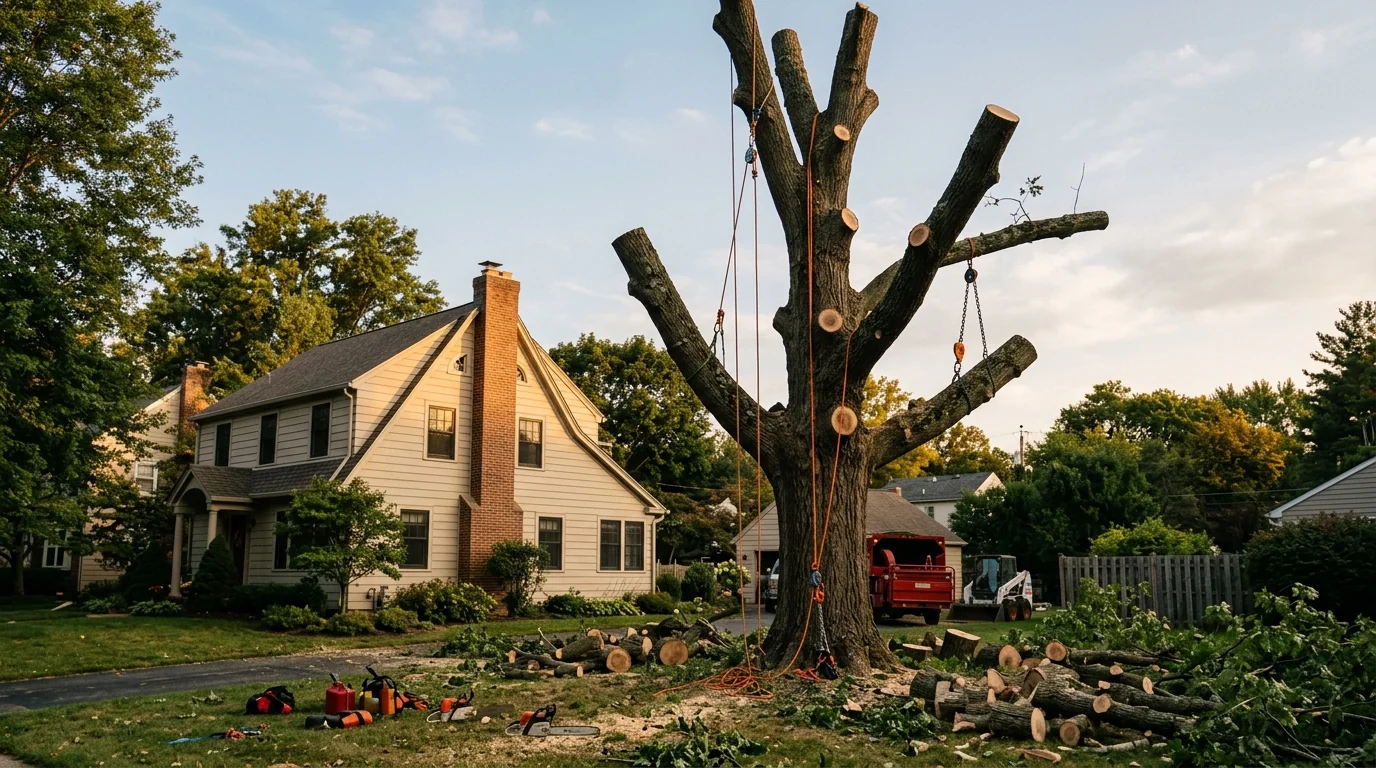
Service area · Tennessee
Tree care in Seymour
Seymour is a census-designated place spanning Blount and Sevier counties in the Knoxville metro. Its mix of suburban subdivisions and rural lots, combined with East Tennessee storm seasons, keeps tree removal demand high year-round. Homeowners here deal with large hardwoods, sloped terrain, and properties that fall under county rather than city jurisdiction.
Why Seymour Tree Removal Is Different
Seymour is not a city with a downtown building department and a tidy permit counter. It is an unincorporated census-designated place that straddles Blount and Sevier counties, sitting at the southern edge of the Knoxville Metropolitan Statistical Area. That dual-county structure changes almost everything about how tree work gets permitted, inspected, and regulated here. Add the East Tennessee topography, the area’s mixed housing stock, and the dense hardwood canopy that covers most residential lots, and you have a tree removal market that rewards contractors who know the local terrain and penalizes those who treat this as just another suburb.
According to Wikipedia’s entry on Seymour, Tennessee, the CDP had a population of 14,705 at the 2020 census. The community’s location along Chapman Highway and the foothills approaching the Smoky Mountains puts most properties on gently to moderately sloped terrain, which affects how crews access large trees and stage equipment.
Soil and Geology in Seymour
Seymour sits in the Ridge and Valley physiographic province of East Tennessee, a region characterized by alternating ridges of more resistant rock and valleys underlain by softer carbonate and shale formations. Surface soils in this corridor tend to be clay-rich, which expands when wet and contracts during dry summers. That soil movement over decades gradually shifts the root anchorage of large trees, making older specimens more vulnerable to toppling even without obvious disease. Slopes near creek drainages, particularly around Boyds Creek and Nails Creek, can develop wet, unstable soil profiles that accelerate root rot in species like silver maple and Eastern red cedar.
Homeowners who notice a previously straight tree beginning to lean after a wet winter should treat that as a warning sign worth a professional assessment rather than a cosmetic concern. Understanding your lot’s drainage pattern is the first step toward knowing which trees are highest risk. The USDA Forest Service’s urban forestry guidance recommends regular professional assessments of trees near structures, especially on properties with drainage changes or recent grading.
Climate and Storm Patterns Near Seymour
East Tennessee’s climate brings four distinct hazard windows for trees each year. Spring severe weather from March through May delivers the most tornado and microburst activity in the region. Summer thunderstorms from June through August produce frequent wind shear events that snap limbs or uproot shallow-rooted trees. The tail end of tropical systems occasionally pushes rainfall and sustained winds inland from the Gulf Coast into Tennessee in August and September. Winter ice storms, while less frequent than in higher elevations, can load branches to failure across the Seymour corridor.
The NOAA Storm Events Database documents a consistent pattern of wind, hail, and severe thunderstorm events in Blount and Sevier counties. Homeowners who have not walked their lot after each major storm to check for newly cracked limbs, uprooted root plates, or leaning trunks are accepting more risk than they likely realize. Emergency removals after a storm event carry a cost premium compared to proactive removal, so identifying hazards early pays off.
Housing Era and Tree Maturity in Seymour
Seymour’s residential development accelerated through several distinct waves. Older stretches along Chapman Highway include homes built in the 1950s through 1970s, many with mature trees that were small ornamentals at planting and are now 50- to 70-year-old specimens pushing 80 feet tall. Subdivisions that filled in during the 1990s and early 2000s used faster-growing species like Bradford pear and silver maple as landscaping anchors. Both of those species are now at or past the age when structural failure becomes common.
Bradford pear, in particular, is notorious for splitting at weak branch unions, often without warning. Silver maple develops surface roots that buckle driveways and crack sidewalks before the canopy shows any visible stress. If your home was built between 1988 and 2005 and the original landscaping is still in place, a canopy assessment is worth scheduling before the next storm season.
Seymour Neighborhoods and Tree Removal Patterns
Different parts of Seymour present different removal challenges. Here is a breakdown of the primary residential areas and what tree work typically looks like in each:
- Chapman Highway Corridor, High-traffic frontage properties with older homes and mature oaks, often within fall distance of the roadway or utility lines. Permit coordination with the county is most common here.
- Boyds Creek Road Area, Rural to semi-rural lots with large hardwoods and limited crane staging area. Piece-by-piece sectional removal is the norm on tighter properties.
- Milestone Drive Subdivisions, Newer construction with HOA-governed lots. Bradford pear and ornamental trees planted at build-out are now reaching structural failure age. Debris haul-off expectations are high.
- Tuckaleechee Area, Foothills terrain with steeper slopes and mature pine stands. Root instability on slopes is a recurring concern after wet seasons.
- Nails Creek Community, Creek-adjacent properties with wet soil profiles. Cottonwood and silver maple removal is common as root systems encroach on foundations and septic fields.
- Seymour Town Center Area, Mixed commercial and residential strips where tree work often requires traffic control planning and coordination with utility contacts.
- Old Seymour Road Residential, Established neighborhoods with a mix of pier-and-beam and slab homes. Mature tree canopy is dense, and neighbor-proximity issues are common.
- River Road Rural District, Larger lots with less urgent removal timelines, but multi-tree projects that require full-day crews and chipper truck access.
- Whitaker Road Suburbs, Mid-2000s construction with landscaping trees now 15 to 20 years old, approaching the size threshold where proximity to structures warrants evaluation.
How to Find a Seymour Tree Removal Contractor
Seymour’s dual-county status and unincorporated character mean that not every Knoxville-area contractor understands the local permit and access landscape. Here are four evaluation criteria that matter specifically in this market.
Credential verification. Ask whether the crew includes or subcontracts an ISA Certified Arborist. The International Society of Arboriculture’s Find an Arborist tool lets you verify credentials by name before any crew sets foot on your property. This matters because Seymour’s terrain and species mix benefit from someone who has formally studied hazard assessment, not just removal mechanics.
Local-experience specificity. A contractor who has genuinely worked in Seymour should be able to describe access challenges on Boyds Creek Road, the soil conditions near creek drainages, or the typical approach to staging equipment on sloped residential lots. Vague answers about “the greater Knoxville area” are a signal that the contractor may not have dealt with this county’s specific access and permitting situations before.
Permit knowledge for unincorporated areas. Because Seymour spans two counties, a contractor who only knows one county’s process is operating with incomplete information. Ask directly: “Which county department handles permits for my address, and do you handle the application?” A competent contractor should be able to answer that question or find out before starting work.
Written scope and haul-off terms. The Tree Care Industry Association’s contractor hiring guidance recommends getting a written contract that specifies what is included. Debris haul-off is a common source of disputes in this market. Confirm before signing whether the quote covers full removal of chips, logs, and brush or whether logs remain on-site as the homeowner’s responsibility.
What to Expect from a Seymour Tree Inspection
A quality inspection in Seymour covers four areas, and each one is relevant to the local conditions.
Exterior walk-around. The inspector checks trunk lean, bark condition, visible root plate movement, and branch structure. On sloped lots near Tuckaleechee or the Boyds Creek drainages, the inspector should pay particular attention to uphill-side root exposure and soil cracking, which indicate root plate instability.
Interior walk-through. For trees close to the home’s footprint, a walk through the rooms nearest the tree checks for signs of root intrusion, foundation cracking, or moisture patterns that suggest the root system is already affecting the structure. This step is especially relevant for pier-and-beam homes along the older Chapman Highway corridor.
Canopy and branch assessment. Dead wood, crossing limbs, and included bark at major branch unions are the indicators an arborist looks for in the upper canopy. Bradford pear trees, common in 1990s-era Seymour subdivisions, often have multiple included-bark unions that are invisible from the ground but detectable with binoculars or a bucket-truck inspection.
Slope and drainage evaluation. Seymour’s terrain means drainage patterns directly affect tree stability. The inspector should note whether surface runoff from driveways or neighbors’ lots is directing water toward the root zone, creating wet conditions that accelerate root decay. Homes in the River Road Rural District and Nails Creek Community are particularly subject to this dynamic.
When you are ready to schedule a site visit, the free inspection request form connects you with contractors familiar with Blount and Sevier county properties.
Repair Methods and Removal Options Used Most Often in Seymour
Seymour homeowners encounter a consistent set of tree service types based on the area’s species mix, lot sizes, and terrain. Here is a breakdown in order of frequency, with cost context from Bob Vila’s tree removal cost guide.
-
Full tree removal. The most common service in Seymour, covering dead oaks, storm-damaged pines, and Bradford pears past structural viability. Bob Vila reports a typical range of $385 to $1,070 for standard residential removals, with larger or more hazardous trees running higher. See detailed size and species pricing on the tree removal cost hub.
-
Emergency storm removal. After severe weather events, which are well-documented in Blount and Sevier counties through the NOAA Storm Events Database, emergency work commands a premium over standard rates. Response speed is critical. Learn about emergency tree removal services in Knoxville.
-
Stump grinding. Most full removals in Seymour include stump grinding as an add-on. Bob Vila cites stump grinding as a separate cost that typically runs $150 to $450 depending on diameter and root complexity. Surface roots from silver maple and oak make stump work more involved on many Seymour lots. See stump-specific pricing on the stump grinding cost page.
-
Crown pruning and hazard trimming. When the tree is structurally sound but specific branches threaten the roofline or a utility line, pruning is the appropriate intervention. The ISA’s homeowner tree care resource explains that preserving a healthy tree through proper pruning is preferable to removal when the structure permits. Review pruning service options on the tree services hub.
-
Crane-assisted removal. On tightly constrained lots, particularly in the Milestone Drive and Old Seymour Road areas where homes sit close together, crane work is sometimes the only safe approach. Bob Vila notes crane-assisted removals can add $500 or more to the base cost. Explore what this method involves on the crane tree removal Knoxville page.
All tree-related hazard identification information is consolidated on the tree problems resource hub for homeowners who want to assess their own property before scheduling a contractor.
Seymour Building Permits for Tree Removal
Because Seymour is an unincorporated community rather than an incorporated municipality, there is no Seymour city permit office. Permit authority rests with the counties. Properties west of the county line fall under Blount County jurisdiction, and those to the east fall under Sevier County. Most residential tree removal on private property in unincorporated areas does not require a permit, but that changes when work involves trees in public rights-of-way, trees within utility easements, or trees on lots where a land disturbance permit is already active.
Homeowners planning any grading, driveway work, or construction alongside a tree removal project should contact Blount County’s or Sevier County’s building and zoning office before starting. Combining tree removal with permitted construction without proper coordination can create liability, particularly if root removal affects erosion control requirements. Contractors familiar with this dual-county market will handle permit inquiries as part of their pre-work process.
Tennessee follows the International Building Code as the baseline for construction standards, but tree removal in residential areas is primarily governed by local land disturbance and utility-corridor ordinances rather than the statewide building code. If your project involves trees near overhead utility lines, contact the utility provider directly, as Tennessee law generally requires utility coordination before any crew works within fall distance of energized lines.
Other Tennessee Cities We Serve
Seymour neighbors several other communities in the Knoxville metro where this same crew network operates.
- Rockford tree removal services, A small community in Blount County that shares Seymour’s rural-to-suburban character and similar terrain challenges.
- Alcoa tree removal services, An incorporated city in Blount County with its own permit office and a higher concentration of commercial tree work around industrial corridors.
- Knoxville tree removal services, The metro anchor, with the widest contractor availability and the most documented storm-event history in the region.
Neighborhoods served
Seymour neighborhoods
- Chapman Highway Corridor
- Boyds Creek Road Area
- Milestone Drive Subdivisions
- Tuckaleechee Area
- Nails Creek Community
- Seymour Town Center Area
- Old Seymour Road Residential
- River Road Rural District
- Whitaker Road Suburbs
Questions
Seymour tree care FAQs
Why is tree removal so common in Seymour?
How much does tree removal cost in Seymour?
Do I need a permit to remove a tree in Seymour?
How do I verify a tree contractor has worked in Seymour before?
Which parts of Seymour have the most tree removal activity?
Can I get a free inspection before committing to removal?
Free estimate
Free Seymour tree estimate
On-site assessment, written quote within 24 hours, no obligation.