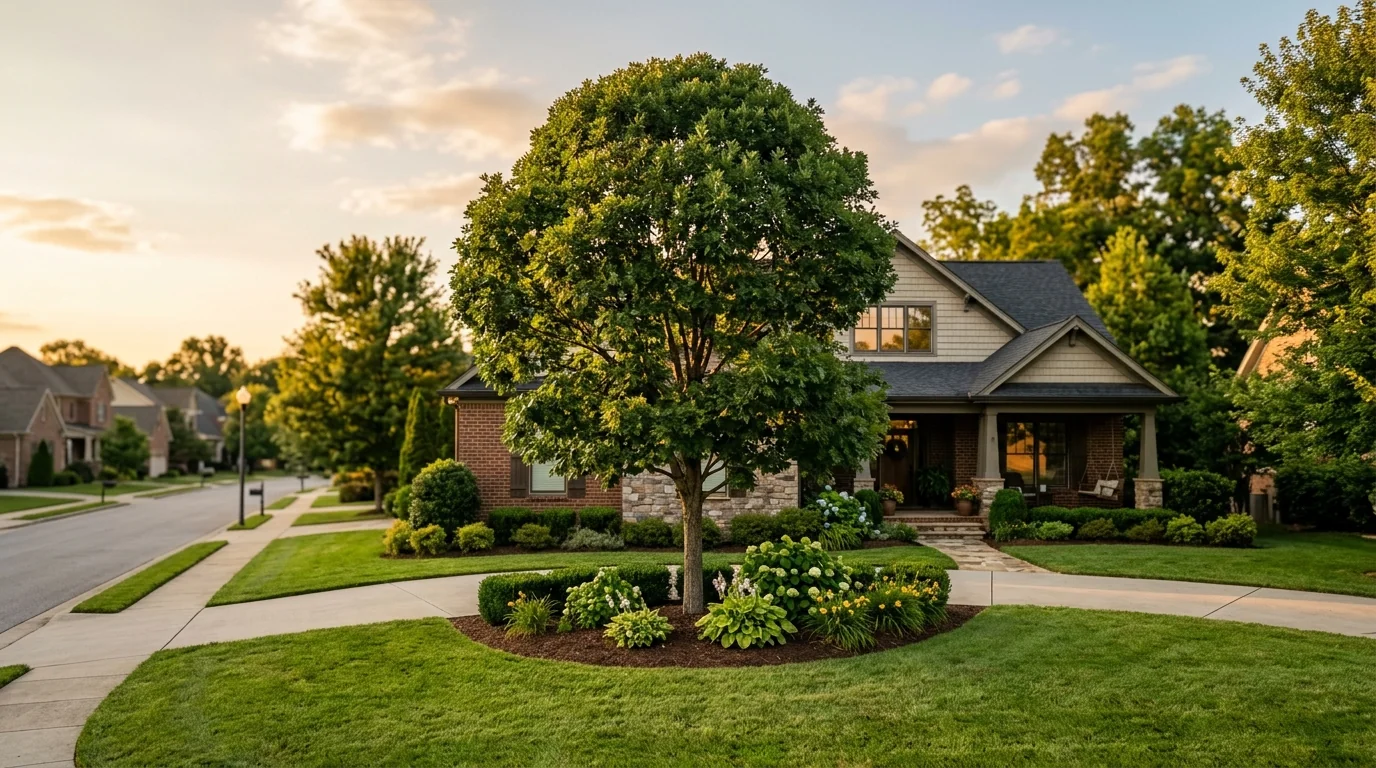
Tree pruning in Knoxville, TN: when it’s the right choice
Tree pruning is the controlled removal of specific branches to improve a tree’s structure, health, or safety profile, and it is one of the most common requests arborists receive across Knox County. When a tree in your yard has dead limbs hanging over a roof, crossing branches rubbing bark off each other, or canopy weight that makes it a liability every time a spring thunderstorm moves through the Tennessee Valley, pruning is almost always the first step to evaluate before considering full removal.
The short version: if the trunk is sound and the root system is intact, pruning can extend a tree’s useful life by decades. If the trunk is hollow, the tree is leaning toward a structure after a saturation event, or more than half the canopy is already dead, the conversation shifts toward tree removal options in Knoxville.
How pruning works mechanically
A proper pruning cut removes a branch at its point of attachment, either back to the parent stem or to a lateral branch large enough to assume the growth role. The cut is positioned just outside the branch collar, a slightly raised ring of protective tissue the tree uses to compartmentalize the wound. Flush cuts that remove the collar, or “stub” cuts that leave several inches of dead wood extending from the trunk, are both ANSI A300 violations and common sources of decay entry. The ANSI A300 Tree Care Standard defines the technical specifications that qualified arborists follow for every cut.
Conditions tree pruning is designed for
Pruning works best when the goal is correcting a specific, identifiable defect in an otherwise viable tree. Common situations in Knoxville:
- Dead or dying limbs from ice-storm breakage. Knox County’s position in East Tennessee makes winter ice events a recurring threat, and the February 2021 ice storm left thousands of residential trees with hanging broken wood that required professional removal.
- Crown thinning to reduce wind resistance in mature oaks and maples before the spring severe-weather season (March through May).
- Structural training on young trees to eliminate co-dominant stems before they become a splitting hazard.
- Clearance cuts to lift the canopy away from rooflines, gutters, or power-line corridors.
- Removal of beetle-infested wood from trees in early-stage Emerald Ash Borer decline, to reduce hazard while a treatment decision is made.
Conditions where removal is the better answer
If a certified arborist finds that the trunk is structurally compromised from the inside, that the root system has heaved after a soil-saturation event, or that a pest infestation such as Hemlock Woolly Adelgid has progressed past the point where treatment is cost-effective, pruning becomes maintenance on a dying asset rather than an investment in a healthy one. Knoxville’s karst limestone soils can hide subsurface voids that shift root anchorage suddenly; a tree that looked stable before heavy rainfall may present a completely different risk profile afterward.
Installation process: how a pruning job works
Step 1: Assessment and plan (30-60 minutes)
Before any cutting starts, the crew lead or on-site arborist walks the tree, identifies target branches, and confirms the ground-level access needed for equipment. For trees close to structures or power lines, this step may involve a consultation with the utility provider.
Step 2: Ground and aerial setup (15-30 minutes)
Cones or barriers protect surrounding landscaping. For trees under about 25 feet with good branch access, an aerial lift or ladder may be sufficient. Larger canopy trees, or those with limited yard access common to Knoxville’s older in-town neighborhoods, typically require a certified climber with rope and saddle equipment. OSHA standards for tree care operations govern fall protection and rigging requirements throughout this phase.
Step 3: Branch removal, top to bottom (1-6 hours depending on tree size)
Cuts proceed from the top of the canopy downward so removed material falls clear of lower work. Large limbs are rigged with ropes to control descent direction and protect structures below. Each cut follows the ANSI A300 collar-preservation method described above.
Step 4: Canopy review
Once the target branches are down, the climber or lift operator makes a final pass through the canopy to confirm balance and identify any secondary issues that became visible only after initial cuts opened up sight lines.
Step 5: Debris processing and cleanup (30-90 minutes)
Branches are fed through a chipper on site or loaded for off-site disposal. Chip debris can typically be left as a mulch layer if the homeowner wants it. Most full-service crews leave the yard clean of sawdust and small wood scraps.
Total time for a typical single-tree residential pruning job in Knox County runs from a half-day for a small ornamental to two full days for a very large canopy oak with extensive dead wood.
Tree pruning vs. tree removal
The most common decision point homeowners face is whether a problem tree deserves pruning or whether it has crossed into removal territory. The comparison table in this page’s metadata captures the side-by-side mechanics. Here is the prose version.
Pruning preserves the asset. A mature oak or hickory in Knoxville can represent decades of growth and meaningful property value. The ISA’s Trees Are Good homeowner education resource is explicit about this: healthy trees increase residential property values and provide measurable energy-cost benefits through summer shade. Removing a 60-year-old tree to solve a branch problem that could be corrected in a half-day of work is a disproportionate response in most cases.
Removal is the right answer when the tree presents a structural hazard that pruning cannot resolve, when the species has been diagnosed with a terminal infestation, or when the tree’s position relative to the home makes ongoing maintenance cost-prohibitive. Knox County’s black walnut population is a specific local example: Thousand Cankers Disease, first confirmed in the eastern United States in Knoxville in 2010 (Tennessee Department of Agriculture, Thousand Cankers Disease Quarantine), creates a situation where progressive crown dieback eventually makes the tree unsalvageable regardless of pruning frequency.
The honest edge cases: pruning is not a replacement for removal when a tree has developed a basal cavity large enough to compromise structural integrity, or when repeated storm damage indicates that the branch architecture is fundamentally weak. Some trees look like pruning candidates from the street and require removal once an arborist is in the canopy. A written pre-work assessment from a credentialed arborist protects both parties in that situation.
Tree pruning cost in Knoxville, TN
According to Bob Vila’s tree removal and pruning cost guide, tree pruning typically runs between $200 and $1,000 or more per tree, depending on size, species, and site conditions. For full context on how pruning costs compare to removal costs in the Knoxville area, see the tree pruning cost breakdown for Knox County.
Several local variables move the number:
Tree height and canopy spread. A small ornamental cherry under 25 feet is a fundamentally different job from a 70-foot white oak. Larger trees require more climber time, heavier rigging, and more chipper capacity.
Access constraints. Knoxville’s older neighborhoods, particularly in North Knoxville, 4th and Gill, and Sequoyah Hills, often have narrow side yards, low fencing, or mature plantings that prevent equipment from getting close to the base. Tight access increases labor time.
Amount of dead wood. A tree with heavy ice-storm damage or significant Emerald Ash Borer dieback generates more material than a routine crown-thinning job.
Canopy complexity. Trees with multiple co-dominant stems, or those growing over structures, require slower, more deliberate rigging and more experienced climbers, both of which affect the labor rate.
Number of trees. Most crews offer per-job pricing that is more efficient when multiple trees are pruned during the same mobilization. If several trees on a property need work, scheduling them together typically reduces the effective per-tree cost.
Warranty and transferability
A standard warranty for pruning work covers workmanship, meaning cuts made in the wrong location or failing to follow ANSI A300 specifications. A one-year workmanship warranty is a reasonable market expectation in the Knoxville area. It does not cover tree mortality from disease, pest pressure, or weather events that occur after the work is complete.
Ask specifically: does the contractor warrant that cuts were made outside the branch collar? Will they return if a stub cut leads to early decay that a follow-up inspection documents? Get the answer in writing before work begins.
Pest-related concerns add a layer of complexity. If Hemlock Woolly Adelgid or EAB is present, no pruning warranty can guarantee the tree’s survival; those outcomes depend on treatment efficacy and timing, which fall under a separate service category. Confirm that the contractor is willing to document pre-existing pest conditions before work begins so there is no dispute about the tree’s status post-pruning.
Permits and engineering in Knox County
Pruning on private residential property within Knox County does not typically require a permit. However, two situations change that:
Trees in the public right-of-way, or trees on city-owned land within Knoxville city limits, fall under the authority of the City of Knoxville Urban Forestry Division. Any work on those trees must be coordinated through the City before a contractor begins. The City’s Community Development department handles urban forestry inquiries; contacting them before scheduling a crew is the correct first step.
Utility-adjacent pruning is the second exception. Trees growing into Knoxville Utilities Board (KUB) distribution lines require KUB involvement. Private tree contractors are not authorized to perform work that involves contact with energized lines, and proceeding without utility coordination creates liability and safety exposure for the homeowner.
For very large trees in structurally sensitive positions, such as a 70-foot white oak leaning toward a structure after a soil-saturation event from a storm system like Hurricane Helene’s remnants (which caused widespread tree failures across Knox County in September 2024), an engineering assessment may be warranted before any pruning alters the tree’s weight distribution. This is not a standard requirement for routine pruning, but a qualified arborist will flag it if the situation calls for it.
If you are ready to schedule an assessment for a tree on your Knoxville property, use the tree service quote request form to describe your situation and connect with a credentialed local crew. For general information about tree services available across the metro, see the Knoxville tree service area overview.
The ISA’s Find an Arborist tool lets you verify credential status for any arborist before they set foot on your property. For Knox County work, look for an active ISA Certified Arborist credential and confirm the contractor carries general liability and workers’ compensation insurance. The Tree Care Industry Association’s hiring guide outlines what third-party accreditation looks like and why it matters when selecting a tree care company.