Service area · Tennessee
Tree care in Wildwood
Wildwood is a small community near Knoxville in the foothills of the Great Smoky Mountains, where heavy tree canopy, mountain terrain, and seasonal storms combine to create real hazards for homeowners. Trees on steep lots, limited equipment access, and proximity to Appalachian ridgelines make proper removal more complex than in flat suburban markets. Finding a contractor with genuine local experience matters here.
Why Wildwood Tree Removal Is Different
Wildwood sits in the foothills of the Great Smoky Mountains, roughly west of Gatlinburg and within the broader Knoxville metro orbit. With a population of around 1,064, it is a tight-knit rural community where almost every residential lot shares its boundary with dense forest. That proximity to Appalachian woodland is beautiful. It also means that homeowners deal with tree hazards that flat suburban markets rarely face. Steep grades, narrow roads, mature hardwoods, and seasonal storm exposure all shape what it costs and how long it takes to safely remove a tree here.
Soil and Geology in the Smoky Mountain Foothills
The East Tennessee foothills sit atop metamorphic and sedimentary rock typical of the Blue Ridge and Valley and Ridge physiographic provinces. Surface soils in this zone tend to be shallow and rocky on upper slopes, with deeper, moisture-retentive clay soils accumulating in hollows and creek drainages. Shallow soil depth limits how far tree roots spread horizontally, which reduces anchorage and raises the risk of windthrow during storm events. Wet clay soils in low-lying areas can become saturated after heavy rain, further destabilizing root systems in trees that appear healthy from the outside. The USDA Forest Service notes that urban and community forests in hilly terrain face compounded stress from root zone limitations and drainage variation. Both conditions are common across Wildwood.
Climate and Storm Exposure
East Tennessee sits in a region that receives storm threats across three distinct seasons. Spring severe weather from March through May brings the highest tornado and microburst risk. Summer thunderstorms from June through August produce regular high-wind events and lightning strikes. Late-season tropical remnants in August and October occasionally push heavy rain and sustained winds into the mountains. The NOAA Storm Events Database documents repeated wind and storm events across Knox and Sevier counties, the counties that bracket the Wildwood area. Winter ice storms, while less frequent, can deposit enough ice on hardwood canopies to cause catastrophic limb failure and whole-tree failures. Homeowners in Wildwood should treat storm-season preparation, not just post-storm cleanup, as part of annual tree care.
Housing Era and Lot Patterns
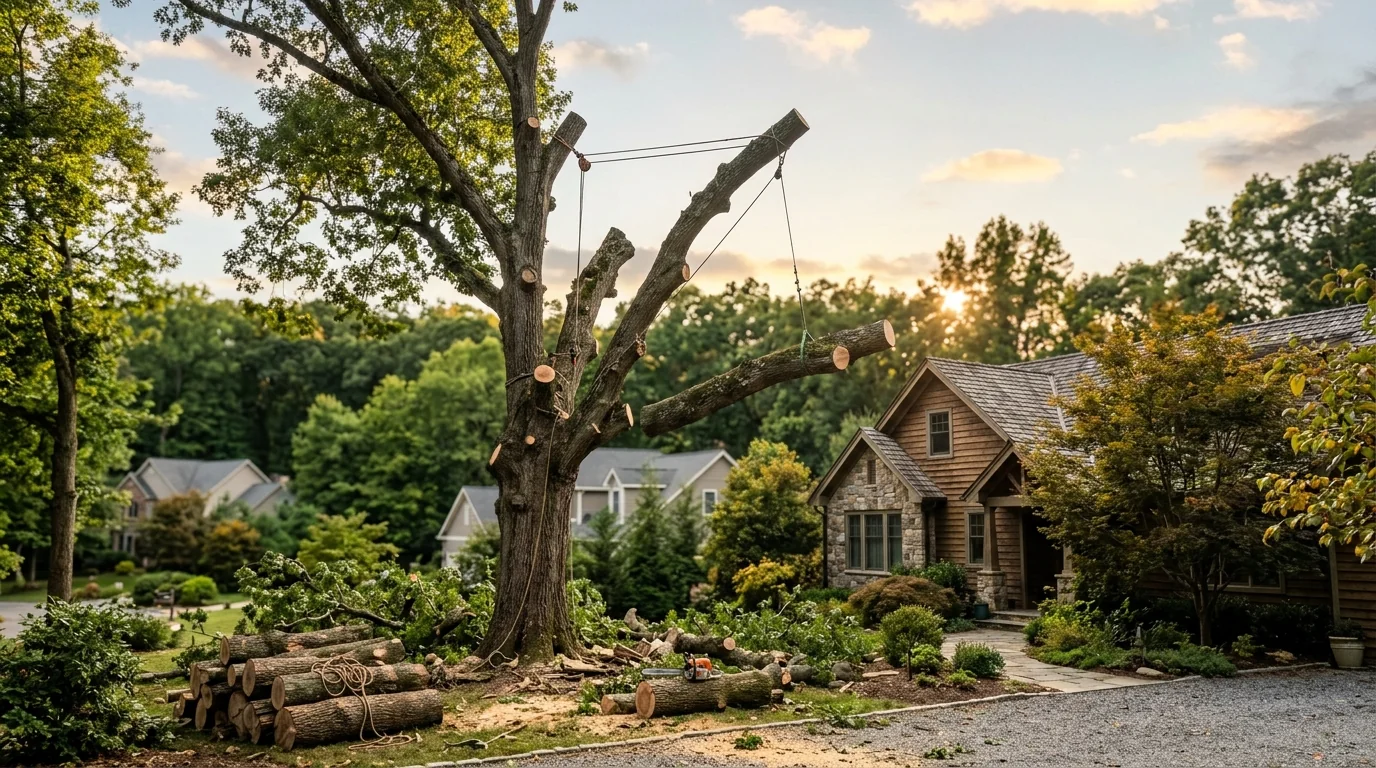
Wildwood’s residential stock reflects a mix of older rural cabins, mid-century homes, and newer retreat-style construction built for people wanting proximity to the Smokies without being inside a resort town. Many older structures were built before modern setback requirements that account for mature tree height. That means trees planted decades ago near foundations, driveways, or outbuildings have since grown into positions where a single failure causes significant property damage. Equipment access compounds the problem. Narrow mountain roads and steep driveways often prevent full-size cranes from reaching the work zone, which forces crews to use rigging and sectional felling techniques that require more time and specialized skill than a standard suburban removal.
Wildwood Neighborhoods and Tree Removal Patterns
The following areas reflect the range of residential conditions found across Wildwood and its immediate surroundings. Each carries its own combination of access constraints, housing age, and canopy density.
- Wildwood Core. The central community cluster, with a mix of older residential structures sitting close to mature oaks and tulip poplars. Limited road width makes equipment staging a recurring challenge.
- Foothills Estates. Newer subdivision-style construction on sloped lots carved out of existing forest. Trees on fill slopes can have compromised root systems from grading work done at construction.
- Ridgeline Road Corridor. Homes perched along exposed ridgelines face elevated wind load on trees during storm events. Trees here tend to be shorter but more heavily wind-formed.
- Smoky Mountain Foothills. Undeveloped forest transitions to residential use throughout this zone, meaning many properties have trees with no prior management history.
- Creek Hollow Area. Low-lying properties along creek drainages. Saturated soils after rainfall increase root instability. Storm debris from upstream lots is also a recurring issue.
- Old Wildwood Road Corridor. An older residential spine with large-canopy trees overhanging structures that predate modern setback planning. Dead or structurally compromised trees here often sit directly above rooflines.
- Westgate Woodlands. Mixed forest-edge lots with moderate slopes. Deer-browse pressure and fungal activity from sustained moisture affect tree health in this zone.
- Hillside Retreats. Vacation and semi-permanent residence mix on steep terrain. Absentee ownership means hazardous trees sometimes go unnoticed until a storm forces immediate action.
How to Find a Wildwood Tree Removal Contractor
Hiring a tree service in a rural mountain community is different from hiring one in a flat suburban market. The pool of contractors who regularly work steep terrain with proper equipment is smaller than it looks. These four criteria will help you sort the qualified from the underprepared.
Verify insurance before anything else. Any contractor working on your property should carry general liability insurance and workers’ compensation. Ask for certificates, not just verbal assurances. A crew member injured on your steep hillside lot without workers’ comp coverage can become your financial problem. The Tree Care Industry Association offers a clear breakdown of what credentials and coverage a reputable tree care company should carry.
Confirm ISA Certified Arborist credentials. The International Society of Arboriculture maintains a searchable database at ISA Trees Are Good where you can verify whether a contractor’s arborist credential is current. In Wildwood, you want someone who can assess whether a tree actually needs removal or whether pruning, cabling, or bracing could address the hazard at lower cost. Contractors with real arboricultural training are more likely to give you an honest answer about preservation options.
Ask about specific steep-terrain and limited-access experience. This is not a question to skip. A contractor who works primarily on flat suburban lots in Knoxville may not carry the rigging equipment or employ the felling techniques that a Wildwood hillside job demands. Ask them to describe how they would stage equipment on your driveway and what their plan is if a full-size chipper cannot reach the work zone. Vague answers are a signal.
Insist on a written, itemized estimate. Verbal quotes for complex removals invite post-job disputes. A written estimate should specify the trees or limbs being removed, whether stump grinding is included, who handles debris haul-off, and what happens if access requires additional equipment time. Compare the tree removal cost guide before you accept any quote, so you understand what the variables actually are.
What to Expect from a Wildwood Inspection
A thorough pre-removal inspection in Wildwood covers four areas. Each one matters for jobs on hilly, forested lots.
Exterior walk-around. The arborist circles the entire tree and surrounding area, checking for visible trunk defects, co-dominant stems, dead wood in the canopy, fungal growth at the base, and lean relative to the target zone. Steep slopes change the fall radius calculation significantly compared to flat terrain, so an experienced inspector will account for slope angle and soil saturation before recommending a felling direction or rigging approach.
Interior walk-through. If the tree is near a structure, the inspector should walk through the home or building to check for any signs of existing damage, root intrusion near the foundation, or soil movement that could indicate prior root failure. This step is often skipped by less thorough contractors and often catches issues that change the scope of the job.
Crawl-space or basement check. Wildwood homes on pier-and-beam or basement foundations often have accessible crawl spaces. The inspector should look for root intrusion, moisture patterns from tree canopy shading, and structural contact points if a previous limb or root failure has gone unaddressed. For questions specific to what a full inspection covers, professional tree care services include a summary of the assessment process.
Slope and drainage assessment. On sloped lots, the inspector should evaluate where water moves during heavy rain, since saturated soil at the base of a tree dramatically increases failure risk. Properties along creek drainages or at the base of ridgelines warrant particular attention. If there is any concern about a tree failing during the next storm before a scheduled removal, the contractor should be willing to discuss whether temporary cabling or priority scheduling is appropriate.
Repair Methods Used Most Often in Wildwood
Tree removal in Wildwood most often involves the following service types. Costs cited are sourced from Bob Vila.
- Standard tree removal. Sectional felling or rigging is used when cranes cannot access the lot. Bob Vila reports that most residential removals cost between $385 and $1,070, with complexity and tree size as the primary cost drivers. See full tree removal cost breakdowns for size-based ranges.
- Crane-assisted removal. Used when trees overhang structures and sectional felling would be too risky. Crane mobilization typically adds $500 or more to the base removal cost according to Bob Vila. Access on Wildwood roads can limit availability of larger crane equipment.
- Emergency storm removal. Post-storm hazard removals command premium pricing. Bob Vila notes that emergency service can add 25 to 50 percent above standard rates. For same-day service after a storm event, emergency tree removal in Knoxville describes the process and typical response expectations.
- Stump grinding. Most removals leave a stump that requires separate grinding. Bob Vila places stump grinding costs between $150 and $450 for most residential stumps. On rocky hillside soils, grinding can cost more if the blade encounters subsurface rock.
- Dead or hazard limb removal. When full removal is not necessary, selective limb work reduces risk without eliminating the tree. This is often the right call for healthy trees with one or two structurally compromised limbs. The International Society of Arboriculture recommends an arborist assessment to determine whether removal or preservation better serves the tree’s long-term health.
- Canopy thinning and storm-prep pruning. Reducing sail area in the canopy before storm season lowers wind-load stress on the root system. This is particularly relevant for exposed ridgeline properties in the Wildwood area.
For the complete cost picture and a side-by-side comparison of service types, visit the tree services hub or browse common tree problems in the region.
Wildwood Building Permits
Wildwood is an unincorporated community, which means it falls under Knox County jurisdiction rather than a municipal government with its own building department. Knox County’s building permit requirements for residential tree removal are limited. Private property owners removing trees from their own land generally do not need a county permit for the removal itself, though work affecting county road rights-of-way, drainage easements, or utility corridors requires prior coordination with the relevant authority.
If your property is near the Sevier County line, which runs close to Wildwood’s eastern edge, you should confirm jurisdiction before beginning work. Sevier County has its own building and codes office with potentially different rules for work near public roads or waterways. Contractors with regular experience in this area will know which county applies to your specific parcel.
Tennessee adopted the 2018 International Building Code with state amendments as its baseline for construction regulation. Tree removal itself is not directly regulated under the building code, but any structural repairs triggered by tree damage, such as roof, deck, or foundation work, will require permits through the appropriate county office. The state building code adoption information is maintained by the Tennessee Department of Commerce and Insurance. For any job that blurs the line between tree work and structural repair, confirming with Knox County Building and Codes before starting protects you from compliance issues after the fact.
Homeowners insurance may cover tree removal costs when a tree damages a covered structure. The Insurance Information Institute provides a plain-language explanation of when policies typically pay, which situations are excluded, and what documentation insurers require. Request an itemized written estimate from your contractor before you file any claim.
To get the process started with a free on-site inspection, use the free tree removal quote form and a contractor serving the Wildwood area will follow up directly.
Other Tennessee Communities We Serve
Wildwood sits near several other communities the team covers regularly across the Knoxville metro. If you know someone in a neighboring area who needs service, these pages cover the local specifics for each market.
- Tree removal in Seymour, TN covers another foothills community south of Knoxville with similar terrain and canopy conditions.
- Tree removal in Rockford, TN addresses a community along the Little River corridor where floodplain trees and access constraints shape removal work.
- Tree removal in Knoxville, TN covers the main metro market, including cost expectations, permitting, and contractor vetting specific to Knox County’s urban core.
Neighborhoods served
Wildwood neighborhoods
- Wildwood Core
- Foothills Estates
- Ridgeline Road Corridor
- Smoky Mountain Foothills
- Creek Hollow Area
- Old Wildwood Road Corridor
- Westgate Woodlands
- Hillside Retreats
Questions
Wildwood tree care FAQs
Why are tree hazards so common in Wildwood?
How much does tree removal cost in Wildwood?
Do I need a permit to remove a tree in Wildwood?
What should I look for in a Wildwood-area tree contractor?
Which neighborhoods in Wildwood have the most tree-removal activity?
Can I get a free inspection before committing to a removal?
Free estimate
Free Wildwood tree estimate
On-site assessment, written quote within 24 hours, no obligation.