Service area · Tennessee
Tree care in Powell
Powell is a census-designated place in Knox County, Tennessee, just north of Knoxville along the Emory Road corridor. The area sits within the Knoxville metro and shares its mix of suburban subdivisions and older residential lots with mature hardwood canopy. Storm season, tight lot lines, and a growing population of post-2000 homes all shape what tree removal looks like here.
Why Powell Tree Removal Is Different
Powell sits just north of Knoxville as a census-designated place in Knox County, positioned along the Emory Road corridor between Knoxville to the south, Clinton to the northwest, and Oak Ridge to the west. That geography matters for tree work. The area is part of the Ridge and Valley physiographic province that defines much of East Tennessee, meaning uneven terrain, clay-heavy soils that shift between wet and dry seasons, and a tree canopy that has been building for decades as the community grew from a rural rail stop into a suburban community of nearly 14,000 residents. Tree removal here is not the same job it is in a flat, newer subdivision on the opposite side of the metro.
The combination of maturing residential lots, a growing number of post-2000 homes packed into subdivisions with tight setbacks, and Knox County’s four-season storm exposure creates a steady demand for both hazard removal and routine canopy management. Understanding why that demand exists starts with the ground underfoot, the weather overhead, and the age of the homes in between.
Soil and Geology in Knox County
Knox County lies within the Valley and Ridge belt of the Appalachian system. The valley floors around Powell feature residual soils derived from limestone and shale, which produce clay-dominant profiles that expand when saturated and shrink during dry summers. That clay behavior affects trees directly. Shallow-rooted species respond to wet-dry cycles by heaving surface roots toward driveways and foundations, and waterlogged soils after heavy rain events compromise root anchorage, making large trees more likely to fail in wind events. The USDA Forest Service urban forestry program notes that soil compaction and poor drainage are among the leading contributors to urban tree decline, both of which are common in older Powell residential lots where construction activity has compressed soil profiles over the years.
Climate and Storm Exposure
Powell sits within the Knoxville metropolitan statistical area and shares the city’s climate patterns. East Tennessee experiences spring severe weather from March through May with the potential for tornadic activity and straight-line wind shear, active summer thunderstorm seasons through August, and periodic winter ice events that can load tree limbs beyond their structural capacity. The NOAA Storm Events Database documents repeated wind and ice events in Knox County going back decades. Ice storms are particularly damaging to Bradford pear, pine, and silver maple, all common ornamental choices in suburban Powell developments. A tree that survives an ice event structurally compromised may not show obvious exterior symptoms until the following growing season, which means inspections after winter weather are just as important as post-storm checks in spring.
Housing Era and Lot Character
Powell’s development history covers a wide range. The Powell Station area carries older residential stock from mid-twentieth century construction, with larger lots, mature hardwoods, and homes more likely to have crawl-space or pier-and-beam foundations. Subdivisions built along Emory Road and Copper Ridge during the post-2000 growth surge feature slab-on-grade construction with smaller setbacks and ornamental trees that are now reaching the size where they interact with rooflines, gutters, and utility easements. That generational mix means any given street in Powell might have a 1950s brick ranch next to a 2005 vinyl-sided colonial, each presenting different access challenges and different risk profiles for the trees overhead.
Powell Neighborhoods and Tree Removal Patterns
The following areas within Powell each carry distinct characteristics that affect how tree work gets planned and priced.
- Emory Road Corridor, The spine of Powell’s suburban growth. Properties here range from older single-family homes to new construction, with varying lot sizes and canopy maturity. Access is generally good but utility lines along Emory Road add complexity to any work near the right-of-way.
- Powell Station area, The original townsite. Homes here are among the oldest in Powell, with established oaks and maples that have had fifty or more years to develop deep canopy and substantial trunk diameter. Removal costs in this area trend higher due to tree size and proximity to structures.
- Copper Ridge, A post-2000 subdivision where ornamental pears and young maples planted at construction are now large enough to become hazards. Tight lot lines mean neighboring properties are often affected by any removal.
- Norwood subdivision area, Established single-family homes with medium-to-large lots. Mature pine stands are common here and present lightning strike and bark beetle risk that prompts removal calls after storms.
- Callahan Road corridor, A transitional zone between suburban and semi-rural character. Properties here often feature larger lots with pines and hardwoods that were not planted ornamentally but grew naturally, meaning they may not have been monitored for health or structure over time.
- Dutch Valley Road area, Older rural-residential lots with mixed hardwood canopy. Slope variation is more pronounced here, which affects equipment access and rigging requirements for large removals.
- Powell High School district, Denser suburban character with smaller lots and tighter canopy clearances. HOA covenants govern many streets in this area, adding an approval layer before removal can begin.
- Oak Ridge Highway corridor, The western edge of Powell’s footprint, running toward Oak Ridge. Commercial and residential uses mix here, and trees near commercial signage or driveways often require permitted removal with more documentation than a purely residential job.
- Lyle Road area, Quieter residential streets with a mix of housing eras. Some lots here back to wooded buffers, and homeowners frequently discover hazard trees along those rear boundaries that have gone unmanaged for years.
How to Find a Powell Tree Removal Contractor
Powell does not have a city-level contractor licensing program of its own. The absence of a city building department means there is no municipal license list to check, which places the screening burden entirely on the homeowner. Four criteria matter most.
Verify insurance before any other conversation. Any legitimate tree service working in Knox County should carry general liability insurance and workers compensation coverage. Ask for certificates naming you as the certificate holder, and call the insurer to confirm coverage is active. Tree work is categorized by OSHA as one of the most hazardous occupational categories. An uninsured crew working on your property creates direct liability exposure if a worker is injured.
Look for an ISA Certified Arborist on the crew. The International Society of Arboriculture maintains a public database where you can verify credentials by name or zip code. An arborist credential signals that at least one person on the job has passed a rigorous exam covering tree biology, pruning standards, and hazard assessment. That matters in Powell, where the mix of species and housing eras demands accurate diagnosis before a saw starts.
Ask for local-experience specifics, not just years in business. A contractor who has worked the Emory Road corridor understands Knox County clay soil behavior, the overhead utility layout along Powell’s main arterials, and the permit process at the county level. Ask directly whether they have pulled Knox County permits for tree work and whether they have worked on similar species and lot types in Powell specifically. Vague answers to specific questions are a flag.
Require a written scope before the crew mobilizes. A diagnostic-first contractor will walk the property, assess the tree, and produce a written scope of work that includes disposal method, cleanup expectations, and any stump grinding line items. According to the Tree Care Industry Association, reputable companies will also explain whether removal is truly necessary or whether pruning or cabling might preserve the tree. That recommendation signals the contractor is not just selling cuts.
Start by scheduling a free Powell tree inspection before committing to any work.
What to Expect from a Powell Tree Inspection
A proper inspection covers four distinct areas. Skipping any one of them leaves gaps that affect both pricing accuracy and safety planning.
Exterior walk-around. The arborist examines the full circumference of the trunk and exposed root flare at ground level. They look for decay indicators such as fungal conks, bark cracks, cavity openings, and deadwood accumulation in the crown. They also assess lean direction, proximity to structures, and whether utility lines cross the removal zone. In Powell, this step frequently reveals surface root issues where clay soil has driven roots toward pavement and foundations.
Interior walk-through. For trees near structures, the inspector checks the interior of the home for signs of root or branch intrusion, including cracks in ceiling drywall, staining near roofline penetrations, and gutter damage from overhanging limbs. These interior signals often correlate with exterior hazards that are not visible from the yard.
Crown and upper canopy assessment. Binoculars or a drone pass gives the arborist a view of the upper crown that is not visible from ground level. Dead branch stubs, bark inclusions at major scaffold unions, and broken tops that never shed cleanly after a prior storm all register here. In Powell’s spring storm season, upper-crown damage is a common finding that homeowners miss until a wind event accelerates the failure.
Slope and drainage assessment. Powell’s terrain includes elevation changes and drainage channels that affect both tree health and equipment staging. The inspector should note whether the removal area involves any slope that requires specialized rigging, and whether the root zone is in a drainage path that has been repeatedly saturated. Waterlogged root zones weaken anchorage over multiple seasons, a pattern documented in urban tree research from the USDA Forest Service.
For a full picture of what hazard signs look like at each stage, the Powell tree problems resource covers common species and failure patterns in the Knoxville metro.
Repair and Removal Methods Used Most Often on Powell Properties
Powell’s mix of housing eras and lot sizes means the full menu of tree service methods sees regular use here. The following are ordered by frequency in this market.
-
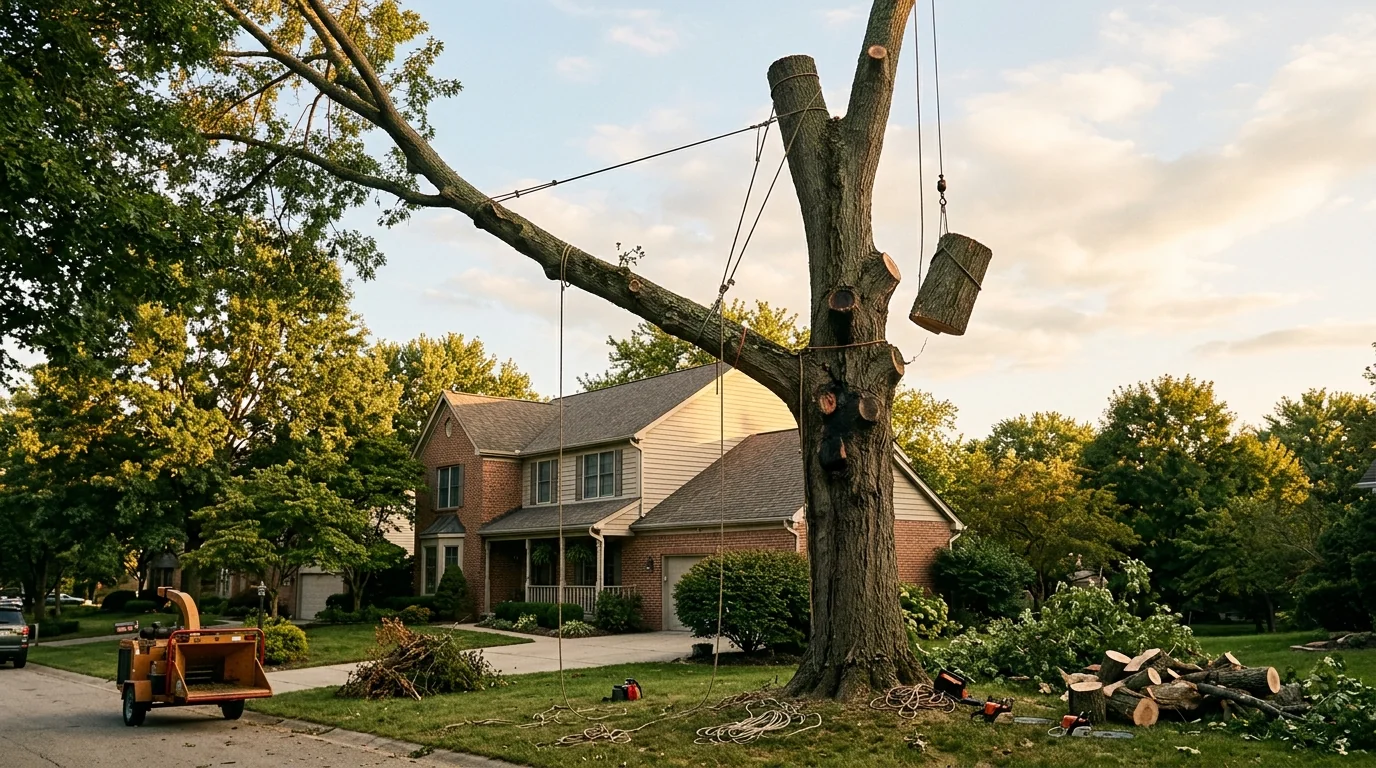
Full tree removal with ground crew. The standard approach for most residential removals in Powell. Crews section the tree from the top down using climbing and rigging equipment, then process limbs and trunk sections on the ground. According to Bob Vila, full removal of a medium tree runs roughly $385 to $1,070 nationally, with larger specimens exceeding that range significantly. See the full tree removal cost guide for a breakdown by size and condition. This method appears on most Powell jobs where the tree is accessible from the property.
-
Emergency storm removal. Spring and summer storm seasons in Knox County drive a consistent volume of same-day and next-day emergency calls throughout Powell. Bob Vila notes that emergency premiums can push costs to $2,500 or more depending on hazard complexity. The emergency tree removal service page covers response procedures and documentation support for insurance claims.
-
Stump grinding. Nearly all full removals in Powell include stump grinding as a line item, particularly in subdivisions where surface stumps affect mowing, curb appeal, and HOA compliance. Bob Vila puts average stump grinding costs in the $150 to $450 range depending on diameter. See stump grinding cost details for specifics.
-
Crane-assisted removal. Larger oaks and pines in the Powell Station area and along Dutch Valley Road occasionally require crane support when the tree is too large or too close to a structure for conventional sectional removal. Bob Vila lists crane-assisted removal as a cost multiplier that can exceed $5,000 for complex jobs. The crane tree removal service page explains when crane work is warranted versus when it adds unnecessary cost.
-
Crown reduction and pruning. When a tree is structurally sound but has limbs that overhang rooflines or driveways, a reduction cut under ANSI A300 standards can resolve the hazard without full removal. The ISA homeowner education resource explains how to evaluate whether pruning is a viable alternative to removal. See the tree trimming and pruning service page for local pricing context.
Powell Building Permits for Tree Removal
Powell is an unincorporated census-designated place. It has no independent municipal government, no city hall, and no city building department. All permitting authority over property in Powell falls to Knox County government.
Knox County administers development activity through Knox County Codes Enforcement, which handles building permits, zoning questions, and land disturbance permits. Homeowners planning to remove trees in the public right-of-way, on utility easements, or as part of a larger land disturbance project should contact Knox County Codes before beginning work. Private lot tree removal in a purely residential context may not require a permit in all cases, but the rules are specific to context and can change. Confirming requirements with the county directly is the only reliable approach.
Tennessee state law governs contractor licensing at the state level. Tree service companies performing work above certain dollar thresholds are required to hold a Tennessee contractor license issued by the Tennessee Department of Commerce and Insurance. Homeowners can verify contractor license status through the state’s online lookup tool. That verification step, combined with insurance certificate confirmation, covers the two primary contractor-qualification checks that Knox County does not perform on a homeowner’s behalf.
HOA covenants add another layer in many Powell subdivisions. Copper Ridge, the Powell High School district streets, and newer Emory Road subdivisions are among the areas where homeowners should review their HOA documents before scheduling removal of any tree visible from the street or common area.
Other Knox County and Knoxville Metro Areas Served
Powell is one of several Knox County communities where this network operates. If you need service in a neighboring area, the following pages cover markets close to Powell.
- Knoxville tree removal services covers the core city and the full range of Knox County urban canopy work, including downtown and Sequoyah Hills.
- Halls tree removal services serves the Halls Crossroads community just northwest of Powell along the Maynardville Pike corridor, where similar clay soil and mature hardwood conditions apply.
- Karns tree removal services covers the Karns area to the west, another unincorporated Knox County community with a comparable mix of established subdivisions and rural-residential lots.
Neighborhoods served
Powell neighborhoods
- Emory Road Corridor
- Powell Station area
- Copper Ridge
- Norwood subdivision area
- Callahan Road corridor
- Dutch Valley Road area
- Powell High School district
- Oak Ridge Highway corridor
- Lyle Road area
Questions
Powell tree care FAQs
Why are hazard trees so common in Powell neighborhoods?
How much does tree removal typically cost in Powell?
Does Powell require a permit before removing a tree on private property?
How do I check whether a Powell tree contractor is legitimate?
Which Powell neighborhoods have the oldest tree canopy?
Are free tree inspections available for Powell homeowners?
Free estimate
Free Powell tree estimate
On-site assessment, written quote within 24 hours, no obligation.