Service area · Tennessee
Tree care in Halls
Halls is a community in the northern Knox County area of Tennessee, where mature hardwood canopies and periodic severe weather create steady demand for tree removal. Homeowners here deal with storm-split oaks, aging pines, and trees too close to rooflines. A qualified arborist familiar with this part of the county can assess whether removal or preservation is the right call.
Why Halls Tree Removal Is Different
Halls occupies a stretch of northern Knox County where the terrain shifts from rolling ridge-and-valley geography into broader bottomland flats along the watershed. That transition shapes almost every tree removal job in the area. Trees on sloped ground develop tension wood and subtle lean over time. Trees in the flatter bottomland sections grow fast in moist soil but develop shallower root systems that give way quickly during wind events. Neither scenario is simple, and both require a contractor who has worked this specific part of the county.
The Halls area also sits squarely in the path of storm systems that track northeast through the Tennessee Valley each spring and summer. The NOAA Storm Events Database documents recurring severe weather across Knox and surrounding counties, including straight-line wind events and tornado touchdowns that routinely split mature hardwoods and drop limbs onto rooflines. That storm exposure is the single biggest driver of emergency tree removal calls in this community.
Soil and Geology in Halls
Knox County’s northern tier sits at the edge of the Valley and Ridge physiographic province, where soils tend to run clay-heavy and moderately deep. Clay soils hold moisture well after rain events, which can destabilize root systems and increase the risk of a tree toppling when the ground is saturated. During dry stretches, clay shrinks and cracks, stressing root zones further. Trees planted too close to structures on this soil type are a persistent source of removal calls, because roots follow the moisture gradient toward foundations and utility lines.
Climate and Storm Exposure
The broader Knoxville metro, including the Halls corridor, experiences a humid subtropical climate with warm, wet summers and mild but variable winters. Spring severe weather season from March through May is the highest-risk period for tree damage, with thunderstorm cells capable of producing damaging wind gusts. Summer storms from June through August add additional hazard. Winter ice storms occur less frequently but can be catastrophic for large-canopy trees, loading branches beyond their structural capacity and causing failures that would not happen under wind alone. Homeowners who have lived through a single ice event understand why pre-emptive removal of compromised trees matters.
Housing Era and Tree Proximity
Halls developed in waves. Earlier residential streets along corridors like Maynardville Pike and Emory Road have homes from the mid-twentieth century, often with mature oak, maple, and pine plantings that are now 50 to 70 years old. Those trees are entering the phase where structural assessment becomes critical. Newer subdivisions built from the 1990s onward planted smaller ornamental trees closer to structures to satisfy landscaping requirements, and many of those trees have since outgrown their original placement. Both eras generate removal demand, but for different reasons. Understanding common tree problems by housing era helps homeowners know what to watch for before a storm makes the decision for them.
Halls Neighborhoods and Patterns
Tree removal demand and access conditions vary across the Halls community. Here is a quick picture of each area:
- Halls Crossroads. The commercial and residential hub of the community. Lots tend to be smaller with trees planted close to driveways and structures, making crane-free removals more common but access tighter.
- Gibbs community. Older residential pockets with large-canopy oaks and pines on properties that have changed hands without routine arborist visits. Storm damage calls run high here after severe weather.
- Copper Ridge area. Newer subdivision development with younger trees, but Bradford pear and pine plantings from the 1990s are now reaching the size where structural weakness becomes a removal trigger.
- Maynardville Pike corridor. A mixed commercial-residential strip where trees near the right-of-way require coordination with county codes before removal begins.
- Norris Freeway corridor. Properties along this route often have slope-side trees with lean issues. Root destabilization on clay soils is a recurring pattern.
- Carter Mill Road area. Larger rural lots with mature hardwood stands. Access for large equipment is generally better here, but the scale of trees means removal cost is correspondingly higher.
- Emory Road corridor. Established residential with mature canopy. Many homes here have trees that predate the structure, requiring careful rigging to protect rooflines during removal.
- Ball Camp Pike area. Transition zone between older rural lots and newer suburban development. Mixed lot types and mixed tree ages mean every property needs individual assessment.
How to Find a Halls Tree Removal Contractor
Finding a qualified contractor in Halls takes more than a quick online search. The following four criteria will help you separate experienced crews from those who work this area only when they happen to have a gap in their schedule.
Verified credentials and liability coverage. Any contractor removing trees near a structure should carry general liability insurance and workers’ compensation. Ask for certificates before signing anything. The Tree Care Industry Association explains what accreditation means and why it matters when a tree falls on a fence or vehicle during the job.
ISA Certified Arborist on the crew. The International Society of Arboriculture maintains a credential that requires ongoing education and examination. An ISA Certified Arborist can distinguish a tree that needs to come down from one that can be saved with pruning or cabling. Roughly 64 percent of homeowners want to preserve a tree if possible, and a credentialed arborist gives you an honest answer rather than defaulting to removal.
Demonstrated local experience in northern Knox County. Ask a contractor to describe specific conditions they have encountered on Halls properties. A contractor who mentions the clay soils along the ridge lines, access challenges on narrow rural lots, or familiarity with the Emory Road corridor has actually worked here. Vague answers about “the Knoxville area” are a signal to probe further.
A diagnostic-first approach. Contractors who recommend removal before they walk the property are skipping the step that protects you. A proper site visit covers root zone assessment, canopy structure, proximity to structures, and a lean or tilt measurement. That assessment should happen before any price is discussed. You can request a free tree removal inspection to start the process with a site visit rather than a phone quote.
What to Expect from a Halls Inspection
A thorough inspection covers four areas and should take at least 20 to 30 minutes on site.
Exterior walk-around. The arborist will examine the trunk base for bark inclusion, visible rot, fungal growth, and soil heaving that indicates root movement. Lean angle and direction relative to nearby structures are measured. Trees within striking distance of a roofline or vehicle get closer scrutiny.
Canopy and branch structure assessment. Dead wood, crossing branches, co-dominant stems, and storm-damaged limbs are identified. This assessment determines whether removal is necessary or whether targeted pruning could reduce hazard and extend the tree’s life. The ISA homeowner education resource outlines what a qualified arborist should evaluate during this review.
Root zone and soil evaluation. On clay-heavy soils common in northern Knox County, the arborist looks for evidence of root girdling, compaction, and surface root disruption near pavement or foundations. Saturated soil conditions after heavy rain can temporarily increase lean in trees that appear stable during dry periods.
Slope and drainage assessment. Properties along the Norris Freeway corridor and Carter Mill Road area often have slope-related drainage patterns that affect root stability. The arborist notes drainage direction and whether standing water after rain events is reaching the root zone.
Repair Methods Used Most Often in Halls
Removal is not always the first or only option. The methods below are listed in order of how frequently they apply to Halls properties, based on the housing stock and tree canopy age in northern Knox County.
- Standard tree removal. The most common outcome for dead, structurally compromised, or dangerously positioned trees. Cost ranges from $385 to $1,070 for most residential trees, per Bob Vila. Review tree removal services and methods for a full breakdown of the process.
- Emergency storm removal. After severe weather events, partially downed or split trees require priority response. Emergency removals carry a cost premium above standard pricing, as documented by Bob Vila. The tree removal cost hub covers how emergency pricing is structured.
- Stump grinding. Most removals leave a stump that is a tripping hazard and a source of root regrowth. Stump grinding is quoted as a separate line item in most bids. See stump grinding cost details for current pricing ranges.
- Canopy pruning and deadwood removal. For trees that are structurally sound but carrying dead limbs or crossing branches, a pruning program can eliminate hazard without full removal. This approach aligns with ANSI A300 standards for pruning practice.
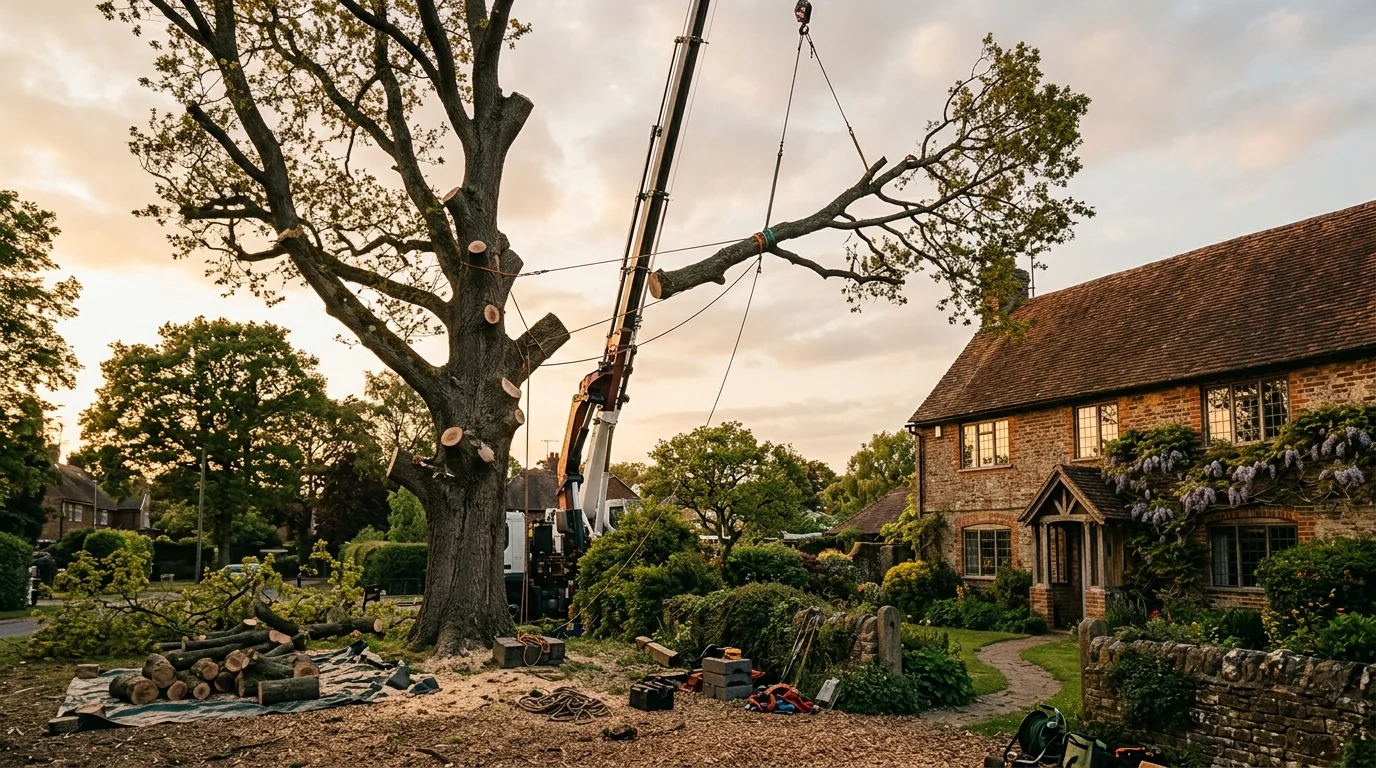
- Crane-assisted removal. Trees over structures, near power lines, or on steep slopes where rigging alone is not safe require crane support. Crane-assisted removal runs higher than standard removal and is detailed on the crane tree removal cost page.
- Cabling and bracing. Co-dominant stems on mature oaks and maples can sometimes be stabilized with steel cable systems rather than removed. This is a preservation option worth discussing with an ISA Certified Arborist before choosing removal.
Halls Building Permits
Halls is an unincorporated community within Knox County, which means building and tree removal oversight falls under Knox County rather than a municipal code department. Knox County does not currently require a permit for removing trees on private residential property in most circumstances. However, there are important exceptions that affect Halls homeowners.
Work within a public right-of-way, including trees adjacent to Maynardville Pike, the Norris Freeway, or Emory Road, falls under county road department and potentially Tennessee Department of Transportation jurisdiction. Removing or trimming trees in those zones without coordination can result in stop-work orders and liability for damage to utility infrastructure.
Homeowners in newer Halls subdivisions should also check HOA covenants before scheduling removal. Many developments built from the 1990s onward include tree canopy provisions in their declaration documents. An HOA board review is required before removing trees visible from common areas or the street. Your contractor should be aware of this step and able to help you document the removal rationale for HOA submission.
Other Tennessee Cities Served
This network covers the broader Knoxville metro and surrounding communities. If you are researching service options for a neighboring area, the pages below cover local conditions and pricing for those markets.
- Tree removal services in Knoxville covers the core metro market with detail on urban canopy regulations and contractor selection in the city proper.
- Powell tree removal services addresses conditions in the Powell community just south of Halls, where similar northern Knox County soil and storm patterns apply.
- Karns tree removal services covers the Karns area to the west, where older residential canopy and clay soils create comparable removal challenges.
Neighborhoods served
Halls neighborhoods
- Halls Crossroads
- Gibbs community
- Copper Ridge area
- Maynardville Pike corridor
- Norris Freeway corridor
- Carter Mill Road area
- Emory Road corridor
- Ball Camp Pike area
Questions
Halls tree care FAQs
Why are tree problems so common in Halls?
How much does tree removal cost in Halls?
Do I need a permit to remove a tree in Halls?
How do I check if a Halls tree contractor has real local experience?
Which neighborhoods in Halls have the oldest trees?
Are free inspections available for Halls homeowners?
Free estimate
Free Halls tree estimate
On-site assessment, written quote within 24 hours, no obligation.