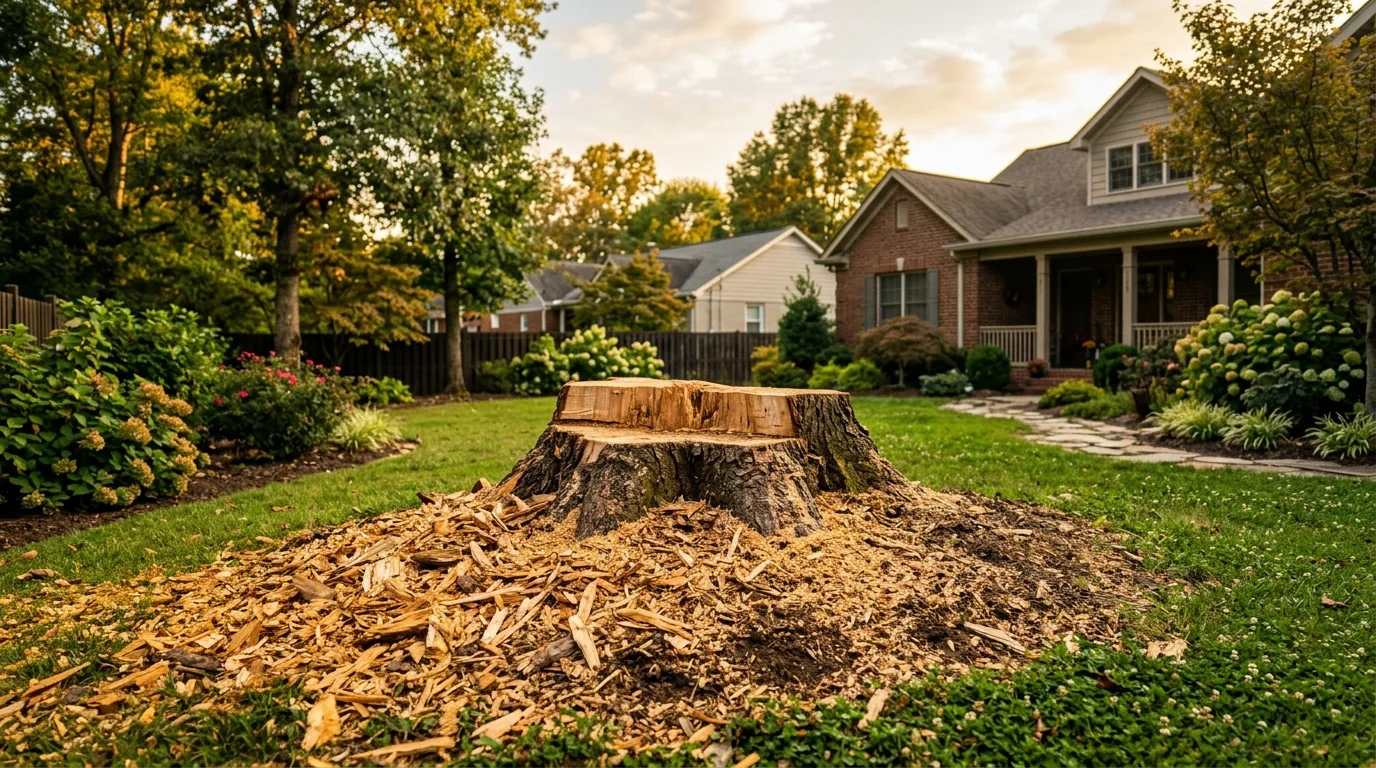
What is stump removal and when is it the right choice?
Stump removal in Knoxville means physically extracting the entire stump and root ball from the ground, not just cutting the wood below grade. Where stump grinding in Knoxville reduces a stump to chips a few inches underground, full removal takes everything out: the crown of the stump, the tap root, and as much of the lateral root mass as the site permits. The result is an open hole that is backfilled, graded, and ready for whatever comes next, whether that is new planting, a poured patio, or a fence line.
How stump removal works mechanically
A crew loosens the soil around the stump using a mini-excavator, hand tools, or a hydraulic stump puller, exposing the root flare and the major lateral roots. Those roots are cut with a reciprocating saw, chainsaw bar, or root saw, working outward until the ball can be lifted free. On Knox County’s sticky residual clay soils (derived from weathered limestone and shale, per the USDA Web Soil Survey), this excavation often requires more effort than in sandier soils because the clay compacts tightly around root fibers. Once the ball is loose, a winch, the excavator bucket, or a dedicated stump puller draws it out. The extracted material is hauled off-site, the cavity is backfilled with native soil or a compatible fill, and the surface is rough-graded.
The conditions stump removal is designed for
Full extraction is the right call in three situations. First, when roots are actively damaging a structure: surface roots that have lifted a driveway, sidewalk, or are pressing toward a foundation need to come out, not just be ground away. Second, when the site will be replanted in the same spot within a season or two. Ground stumps leave a pocket of wood chips that binds nitrogen as they decompose, making that soil inhospitable to new plantings for one to three years. Third, when a construction project requires a certified clear site. Contractors pouring footings, laying drainage pipe, or building an addition need documentation that organic material has been extracted, not left to rot underground.
When an alternative is the better choice
If budget is tight and the stump is in a lawn area with no structural conflict, stump grinding is faster, cheaper, and causes far less surface disruption. Grinding is also the preferred method when the stump is near a building and a full excavation would require digging closer to the foundation than is safe. The comparison table in the frontmatter covers the specifics side by side; the prose comparison below adds the nuance.
Installation process
1. Site assessment and utility marking (day before or morning of job)
Before any equipment enters the yard, the crew walks the site to measure stump diameter, probe for nearby utility lines, and assess root spread. Tennessee One Call (811) must be notified at least three business days before excavation of any kind. Knox County’s karst limestone geology adds a layer of caution: subsurface voids have been documented throughout the county, and an experienced crew will probe the area before committing equipment to the excavation zone.
2. Equipment setup (30-60 minutes)
For most residential stumps, the primary equipment is a compact track loader or mini-excavator, a root saw, and a winch or hydraulic puller. The crew lays ground protection boards on turf if access to the stump requires crossing a lawn, minimizing ruts on Knoxville’s clay-heavy soils.
3. Soil removal and root exposure (1-3 hours)
The operator excavates a ring around the stump to expose the root flare and the first major lateral roots. On large oaks, mature maples, or black walnuts (a species of particular concern in Knoxville given the Thousand Cankers Disease outbreak that originated in Knox County in 2010), the lateral root spread can extend well beyond the visible crown of the stump.
4. Root cutting (30-90 minutes)
Individual roots are severed at a practical distance from the stump. The crew works from the outside in, cutting the largest anchoring roots last. This is the most labor-intensive step, particularly on old-growth hardwoods.
With the roots cut, the excavator bucket or hydraulic puller lifts the ball free. Larger stumps may require a winch anchored to a truck or a dedicated tree puller. The extracted root ball and attached soil are loaded for haul-off.
6. Backfill and grading (30-60 minutes)
The cavity is filled with native soil or an approved fill mix, then rough-graded to match the surrounding grade. Knoxville homeowners should expect the fill to settle two to four inches over the following four to eight weeks, requiring a follow-up top-dress before seeding or sodding.
Typical total time: Two to eight hours for a standard residential stump. Large stumps (30 inches in diameter or more), stumps with restricted equipment access, or stumps on tight-clearance lots in neighborhoods like Sequoyah Hills or Norwood can run a full day.
Stump removal vs stump grinding
The two methods solve different problems, and choosing the wrong one wastes money.
Grinding is faster and less disruptive. A rotary drum reduces the stump to chips six to twelve inches below grade in a fraction of the time full extraction takes, and it leaves the turf around the stump largely intact. The chips decompose over several years, and lateral roots break down on their own timeline. For a stump that is simply in the way of a mower, grinding is the efficient answer.
Full removal is the correct choice when the roots are the problem, not just the above-grade stump. If an ash tree (likely dead or dying from Emerald Ash Borer, now confirmed in Knox County) has surface roots lifting your driveway apron, grinding the stump does nothing to relieve the upward pressure of those roots. Extraction takes them out. Similarly, if you are planning a vegetable garden, a new ornamental bed, or a lawn renovation in the same footprint within the next two years, grinding leaves a nitrogen-starved chip pocket that will disappoint whatever you plant there.
The cost gap is real but not always decisive. Per Bob Vila’s tree removal cost guide, stump grinding typically runs less per stump than full extraction, and the job takes less time. But if extraction prevents a second visit to deal with root damage to a structure two years from now, the upfront premium often pays for itself.
One edge case where grinding wins even on a construction site: when the stump is close enough to an existing foundation that excavating the root ball would require digging against the footing. In that situation, a grinding contractor can work at grade without destabilizing the surrounding soil, and the construction crew can address the remaining root decay in their normal site prep.
For a direct cost comparison and scheduling help, request a stump removal quote for your Knoxville property and a local crew can assess which method fits your site.
Stump removal cost in Knoxville, TN
According to Bob Vila’s cost guide, full stump removal typically runs between $150 and $500 per stump for residential projects, with large stumps or difficult sites pushing costs higher. This Old House’s 2026 pricing guide corroborates the general range and notes that stump diameter is the primary cost driver.
For Knoxville specifically, several local variables move the number:
Stump diameter. Pricing is almost always quoted per inch of diameter. A 12-inch stump costs substantially less than a 36-inch oak. Get the diameter measured at ground level before accepting any quote.
Root spread and depth. Knox County clay soils grip roots tightly, and some species, particularly oaks and black walnuts, spread lateral roots far beyond the stump. A root system that extends under a sidewalk or fence line adds labor time and therefore cost.
Equipment access. Properties in older Knoxville neighborhoods like Fourth and Gill, Holston Hills, or the hillside lots of West Hills often have limited gate widths or steep grades. When a full-size mini-excavator cannot reach the stump, crews use hand tools or smaller equipment, which increases labor hours.
Number of stumps. Most contractors discount multi-stump jobs. If a storm event, like the saturation-driven tree failures that followed Hurricane Helene’s remnants through Knox County in September 2024, left you with three or four stumps to clear, negotiate a per-job rate rather than a per-stump rate.
For the current Knoxville cost breakdown by size and site type, see the stump removal cost guide for Knoxville.
Warranty and transferability
Full stump removal is a one-time mechanical service, so the warranty structure differs from a multi-year treatment program. What a reputable Knoxville contractor should put in writing is straightforward: the stump and primary root ball are gone, the site is backfilled and graded, and if any portion of the extracted material is found to have been left in place (visible regrowth from an overlooked root mass, for example), they will return to finish at no charge.
Ask specifically for:
A written scope statement. Confirm that the contract specifies complete root ball extraction, not just above-grade removal. Some contractors quote “stump removal” and mean grinding. The distinction matters.
A backfill specification. The contract should state what fill material is used and to what compaction standard, particularly if you are preparing the site for construction. Knoxville’s clay soils require proper compaction to prevent differential settling.
Haul-off confirmation. Verify that the extracted material, including the root ball and excavated soil, is removed from your property as part of the quoted price. Some quotes include haul-off only of the wood; excess soil may be a separate line item.
The Tree Care Industry Association recommends verifying that any tree care contractor you hire carries general liability insurance and workers’ compensation before work begins. Ask for certificates, not just verbal confirmation.
Permits and engineering in Knoxville
Stump removal itself does not require a standalone permit under most circumstances, but the tree removal that precedes it often does. In the City of Knoxville, Development Services (865-215-2255) handles permits for regulated tree removal. Knox County codes and the Municipal Planning Commission govern unincorporated areas of the county. The relevant threshold varies by ordinance and is periodically updated, so confirm current requirements with the permit office directly before scheduling work.
If the stump is within the public right-of-way, a street tree permit is required regardless of who owns the stump or who caused the tree to be removed. Work within Knoxville Utilities Board easements may also require prior approval.
For properties in HOA-governed communities, which cover roughly 45 percent of suburban Knoxville homes, written HOA approval is typically required before any visible tree work begins. Stump removal that leaves an obvious hole in a front yard will almost certainly require prior notice even if the HOA does not explicitly enumerate it.
Engineering consultation is rarely required for a straightforward residential stump removal. The exception is when the stump is within ten feet of a structure’s foundation or within a documented karst feature area. Knox County’s subsurface limestone geology includes solution cavities and documented sinkhole zones; if the excavation is near a potential void, a geotechnical assessment before digging protects both the homeowner and the contractor.
To connect with a crew familiar with Knox County’s permit requirements and soil conditions, schedule a stump removal assessment for your Knoxville property and get a written quote before committing to any scope.