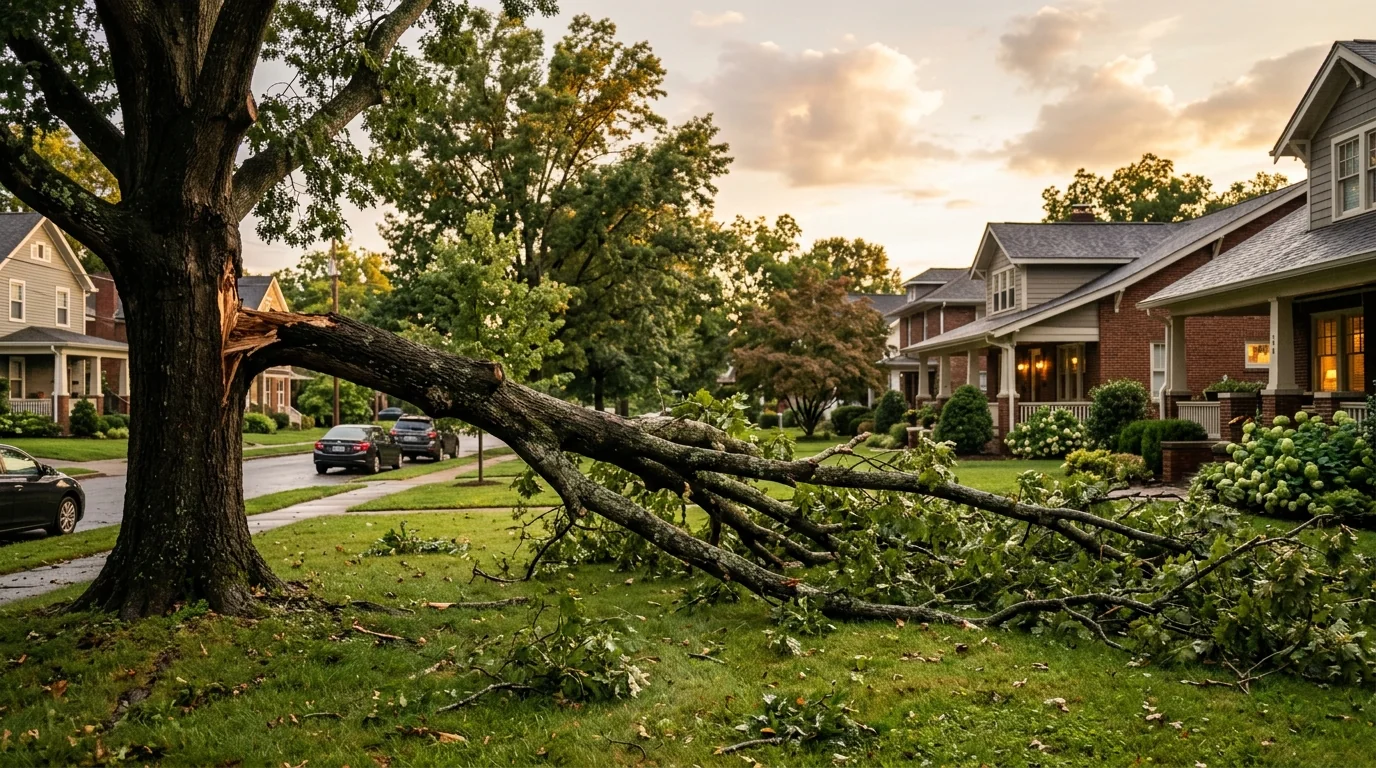
What is storm response and when is it the right choice?
Storm damage cleanup is the emergency branch of tree service: it covers everything a crew does in the hours and days after a wind event, ice storm, or flood has split, toppled, or destabilized trees on your property. In Knoxville, the trigger is almost always one of three events, a spring thunderstorm, a summer microburst, or a winter ice event. The September 2024 remnants of Hurricane Helene brought all three stresses at once, producing saturation-driven root failures across Knox County that required emergency removals on a scale the area rarely sees.
The distinction between storm response and a standard tree removal is not just speed. It is the hazard category. A tree that is actively resting on a roof, has snapped onto a power line, or is leaning at a new angle over a driveway after root heave is a life-safety problem before it is a landscaping problem. That changes the crew composition, the equipment on the truck, the pricing structure, and whether your homeowner’s insurance policy is involved.
If none of those conditions apply, and the tree is simply dead, declining, or inconveniently placed, a planned Knoxville tree removal is the appropriate service and will cost meaningfully less.
How storm response works mechanically
Emergency crews work in a specific sequence. They assess tension and compression forces in the damaged wood before any cut is made, because a storm-split tree stores energy that can cause logs to kick or pinch a chainsaw violently. Rigging ropes and mechanical advantage systems control where each section lands. On over-structure jobs, a crane lifts sections clear of the roof rather than dropping them. This precision work is why a storm removal on a 40-foot oak resting on a garage costs substantially more than removing that same oak on a calm Tuesday with clear ground access.
The conditions storm response is designed for
Storm response is the right call when:
- A tree or major limb is in contact with the house, power lines, a fence, or a neighboring structure.
- A tree has uprooted and is resting at an angle, with root ball still partly in the ground and root plate heaved.
- Multiple trees came down in a single event and the debris is blocking a driveway or creating a cascade hazard.
- Ice loading has split a hardwood and the hanging section is suspended above a high-traffic area.
Knox County’s moderate-to-high ice storm risk makes the third and fourth scenarios common. The February 2021 freezing-rain event caused widespread limb breakage in Knox County hardwoods and white pines, producing exactly the kind of suspended-limb hazard that requires trained crews rather than a homeowner with a pole saw.
When a planned removal is the better choice
If a tree survived the storm but you now want it gone because you are worried about the next event, a scheduled removal is appropriate. The same applies if a tree is declining from Emerald Ash Borer or Hemlock Woolly Adelgid pressure and has not yet failed. Planned removals allow crews to work at standard rates, schedule equipment in advance, and often perform stump grinding in the same visit. See tree problems caused by pest and disease pressure in Knoxville for guidance on when a declining tree becomes an imminent hazard.
Installation process: how storm cleanup unfolds
Emergency tree work follows a structured sequence regardless of how chaotic the scene looks on arrival.
Step 1: Hazard triage (15 to 30 minutes)
The crew lead walks the site before any equipment is unloaded. They identify power-line contact, check for gas-line proximity, assess lean direction, and look for secondary hazards like widow-makers (hanging broken limbs) in adjacent crowns. This assessment determines crew size, rigging plan, and whether a crane is needed. If a power line is involved, the crew contacts Knoxville Utilities Board (KUB) before any cutting begins.
Step 2: Utility coordination (variable)
KUB and Tennessee Valley Authority (TVA) operate the distribution network in Knox County. When a tree is on primary lines, the utility must de-energize the line before the crew works in the zone. This can add two to eight hours to the response. Crews typically begin cleanup on non-utility portions of the job while waiting.
Step 3: Stabilization and rigging setup (30 to 90 minutes)
If a tree is partially supported by a structure, the crew installs rigging to transfer load before cutting. This prevents the structure from taking a sudden impact when the wood is freed. On jobs requiring a crane, the operator positions the boom and attaches a bull rope to the first lift section. Neighbors may need to be notified if the crane swing crosses a property line.
Step 4: Sectional removal (1 to 6 hours depending on tree size and complexity)
The crew works top-down in manageable sections. Each section is rigged, cut, and lowered or set-down before the next cut begins. Larger sections are fed through a chipper on the street or loaded into a truck for haul-off. Disruption is significant: expect a crew of three to five workers, a chipper truck, and possibly a crane on your street or driveway for most of the workday.
Step 5: Site documentation (30 minutes)
Before debris is removed, the crew photographs each tree from multiple angles with timestamps. This documentation becomes part of the insurance package. A written scope of work is generated listing each tree, each service performed, and equipment deployed.
Step 6: Debris haul-off and site cleanup (1 to 3 hours)
Brush, wood rounds, and chips are cleared. Most homeowners expect haul-off to be included in the base price. Confirm this before signing an estimate, because some emergency contractors charge haul-off separately, which is a common complaint pattern in storm-damage situations.
Storm response vs. routine tree removal
The practical difference comes down to four factors: urgency, equipment, insurance, and pricing.
A routine removal is a planned event. The homeowner schedules it, the crew arrives with a ground team and a chipper, and the job follows a predictable path. There is no premium for speed, no adjuster waiting on documentation, and typically no crane unless the tree’s position genuinely requires one. Reviewing what a standard Knoxville removal involves helps clarify when that path is appropriate.
Storm response adds all the variables that routine work deliberately avoids. The crew does not know the full scope until they arrive. Equipment decisions are made on-site. The tree may be bearing weight on a structure, which means every cut carries structural consequences. Insurance coordination adds a documentation layer that the crew must execute correctly or the homeowner risks a denied claim.
When to pick storm response over waiting: any time a tree or limb is actively in contact with a structure, utility, or occupied space, or when an uprooted root plate has destabilized the tree’s position entirely. Waiting for normal business hours or a lower-cost crew to become available is not worth the risk.
When to pick a planned removal: when the tree survived the storm but is now on your removal list, when a pest-damaged ash or hemlock has not yet failed, or when a neighbor’s tree concerns you but poses no immediate hazard. In those cases, schedule the work through the normal process and avoid paying an emergency premium.
Storm damage cleanup costs in Knoxville, TN
Emergency tree removal in Knoxville carries a premium over standard rates. According to Bob Vila, standard full tree removal runs roughly $385 to $1,070 nationally, with hazard removals routinely reaching $2,500 to $5,000 or more. Emergency response typically adds 25 to 50 percent above standard rates. Crane-assisted work is billed as an additional line item, often $500 to $1,000 or more for a half-day of crane time.
This Old House corroborates similar ranges and notes that location, access difficulty, and species all affect final pricing. Knox County’s terrain, with many properties on sloped lots in areas like Sequoyah Hills, Bearden, and West Knoxville, can limit access and push costs toward the higher end of any range.
Local variables that move the Knoxville number:
- Tree size and species. A downed 80-foot white oak requires more time and equipment than a 30-foot Bradford pear.
- Proximity to the structure. A tree resting on a roof requires rigging that adds crew time and liability.
- Number of trees. Multi-tree events from a single storm may qualify for a per-job rate rather than a per-tree rate.
- Debris volume. Large canopy hardwoods produce multiple truckloads of brush and wood.
For a full breakdown of what drives the final number, see the storm response cost guide for Knoxville.
To get a same-day emergency quote, request emergency storm damage service now.
Warranty and transferability
Warranty expectations for storm response work differ from those on new construction or a structural install. The workmanship being guaranteed is the quality of the cuts, rigging, and cleanup, not a product with a long service life.
A reasonable minimum for Knoxville homeowners: a written one-year workmanship warranty covering any defect in the removal cuts (including stump height if specified) and cleanup quality. Some contractors extend this to two years.
Questions to ask before signing:
- Is the warranty written into the contract, or is it a verbal commitment?
- Does it cover the stump and root plate, or only the above-ground work?
- Is it transferable if you sell the home? This matters if your insurance claim is tied to the removal and the next owner needs documentation.
- What is the dispute resolution process if you disagree about what the warranty covers?
On jobs involving insurance, ask whether the contractor’s documentation warranty is separate from the workmanship warranty. If an adjuster disputes the scope months after the work is complete, having a contractor willing to provide a supplemental statement is valuable.
Permits and engineering in Knox County
Permit requirements for storm damage cleanup in Knoxville operate differently from routine removals. The City of Knoxville Development Services Department and Knox County both require permits for removal of trees above a threshold diameter in normal circumstances. However, documented storm emergencies often qualify for expedited review or after-the-fact permitting when a hazard requires immediate action.
Practically, this means a crew can begin emergency work, particularly when a tree is on a structure or blocking access, and submit the permit application within 24 to 48 hours. This is standard practice in the industry after major events, and local building departments typically accommodate it for genuine emergencies.
For work in the public right-of-way, including trees between the sidewalk and the street, Knox County or the City’s Urban Forestry division may need to be notified even if the tree is storm-damaged. KUB and TVA retain jurisdiction over any tree work within their utility easements regardless of storm circumstances.
If the tree removal involves any structural assessment of the home (such as confirming the house framing was not compromised by the impact), a licensed structural engineer’s report may be required before the insurance claim is settled. This is separate from the tree contractor’s scope and is typically arranged by the homeowner or their public adjuster.
The International Society of Arboriculture recommends that homeowners request credentials before any crew begins work. Verify that the lead arborist carries ISA certification and that the company carries current liability insurance and workers’ compensation coverage for Knox County operations. The Tree Care Industry Association maintains an accreditation directory that can help confirm a company’s standing before you authorize emergency work.
For homeowners across the Knoxville metro, including West Knoxville, Powell, Farragut, and Fountain City, local permit offices and utility contacts remain consistent across the county, but HOA approval may also be required before visible work begins on lots in governed communities. Confirm with your HOA before the crew starts if the damaged tree is in a front-yard or street-facing position.
Reach out through the Knoxville service area contact page to connect with crews familiar with local permit protocols and utility coordination in Knox County.