Service area · Tennessee
Tree care in John Sevier
John Sevier is a small community in the Knoxville metro area, sitting in the ridge-and-valley terrain of East Tennessee. The area combines mature tree canopy with storm exposure typical of the region. Homeowners here face the same spring severe weather and summer thunderstorm cycles that push emergency tree work across Knox County every year.
Why John Sevier Tree Removal Is Different
John Sevier sits in the eastern edge of Knox County, tucked into the ridge-and-valley province that defines East Tennessee’s landscape. It is a small, largely unincorporated community with a population around 833, flanked by the French Broad River and bordered by the working edges of the Knoxville metro. What makes tree work here distinct is the combination of mature wooded lots, seasonal storm exposure, and terrain that limits equipment access in ways that flat suburban neighborhoods simply do not present. Crews accustomed to open Knox County subdivisions sometimes arrive unprepared for slope grades, narrow lane access off Strawberry Plains Pike, or root systems that have grown into rocky hillside soils over decades.
Soil and Geology in East Tennessee
East Tennessee falls within the Valley and Ridge physiographic province, where alternating bands of limestone, shale, and sandstone create soil conditions that shift dramatically over short distances. Soils in the Knox County lowlands tend toward silt loams and clay-heavy series that hold moisture well after rain events. That moisture retention matters for tree stability: saturated soils reduce the anchoring strength of root systems, which is why trees that look healthy will topple after a heavy spring rain that follows a dry spell. The USDA Forest Service notes that urban and peri-urban tree failures often trace back to root zone stress rather than obvious crown damage. On sloped lots near the French Broad River corridor, shallow bedrock can force root systems to spread laterally rather than deep, creating trees that are more vulnerable to wind throw than their canopy size suggests.
Climate and Storm Exposure
East Tennessee sees a four-season storm calendar that keeps tree services busy year-round. Spring brings severe weather from March through May, including the tornado and microburst activity that tracks through the Tennessee Valley. Summer thunderstorms produce wind shear that snaps major limbs. The late-summer and early-fall period carries remnant tropical moisture from Gulf systems that can deliver sustained high winds well inland. Winter ice events are less frequent but historically among the most destructive, coating limbs with weight that older trees cannot absorb. The NOAA Storm Events Database documents the pattern of wind and convective events across Knox County going back decades. Homeowners in John Sevier who have large pines or oaks overhanging structures should account for all four seasons when prioritizing removal or trimming work, not just the most recent storm.
Housing Era and Tree Maturity
John Sevier’s residential character reflects the broader Knox County development pattern: a mix of mid-century homes on larger lots and post-1980 construction that filled in as the Knoxville metro expanded east. Older properties often have trees that were planted or left standing at the time of construction and have since grown to full canopy size. A pine planted near a foundation in 1975 is now a structurally significant tree. Bradford pears, which were popular landscape choices through the 1980s and 1990s, are now reaching the end of their structural lifespan across the metro. For John Sevier homeowners, tree age relative to house age is a useful first diagnostic: if the tree is older than the house, it almost certainly warrants a professional assessment before any major storm season.
John Sevier Neighborhoods and Tree Patterns
The John Sevier community does not have formally platted neighborhoods in the way incorporated cities do, but distinct areas exist along the road and river network that shape tree removal demand.
- John Sevier community core. Residential lots along the historic community center, with a mix of hardwoods and mature ornamentals close to structures.
- French Broad River corridor. Wooded riverfront lots where large sycamores, cottonwoods, and oaks grow in high-moisture soils prone to undercutting. Flood-risk zones add complexity to removal logistics.
- Boyds Bridge area. Transitional lots between agricultural and residential use. Trees here include volunteer growth that has matured unchecked near fencing and outbuildings.
- Forks of the River industrial corridor edge. Properties bordering light industrial use on one side and residential on the other. Utility line proximity is a regular factor in removal scope.
- Strawberry Plains Pike corridor. Higher-traffic road frontage with residential side streets. Older trees near the road edge sometimes involve right-of-way questions that require coordination with Knox County.
- Lower Sevier Road residential. Longer-established residential stretches with full-canopy hardwoods on lots averaging a quarter acre or more.
- Mascot Road transitional area. A mix of newer construction and infill lots where maturing pines now overhang rooflines installed well after the trees were established.
- River Road wooded lots. Deep lot lines backing up to tree lines along the river. Access for large equipment can require planning, and some lots require hand-carry sections during removal.
How to Find a John Sevier Tree Removal Contractor
Finding a qualified contractor in a small community like John Sevier means looking past yard signs and generic Google listings. Four criteria separate reliable contractors from those who will create additional problems.
Verify insurance before any conversation about price. General liability and workers’ compensation are the minimum. A tree falls on a structure or a crew member is injured on a sloped lot. Without current coverage, the homeowner absorbs the cost. Ask for certificates of insurance naming your address as the job site before work begins. The Tree Care Industry Association outlines exactly what documentation homeowners should request, and it is worth reviewing before you make a single call.
Look for ISA Certified Arborist credentials on the crew. An ISA credential means the individual has passed a knowledge exam on tree biology, pruning standards, and hazard assessment. The International Society of Arboriculture maintains a public directory where you can verify a credential by name. In the John Sevier area, where some lots have trees overhanging both a structure and a slope, the arborist assessment step is not optional.
Ask specifically about local terrain experience. A contractor who works regularly in East Tennessee’s ridge-and-valley terrain understands what Knox County soil conditions, slope grades, and narrow access roads require. Ask how they handle removals where a bucket truck cannot reach the work zone. The answer tells you whether they have done this locally or whether they are applying a flat-market playbook to a terrain-specific problem.
Insist on a diagnostic inspection before any removal commitment. Forty-nine percent of homeowners have been told by one contractor to remove a tree and by another to save it, according to industry surveys. A contractor who recommends removal before completing a full inspection is not performing a service, they are performing a sale. Inspection should come first. Use the free inspection form to schedule an on-site visit before any contract discussion.
What to Expect from a John Sevier Inspection
A professional tree inspection in this market covers four areas.
Exterior walk-around. The inspector documents the full canopy, trunk, and base of each tree in question. They look for crown dieback, co-dominant stems with included bark, visible decay, root flare abnormalities, and lean direction relative to target zones (structures, fences, power lines). In John Sevier, slope aspect matters here: a tree leaning toward a downhill structure carries more risk than the same lean angle toward open space.
Interior walk-through. Inside the home or structure closest to the tree, the inspector checks for signs that root activity or moisture changes from the tree are already affecting the building. Sticking doors, floor gaps near exterior walls, and water intrusion at the foundation line can all connect to large tree proximity.
Root-zone and access check. Properties in this part of Knox County sit on varied lots, some with accessible crawl spaces and others cut into the hillside. Root intrusion and drainage interference from large trees show up first near the home’s base. The inspector checks for root evidence and moisture patterns before making a removal recommendation.
Slope and drainage assessment. John Sevier’s terrain means that removing a large tree changes how water moves across a lot. A tree that has been intercepting rainfall and moderating runoff for decades leaves a void when it comes out. The inspection should include a conversation about slope stabilization and replanting if the removal site is on any kind of grade.
Repair Methods Used Most Often in John Sevier
The most common tree services requested in this market, in order of frequency, run from emergency removal through preventive care.
-
Emergency storm removal. The highest-volume single service category. When a tree has fallen or is actively threatening a structure, speed and crane or lift capability determine the contractor choice. According to Bob Vila, emergency removals can run $2,500 to $5,000 or more depending on size and site. See emergency tree removal in Knoxville for service details.
-
Full tree removal (non-emergency). Planned removal of dead, dying, or hazardous trees before a storm event creates urgency. Costs for standard removals range from $385 to $1,070 for most residential trees per Bob Vila. Review the full tree removal cost guide for size-based breakdowns.
-
Stump grinding. Roughly 62 percent of full removals include stump grinding as a line item. Grinding eliminates the trip hazard and the regrowth potential that cut stumps produce. See stump grinding cost details for current pricing context.
-
Crown pruning and canopy thinning. For trees that do not need removal, reducing sail area before storm season lowers wind-throw risk. ANSI A300 standards, maintained by the Tree Care Industry Association, define how much live crown can be removed in a single pruning cycle without harming tree health.
-
Hazard assessment without removal. Some trees that look alarming are structurally sound. An ISA-certified arborist assessment documents condition and gives homeowners a defensible record for insurance purposes. The tree problems resource covers the most common hazard indicators by species.
-
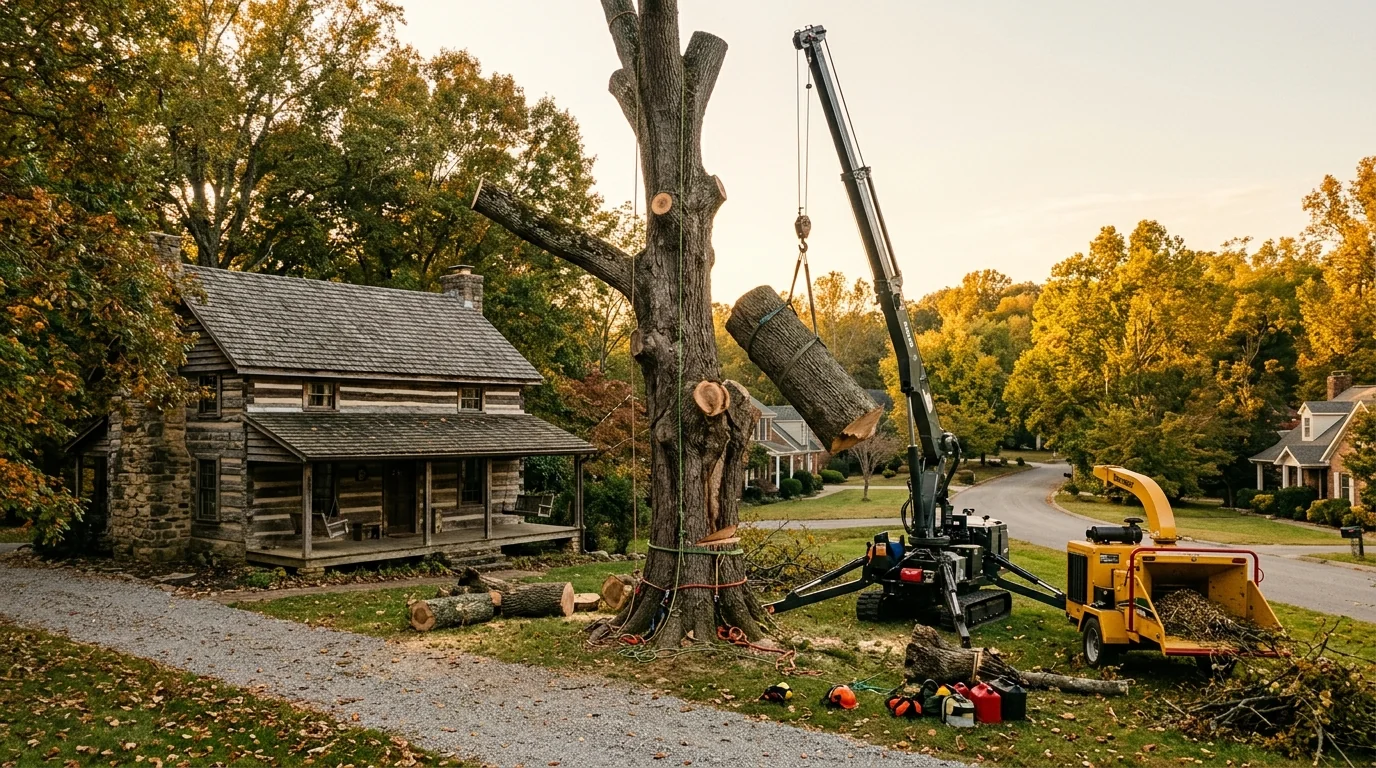
Crane-assisted removal. For large trees on sloped lots or those overhanging structures where conventional sectional removal is too risky, crane-assisted work is the right method. It carries a cost premium but eliminates the risk of controlled sections landing where they should not. See crane tree removal services for scope and access requirements.
John Sevier Building Permits
John Sevier is an unincorporated community. It does not have its own city government or code enforcement office. Permitting authority for tree removal falls to Knox County. The Knox County codes department handles right-of-way work, large-tree removal near utility infrastructure, and any grading or land disturbance that accompanies a removal project. Homeowners on larger lots adjacent to agricultural land or near county road frontage should confirm whether a county permit or right-of-way encroachment permit applies before work begins.
Tennessee operates under a statewide building code adoption framework. Local jurisdictions adopt and administer the codes, but the state sets the floor. For tree removal specifically, the permit trigger in Knox County is often tied to land disturbance thresholds or proximity to public infrastructure rather than tree size alone. Your contractor should be familiar with current Knox County requirements and should pull any required permits as part of the job scope. If a contractor tells you permits are not needed without first checking your parcel specifics, that is worth pressing on.
Knox County Code Administration can be reached directly to confirm current requirements for your address. The county’s approach to unincorporated areas like John Sevier is to apply countywide standards rather than site-specific overlays, which keeps the process more straightforward than it would be inside Knoxville city limits.
For all tree services in the John Sevier area, the tree services overview page covers scope, credentials, and what to ask before signing any contract.
Other Knoxville Area Communities We Serve
John Sevier sits within the broader eastern Knox County market, and the same crews serve neighboring communities along the river and pike corridors.
- Residents along the river corridor can review tree removal services in Mascot, which covers the stretch of Knox County just north of John Sevier.
- Homeowners in the southern part of the metro can find details at tree removal in Seymour, covering Sevier County-adjacent neighborhoods.
- For the core Knoxville metro area, the Knoxville tree removal service area page covers the full range of city and county services available.
Neighborhoods served
John Sevier neighborhoods
- John Sevier community core
- French Broad River corridor
- Boyds Bridge area
- Forks of the River industrial corridor edge
- Strawberry Plains Pike corridor
- Lower Sevier Road residential
- Mascot Road transitional area
- River Road wooded lots
Questions
John Sevier tree care FAQs
Why is tree removal a common need in John Sevier?
How much does tree removal cost in John Sevier?
Do I need a permit to remove a tree in John Sevier?
What should I look for in a John Sevier tree removal contractor?
Which neighborhoods or areas in John Sevier see the most tree work?
Can I get a free inspection before committing to tree removal?
Free estimate
Free John Sevier tree estimate
On-site assessment, written quote within 24 hours, no obligation.