Service area · Tennessee
Tree care in Rockford
Rockford is a small city in Blount County, Tennessee, situated within the Knoxville metro area. The area sits at the edge of the Ridge and Valley physiographic province, where mature hardwood canopy and frequent storm activity combine to create steady tree removal demand. Homeowners here deal with steep lots, clay-influenced soils, and species like oak and pine that grow large under ideal valley conditions.
Why Rockford Tree Removal Is Different
Rockford sits in Blount County at the southwestern edge of the Knoxville Metropolitan Statistical Area, where the Ridge and Valley physiographic province begins to give way to the foothills of the Great Smoky Mountains. That location shapes nearly every aspect of tree removal work here. Mature hardwood canopy grows dense and tall on well-drained valley soils, lot grades are often steeper than suburban Knoxville norms, and storm systems that push through the Tennessee Valley regularly deposit ice or produce severe wind that splits large trees. With a population of roughly 849 residents according to Wikipedia, Rockford is not a large city, but its tree removal market mirrors the broader challenges found across Blount County’s wooded residential landscape.
Soil and Geology in the Rockford Area
Blount County occupies the eastern edge of the Ridge and Valley province, a geologic belt characterized by parallel ridges of folded sedimentary rock separated by valleys floored with deep residual soils. In the low ground around Rockford, those soils tend to run moderately deep with clay subsoil layers that slow drainage. Clay-heavy subsoil expands and contracts seasonally, which matters for tree removal because large root systems in shrink-swell soils can displace or crack foundations, driveways, and utility lines over years of growth. When a contractor proposes leaving a large stump in place, that decision carries real consequences in clay-influenced ground. Complete stump grinding is standard practice here, not an optional add-on.
The underlying bedrock shifts across short distances in Blount County, moving from carbonate-rich limestone and dolomite in the valley floors to harder sandstone and shale on the ridge faces. Contractors working near the ridge margins encounter rock closer to the surface, which can complicate stump grinding and root excavation. Anyone hiring for a removal job on a hillside lot should ask the contractor directly whether they have encountered rock in this part of the county before.
Climate and Storm Exposure
The Knoxville metro sits in a climate corridor that receives meaningful ice storm activity in winter and severe convective storms in spring and summer. The NOAA Storm Events Database documents repeated wind, hail, and ice events across the Knoxville area and Blount County going back decades. Ice storms in particular load Blount County’s large hardwoods with weight they were not designed to carry, leading to crown failures and whole-tree toppling that happens overnight with no warning.
Spring severe weather runs from March through May and brings thunderstorm wind shear capable of snapping mature pines and splitting Bradford pears at the branch unions. Summer storms add to that toll through August. Homeowners who have large trees within striking distance of the home, a power line, or a vehicle should treat a pre-storm season inspection as routine maintenance, not a luxury. See the full breakdown of common tree problems that lead to removal for a closer look at how storm damage progresses through different species.
Housing Era and Lot Patterns
Rockford’s housing stock reflects Blount County’s development pattern, which spans from older farmstead conversions to mid-century ranch homes to newer infill along state routes. Older properties often have trees that were planted or that self-seeded decades ago, meaning they have had 40 to 60 years to reach full canopy size. On those lots, the trees that looked manageable when a homeowner bought the property have often grown substantially in the years since.
Newer residential development along the highway corridors tends to have smaller lots where trees were either preserved from the original timber or planted close to structures for shade. Either scenario can create tight-access removal jobs where a chipper truck cannot reach the base of the tree and rigging is needed to lower sections over the roof line.
Rockford Neighborhoods and Patterns
Rockford’s compact footprint means neighborhood distinctions are subtle, but lot type and age vary meaningfully across the city and its surrounding areas.
- Rockford Town Center. The oldest section of the community, with mature shade trees that have grown close to older structures and utilities over decades.
- Highway 321 Corridor. Mixed residential and commercial frontage with large pines and oaks common on deeper lots set back from the roadway.
- Little Tennessee River Bottom. Low-lying properties with high moisture availability that accelerates tree growth and increases the risk of root spread toward foundations and drain lines.
- Old Maryville Pike Area. Transitional residential lots with a mix of housing eras, where self-seeded trees from fence lines and wood edges have matured unmanaged.
- Wildwood Road Vicinity. Larger rural-edge parcels where timber-sized hardwoods are common and crane access is often impossible without careful rigging.
- Blount County Rural Edge. Working-rural properties that abut timber land, where wind-throw from adjacent canopy is a recurring hazard after major storm events.
- South Knoxville Transition Zone. Lots that functionally connect Rockford to the south Knoxville suburban fabric, with newer construction and trees planted at establishment that are now approaching mature size.
- Rockford Riverside. Properties closest to the Little Tennessee River corridor with the highest flood-event exposure and correspondingly stressed tree root systems.
How to Find a Rockford Tree Removal Contractor
Hiring tree work in a small Blount County community means there is a thinner bench of established local contractors than you would find in Knoxville proper. That makes credential verification more important, not less. The Tree Care Industry Association outlines what accreditation means and what homeowners should ask before signing.
Verify insurance before anything else. General liability and workers’ compensation coverage must both be current. Ask for certificates of insurance naming you as the certificate holder, then call the insurer to confirm the policy is active. Tree removal on steep or wooded Blount County lots carries real hazard, and an uninsured crew working on your property puts your homeowner’s insurance at risk if someone is injured.
Check ISA certification. The International Society of Arboriculture maintains a public directory where you can confirm whether an arborist’s credential is current. An ISA Certified Arborist has demonstrated baseline competency in tree health assessment, which matters when you are trying to decide whether a tree should come down or be saved through pruning and cabling. Contractors without any credentialed arborist on staff are not automatically disqualified, but you lose the independent health-assessment piece.
Ask for Blount County-specific experience. A contractor who regularly works the Rockford and Maryville corridor knows the soil conditions, the typical access constraints, and the ridge-to-valley grade changes that affect rigging decisions. Ask directly how many jobs they have completed in this part of Blount County in the past year. Vague answers should prompt more questions.
Demand a written scope before any work begins. The written scope should name the tree or trees, describe the removal method, state whether stump grinding is included, and confirm that all debris haul-off is covered in the quoted price. Surprise line items for haul-off are a common complaint pattern in this market. A contractor who resists putting the scope in writing is a contractor worth skipping.
What to Expect from a Rockford Inspection
A professional pre-removal inspection on a Rockford property covers four distinct areas. Scheduling one before work begins is the single best way to avoid surprises. Request a free inspection quote to get the process started.
Exterior walk-around. The arborist or crew lead will circle the tree to assess lean, crown symmetry, bark condition, and any visible wound wood or fungal growth at the base. On Rockford’s sloped lots, the direction of lean relative to the home, the fence line, and the property boundary all factor into how the removal will be staged.
Interior walk-through. If the tree is near the structure, a brief interior walk-through lets the contractor check for visible cracking above windows, doors that stick in wet weather, or floor slope that might suggest root pressure on the foundation. This step is brief but catches issues that exterior-only inspections miss.
Root zone and stump assessment. The contractor should evaluate how much of the root system is accessible, whether surface roots have already contacted the foundation or utility lines, and whether stump grinding can be completed in a single mobilization. On clay-heavy Blount County soils, leaving a large stump to decay in place is a slow process that keeps root pressure active for years.
Slope and drainage review. Rockford’s ridge-and-valley terrain means many lots drain toward the structure rather than away from it. Removing a large tree changes the evapotranspiration load on the soil, which can temporarily increase drainage toward the foundation. A thorough contractor will note this and may suggest a follow-up grading check after the root system dies back.
Repair Methods Used Most Often in Rockford
The methods available for managing problem trees in Rockford track closely with what works across the Knoxville metro, though steep lots and clay subsoils push certain techniques to the front of the list. For full method descriptions, see the tree services overview.
-
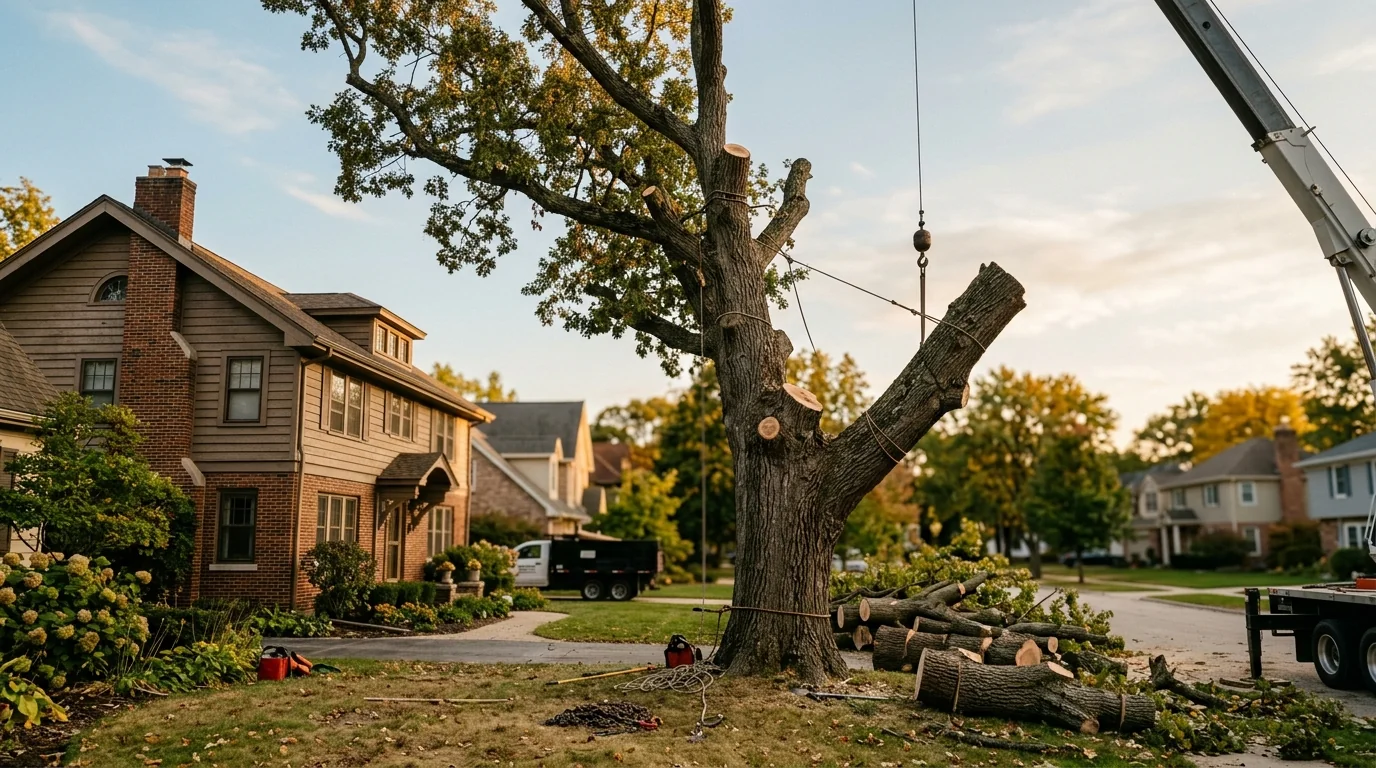
Sectional removal with hand rigging. The most common technique on tight or sloped Rockford lots where a ground fall is not safe. Sections are cut and lowered on rope systems. According to Bob Vila, full tree removal costs typically range from $385 to over $1,070 for standard residential trees, with hazard jobs reaching $2,500 to $5,000 or higher.
-
Stump grinding. Standard follow-on service after removal. Grinding eliminates continued root activity and prepares the ground for replanting or lawn restoration. This is especially important on clay soils where stump decay is slow and root systems remain biologically active longer than in sandy ground.
-
Emergency hazard removal. Storm-damaged trees that have partially failed or are leaning onto a structure require immediate response. Emergency premiums apply, but the alternative is compounding damage. Review tree removal pricing details for a fuller cost breakdown.
-
Crown reduction and cabling. When a tree is structurally sound but has one problematic scaffold limb or a co-dominant stem that poses risk, crown reduction combined with dynamic cabling can extend the tree’s life. This option suits Rockford homeowners who want to keep mature shade trees if possible. Pruning work follows ANSI A300 standards.
-
Crane-assisted removal. Used on large trees overhanging structures where rigging alone is insufficient. Crane access requires a staging area with firm, level ground, which is not always available on Blount County hillside lots. Contractors should assess site suitability before committing to this method.
Rockford and Blount County Building Permits
Rockford is an incorporated city within Blount County, but it is a small municipality with limited standalone administrative capacity. Permit authority for tree removal on private residential property in unincorporated Blount County falls to Blount County Codes Enforcement. For properties within Rockford’s city limits, contacting Blount County directly is the most reliable way to confirm current requirements, since small Tennessee municipalities often coordinate or share code enforcement services with the county.
Tennessee adopted the International Building Code family and the state has updated its residential code adoption periodically, but tree removal on private property does not typically trigger a building permit under state residential code. The more relevant regulatory layer is any local tree preservation ordinance, which Blount County municipalities may or may not have enacted. Rockford’s small size makes a formal tree ordinance less likely than in Maryville or Knoxville, but confirming with the county before removing any tree that sits in or near a road right-of-way is a practical precaution.
HOA covenants are a separate layer entirely. Roughly 45 percent of Southeast suburban homes fall under HOA governance, and those agreements frequently require written approval before any tree removal visible from the street. Check your HOA documents before scheduling work, because violation penalties can exceed the cost of the removal itself.
Other Tennessee Cities Served
Rockford sits at the center of a service area that extends across Blount County and into the broader Knoxville metro. If you own property in a neighboring community, service is available there as well.
- Tree removal services in Alcoa, TN covers the Alcoa Highway corridor and the city’s mix of established neighborhoods and newer residential development.
- Tree removal services in Seymour, TN serves the rural and suburban properties south of Knoxville toward the Sevier County line.
- Tree removal services in Eagleton Village, TN reaches the community immediately adjacent to Rockford along the Blount County corridor.
Homeowners across this part of the Knoxville metro area face similar soil conditions, storm exposure, and large-canopy species. The same questions about contractor credentials, written scopes, and permit requirements apply regardless of which community you live in. Get a free tree removal inspection to connect with a qualified crew serving Rockford and the surrounding Blount County area.
Neighborhoods served
Rockford neighborhoods
- Rockford Town Center
- Highway 321 Corridor
- Little Tennessee River Bottom
- Old Maryville Pike Area
- Wildwood Road Vicinity
- Blount County Rural Edge
- South Knoxville Transition Zone
- Rockford Riverside
Questions
Rockford tree care FAQs
Why is tree removal so common in Rockford and Blount County?
How much does tree removal cost in Rockford, TN?
Do Rockford homeowners need a permit to remove a tree?
What should I look for in a Rockford tree removal contractor?
What neighborhoods or areas in Rockford see the most tree removal work?
Can I get a free inspection before committing to tree removal in Rockford?
Free estimate
Free Rockford tree estimate
On-site assessment, written quote within 24 hours, no obligation.