Is Tree Removal Covered by Insurance in Knoxville TN
Homeowners insurance sometimes covers tree removal in Knoxville, but only under specific conditions tied to the cause of the fall and what the tree damaged. Understanding those conditions before a storm hits can save you thousands. This page breaks down the coverage rules, typical out-of-pocket costs, and what Knoxville-area homeowners should document.
Updated Jul 14, 2025 · 8 min read
Is Tree Removal Covered by Insurance in Knoxville, TN?
The answer depends on one thing more than any other: what did the tree hit? The Insurance Information Institute explains that standard homeowners policies typically cover tree removal when a tree falls on a covered structure, such as your home, a detached garage, or a fence, as a result of a windstorm, lightning, ice, or another named peril. If the tree missed everything and is just lying in your yard, most policies will not pay for its removal at all.
That rule matters a great deal in Knoxville, where NOAA storm data documents recurring ice storms, thunderstorm wind events, and the remnants of tropical systems pushing inland. Hurricane Helene’s remnants reached East Tennessee in September 2024 and caused widespread tree failures across Knox County. When those trees land on a structure, a claim may be in play. When they land in open yard, homeowners are typically on their own.
The baseline cost for tree removal in those uncovered situations is not trivial. Bob Vila puts the national average near $630, with a typical range of $385 to $1,070 for a standard residential removal. Emergency work, crane-assisted removals over a roofline, or large hardwoods push costs well above that range.
What Drives the Cost of Tree Removal in Knoxville
Several variables move the final number, whether you are paying out of pocket or your insurer is covering part of it.
Tree size. Bob Vila shows that small trees under 30 feet run $150 to $400, mid-size trees of 30 to 60 feet run $400 to $1,000, and large trees above 60 feet can cost $1,000 to $2,000 or more. Knox County’s mature white oaks, black walnuts, and eastern hemlocks frequently fall in the large category.
Emergency premium. Storm-response work carries a surcharge because crews work overtime hours, equipment is deployed with no advance staging, and demand spikes across the entire metro simultaneously. Emergency jobs often cost 25 to 50 percent more than a scheduled removal.
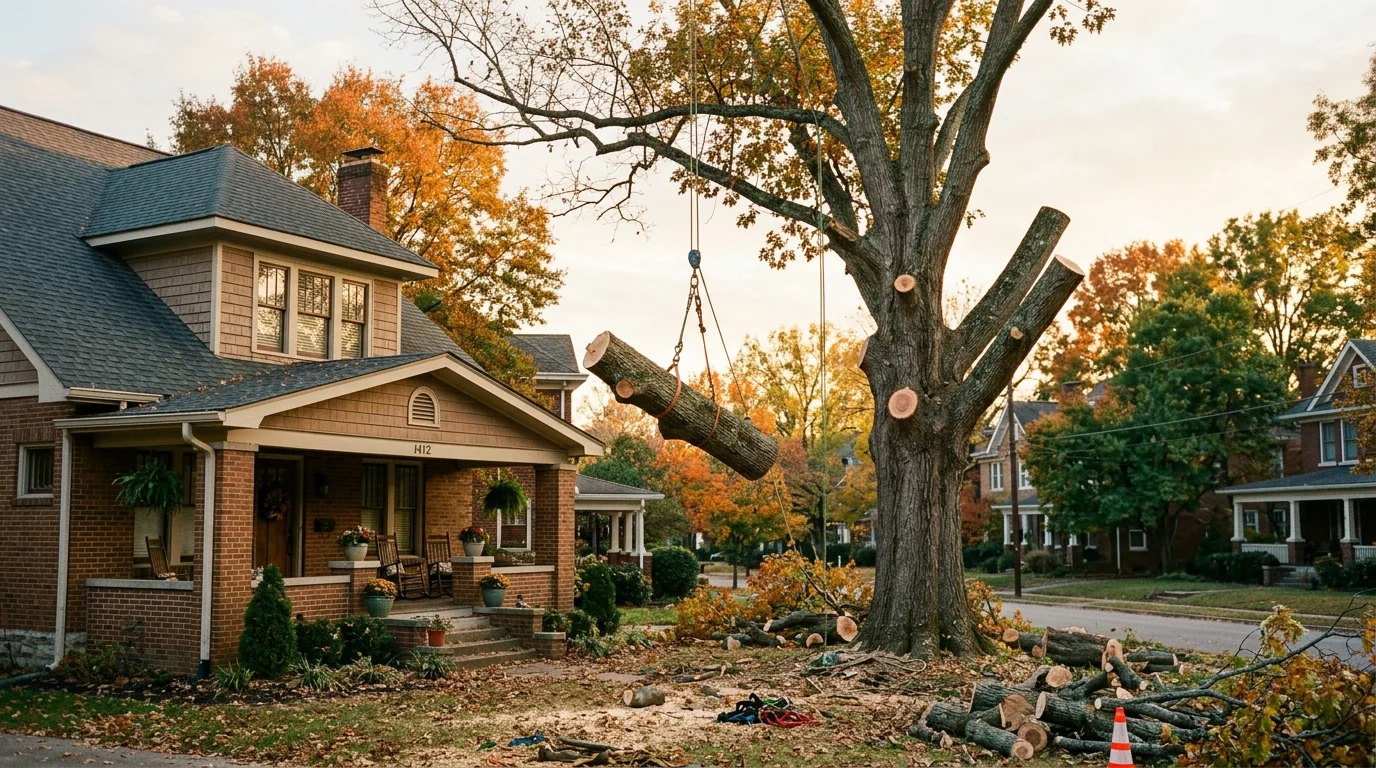
Crane requirement. When a tree is pinned against a structure or standing over a roof with no safe felling lane, a crane is required. Bob Vila cites crane-assisted removal adding $500 to $1,500 or more to the base cost. In Knoxville’s older neighborhoods, tight lot lines make crane work more common.
Access conditions. Knoxville’s Valley-and-Ridge terrain means some lots sit on slopes with no driveway access for heavy equipment. Difficult terrain adds crew time and can require specialized rigging.
Debris hauling. Removal and hauling are sometimes quoted separately. Confirm before signing whether the estimate includes full debris haul-off, which most Knoxville homeowners expect as part of the job.
Stump grinding. Insurance does not cover stump removal as a rule, even when it covers the tree removal itself. Stump grinding typically adds $150 to $500 depending on stump diameter.
Coverage Scenarios: What Insurance Pays and What It Does Not
Understanding the coverage map ahead of time keeps you from making assumptions that cost you money after the storm passes.
Covered: Tree falls on your dwelling. If a windstorm, lightning strike, ice load, or another named peril brings a tree down on your roof or exterior walls, your dwelling coverage (Coverage A) typically applies. Your insurer will cover the structural repair and a portion of tree removal, often up to $500 to $1,000 for removal itself, after your deductible.
Covered: Tree falls on a detached structure. A tree that crushes a detached garage, shed, or fence may fall under your other-structures coverage (Coverage B), which is usually 10 percent of your dwelling coverage limit. The same removal sub-limit typically applies.
Not covered: Tree falls but hits nothing. The Insurance Information Institute is explicit on this point. A tree in your yard that falls harmlessly onto grass generates no covered loss. You pay the full removal cost.
Not covered: Preventive removal of a hazard tree. Knoxville faces active pressure from Emerald Ash Borer, which the Tennessee Department of Agriculture has confirmed in Knox County and which kills ash trees within three to five years. Thousand Cankers Disease, first detected in the eastern United States right here in Knox County in 2010 (per the Tennessee Department of Agriculture and University of Tennessee Extension), creates high mortality risk for black walnuts. Removing a dead or dying tree before it falls is maintenance, not a sudden loss. No standard policy covers it.
Not covered: Your tree falls on your neighbor’s property. This surprises many homeowners. The Insurance Information Institute notes that if your tree falls on your neighbor’s house, your neighbor’s own homeowners policy is the primary payer. Your liability coverage only becomes relevant if your neighbor can demonstrate you were negligent, for example, if they sent you written notice that the tree was dead and you did not act.
For Knoxville homeowners with known-diseased trees, such as ash trees showing the D-shaped exit holes of Emerald Ash Borer or black walnuts showing the crown dieback of Thousand Cankers Disease, that negligence standard is worth taking seriously. A written assessment from an ISA-certified arborist creates a paper trail that can clarify liability in either direction.
Insurance Sub-Limits, Deductibles, and What Actually Gets Paid
Knowing you have coverage is only half the picture. The sub-limit and deductible structure determines what you actually receive.
Most standard homeowners policies apply a $500 to $1,000 sub-limit specifically to tree removal, separate from the structural repair coverage. That sub-limit may cover one tree or up to three trees depending on the policy language. If a storm drops four trees on your property, you may recover the removal cost for only some of them.
Tennessee deductibles for wind or named-storm events sometimes carry a separate, higher rate than your base all-perils deductible. A policy with a $1,000 base deductible might carry a 1 to 2 percent of dwelling value wind deductible. On a $300,000 home, that is $3,000 to $6,000 out of pocket before coverage kicks in. If the total damage is modest, filing the claim may cost you more in future premium increases than you recover.
Permits, Documentation, and Working with Your Adjuster
Knoxville and Knox County do not currently require a permit for removing a tree on private residential property in most circumstances, but confirm with Knox County Code Enforcement before work begins, particularly for trees near rights-of-way or in historic districts.
What adjusters do require is thorough documentation. Take dated photographs within the first hour after the damage. Photograph the tree at its origin, the point of impact, and all visible structural damage. Keep those files stored somewhere other than your phone in case the device is lost or damaged during the event.
Get a written estimate on company letterhead that itemizes removal separately from structural repair and debris hauling. An estimate that bundles everything into one number is harder for an adjuster to allocate across coverage categories. The Tree Care Industry Association recommends working only with accredited companies that carry proper liability insurance, which also protects you if a crew member is injured during removal.
Financing Options When Insurance Falls Short
When coverage does not apply or your deductible erases the benefit, two financing paths are practical for most Knoxville homeowners.
A home equity line of credit gives you a revolving credit line secured by your home’s equity. The Consumer Financial Protection Bureau explains that a HELOC typically carries a variable interest rate and a draw period during which you borrow as needed. For homeowners with substantial equity, this is usually the lowest-cost borrowing option for a large, unexpected tree removal.
Many Knoxville tree services also offer contractor financing through third-party lenders, often with promotional periods of six to twelve months at zero interest if paid in full. Read the fine print carefully. Deferred-interest promotions convert to high rates if any balance remains at the end of the promotional window.
Getting an Accurate Quote After Storm Damage
The first contractor to call back after a storm gets a large share of the jobs, and some of them know it. Protect yourself with a few concrete practices.
Insist on a written estimate before any work begins. Verbal agreements for emergency work create disputes over scope and price that are difficult to resolve. A reputable company provides an itemized written estimate within the same visit or within a few hours for genuine emergencies.
Be cautious of quotes that include no mention of the company’s liability insurance or that cannot be verified through the ISA Find an Arborist directory. “Today only” pricing on emergency work is a red flag. Legitimate contractors understand that you need to contact your insurer before authorizing large expenditures.
For Knoxville homeowners dealing with storm aftermath, you can review typical removal costs on the tree removal cost guide and connect with credentialed local crews through the tree services directory. If an active hazard needs same-day attention, the emergency quote form connects you with available crews.
Knoxville’s storm exposure is real. Knox County’s ice storm history, its heavy hardwood canopy, and the added disease pressure from Emerald Ash Borer and Thousand Cankers Disease mean that tree failures are not hypothetical risks here. Knowing your insurance position before the next storm season, and having the contact information ready, is the most practical thing a Knoxville homeowner can do.
For more on the tree health threats that create removal pressure in Knox County, visit the tree problems resource covering local pest and disease conditions.
Free written estimate
Worried about a tree? Get a free estimate.
On-site assessment and a written estimate. Same-day for emergencies. No obligation.
Questions
Is Tree Removal Covered by Insurance in Knoxville TN FAQs
Does homeowners insurance pay for tree removal if the tree did not hit anything?
Whose insurance pays if my neighbor's tree falls on my house?
Does insurance cover emergency tree removal after a Knoxville ice storm?
How much does tree removal typically cost in Knoxville without insurance?
What documentation does an insurance adjuster need for a tree removal claim?
Will insurance cover removal of a dead ash or walnut tree before it falls?
What is a typical insurance deductible for storm tree damage in Tennessee?
Free estimate
Talk to a Knoxville tree pro
On-site assessment and a written estimate, often same day. No obligation.