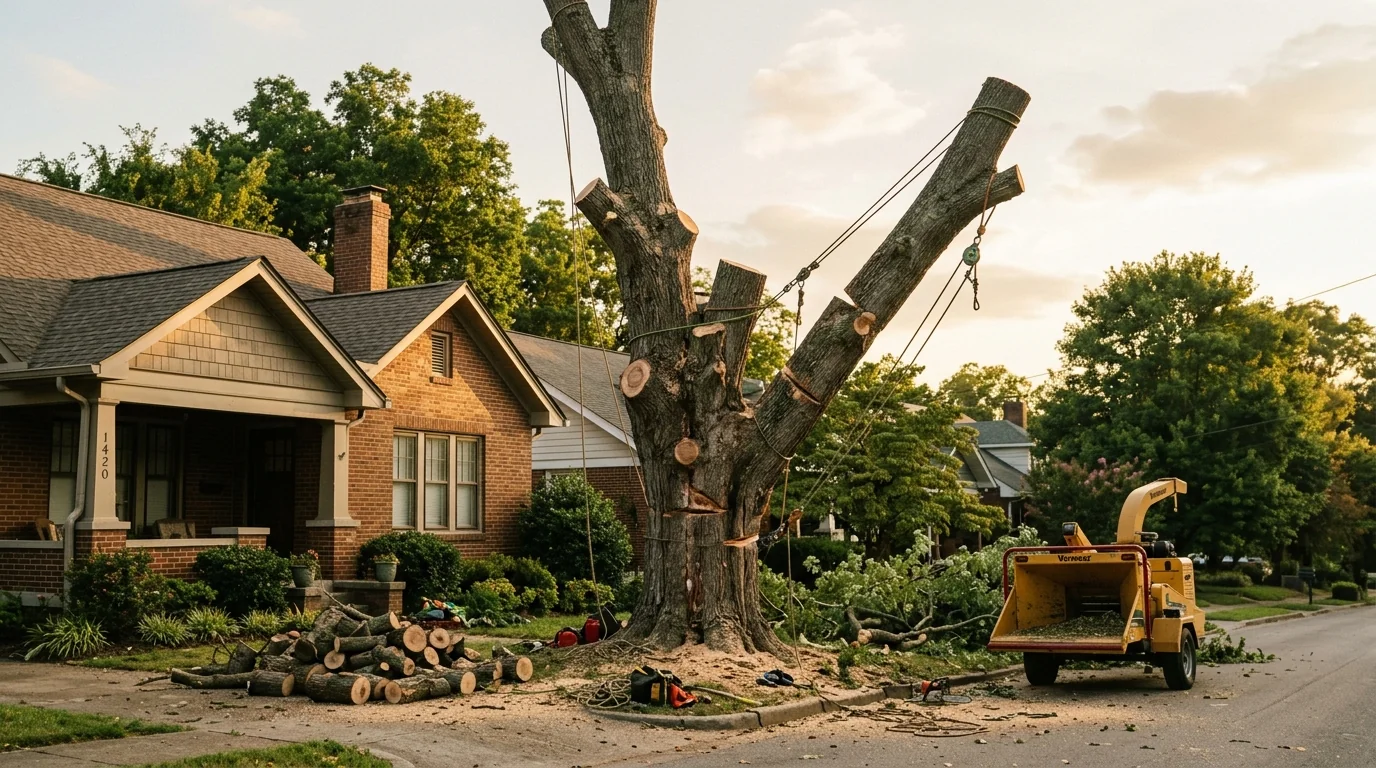
Signs Your Tree Needs to Be Removed
A tree needs to be removed when it poses a safety hazard or is too far gone to save. Key warning signs include a leaning trunk after storm damage, large dead branches, hollow or decayed wood at the base, root damage near a structure, and active pest infestations such as Emerald Ash Borer or Hemlock Woolly Adelgid. An ISA-certified arborist can confirm whether removal or treatment is the right call.
Updated Jan 30, 2025 · 7 min read
A tree in Knoxville, TN should be removed when it poses a clear safety hazard, is dead or structurally compromised, or is too far damaged by pests or disease to recover. The most reliable warning signs are a new lean after storm saturation, large dead branches over a living space, advanced decay at the trunk base, root damage near the foundation, or confirmed infestation by a lethal pest such as Emerald Ash Borer. A tree health and hazard assessment from a certified arborist is the only way to get a definitive answer.
The Warning Signs That Mean a Tree Should Come Down
Not every sick or damaged tree needs to be removed. About 64 percent of homeowners want to save a tree if possible, and that instinct is often right. The signs below are the ones that shift the decision from “treat and monitor” toward “remove.”
1. A New Lean, Especially After Heavy Rain or Storm Damage
A gradual lean that has existed for years and points away from structures is usually stable. A lean that developed recently, or worsened after the kind of rain-saturated soil conditions Knox County gets with its 47.9 inches of annual rainfall (NWS Morristown, 1991-2020 Climate Normals), is a different situation entirely. Watch for the root ball lifting on the uphill side, soil cracking in an arc around the base, or roots pulling free. These are signs the tree’s anchor is failing.
Remnants of Hurricane Helene in September 2024 produced exactly this pattern across East Tennessee, with saturation-driven root failures causing tree collapses days after the storm itself had passed.
2. Large Dead Branches in the Upper Crown
Dead branches over 3 to 4 inches in diameter, particularly those hanging over a roof, driveway, or outdoor living area, are a drop hazard. A single dead limb does not automatically mean the whole tree must go, but multiple large deadwood clusters in the upper crown suggest systemic decline. The International Society of Arboriculture recommends professional evaluation when crown loss approaches or exceeds roughly 30 percent of the living canopy.
3. Hollow or Severely Decayed Wood at the Base
Knock on the lower trunk. A hollow sound, soft spots you can probe with a screwdriver, visible cavities, or shelf fungi (conks) growing at the base all indicate internal decay. A tree can survive with some internal decay, but once the sound-wood shell is too thin to hold the load, no amount of treatment reverses the structural failure risk. An arborist can probe and assess how much structural wood remains.
4. Bark Abnormalities That Signal Active Pest Damage
Several pests active in Knox County cause damage that leads directly to tree death and removal.
Emerald Ash Borer (EAB) is confirmed in Knox County. Look for D-shaped exit holes roughly 1/8 inch wide, S-shaped galleries under the bark, and crown dieback starting at the top. Untreated ash trees typically die within 3 to 5 years (Tennessee Department of Agriculture, EAB Quarantine and Pest Alert). Dead ash trees become brittle hazard trees fast.
Hemlock Woolly Adelgid (HWA) is widespread across East Tennessee. The signature sign is white, woolly egg masses at the base of needles on the branch underside. Without treatment, eastern hemlocks typically die within 4 to 10 years (USDA Forest Service, Hemlock Woolly Adelgid in the Southern Appalachians). Dead hemlocks near homes are a removal priority.
Thousand Cankers Disease deserves special mention because Knoxville is where it first appeared in the eastern United States, confirmed in Knox County in July 2010. Black walnut trees with progressive top-down crown dieback, yellowing leaves, and tiny beetle entry holes with small cankers beneath the bark are candidates for removal after the disease advances past a recoverable point (Tennessee Department of Agriculture, Thousand Cankers Disease Quarantine; University of Tennessee Extension W-277).
5. Root Damage or Construction Damage Near the Base
Roots cut or paved over within the drip zone of a tree compromise its structural anchor and its ability to take up water and nutrients. Knox County’s heavy clay soils, derived from weathered limestone and dolomite in the Valley and Ridge province (USDA Web Soil Survey, Knox County, Tennessee), compact easily and drain poorly after disturbance. A tree that had significant root work within the last two to three years and is now showing wilting, leaf scorch, or thinning canopy may be in a slow decline that is not reversible.
6. The Tree Is Growing Into a Structure or Power Line
A tree whose canopy or roots are encroaching on a roofline, foundation, or power infrastructure is a practical removal candidate even if the tree itself is healthy. Knoxville utility corridors follow standard TVA and utility company clearance requirements, and trees that cannot be pruned back to safe clearance distances without destroying the canopy often need full removal.
Why Knoxville Trees Face Particular Risks
The Knoxville metro has a combination of factors that makes tree hazard assessment more urgent than in many other markets.
Ice storms are a recurring hazard. East Tennessee’s elevation and geography make winter ice events a significant problem. The February 2021 ice storm and repeated freezing-rain events since have caused widespread limb breakage in Knox County hardwoods and white pines. Ice-damaged trees with major scaffold limbs torn from the trunk often cannot structurally recover.
Clay soils shrink and swell. Knox County’s silty clay soils go through wet-dry shrink-swell cycles with the seasons. This movement, combined with the county’s karst limestone topography, can shift and expose roots over time, destabilizing trees that looked healthy in prior seasons.
Bradford pears and older white pines are common failure trees. Bradford pear trees, widely planted in Knoxville suburbs, are structurally weak by design: their tight, upright branching creates included bark that splits under load. Older white pines become top-heavy as they age and shed their lower limbs, making them vulnerable to wind shear in summer thunderstorms.
Spotted Lanternfly is on the way. This invasive pest has not yet established in Knox County, but it is advancing toward Tennessee (USDA APHIS Spotted Lanternfly Program; Tennessee Department of Agriculture). Homeowners should learn to recognize it now. If it arrives, it will stress a broad range of host trees including oaks and black walnuts already under pressure from other threats.
How to Evaluate a Tree You Are Worried About
A structured walk-around takes about ten minutes and covers the main risk zones.
- Start at the base. Look for fungi, cracks, soil heaving, or exposed roots pulling free of the ground.
- Check the trunk from base to first scaffold branches. Note any cavities, bulges, missing bark patches, exit holes, or old wounds that never closed.
- Look up into the canopy. Count the proportion of dead wood versus live, green growth. Look for hanging limbs or branches that have already broken and are caught in the canopy.
- Note the lean. Stand back and sight down the trunk. Identify whether any lean points toward a structure, vehicle, or frequently used area.
- Look at the ground. Cracks radiating from the base in a curved pattern indicate root-plate movement.
Document everything with photos and dates. If any of the warning signs above are present, the next step is a professional assessment, not a wait-and-see approach.
What This Means for Your Project
A tree that shows multiple warning signs is not a situation to put off. Removal costs generally rise when a tree fails on its own because crane access, structural complications, and emergency-rate pricing all push the number higher. The tree removal cost guide for Knoxville covers what size, location, and access do to pricing, and you can see the full range of tree services available in the Knoxville area if you are weighing removal against treatment options such as cabling, pruning, or pest management.
If you have a tree that concerns you right now, the fastest path to an answer is getting a qualified arborist on-site. Request a tree removal assessment for your Knoxville property and have someone look at it before the next storm season makes the decision for you.
Cost figures cited above are sourced from Bob Vila’s tree removal cost guide and represent national ranges. Actual Knoxville quotes depend on site conditions, access, and current contractor availability.
Free written estimate
Worried about a tree? Get a free estimate.
On-site assessment and a written estimate. Same-day for emergencies. No obligation.
Questions
Signs Your Tree Needs to Be Removed FAQs
How do I know if a dead tree needs to come down right away?
Can a tree that is leaning be saved instead of removed?
What does Emerald Ash Borer damage look like on a Knox County ash tree?
Does homeowners insurance cover removing a hazard tree before it falls?
How much does it cost to remove a tree in Knoxville, TN?
What is the 30 percent rule for tree crown damage?
Do I need a permit to remove a tree in Knoxville?
Free estimate
Talk to a Knoxville tree pro
On-site assessment and a written estimate, often same day. No obligation.