What is emergency tree removal and when is it the right choice?
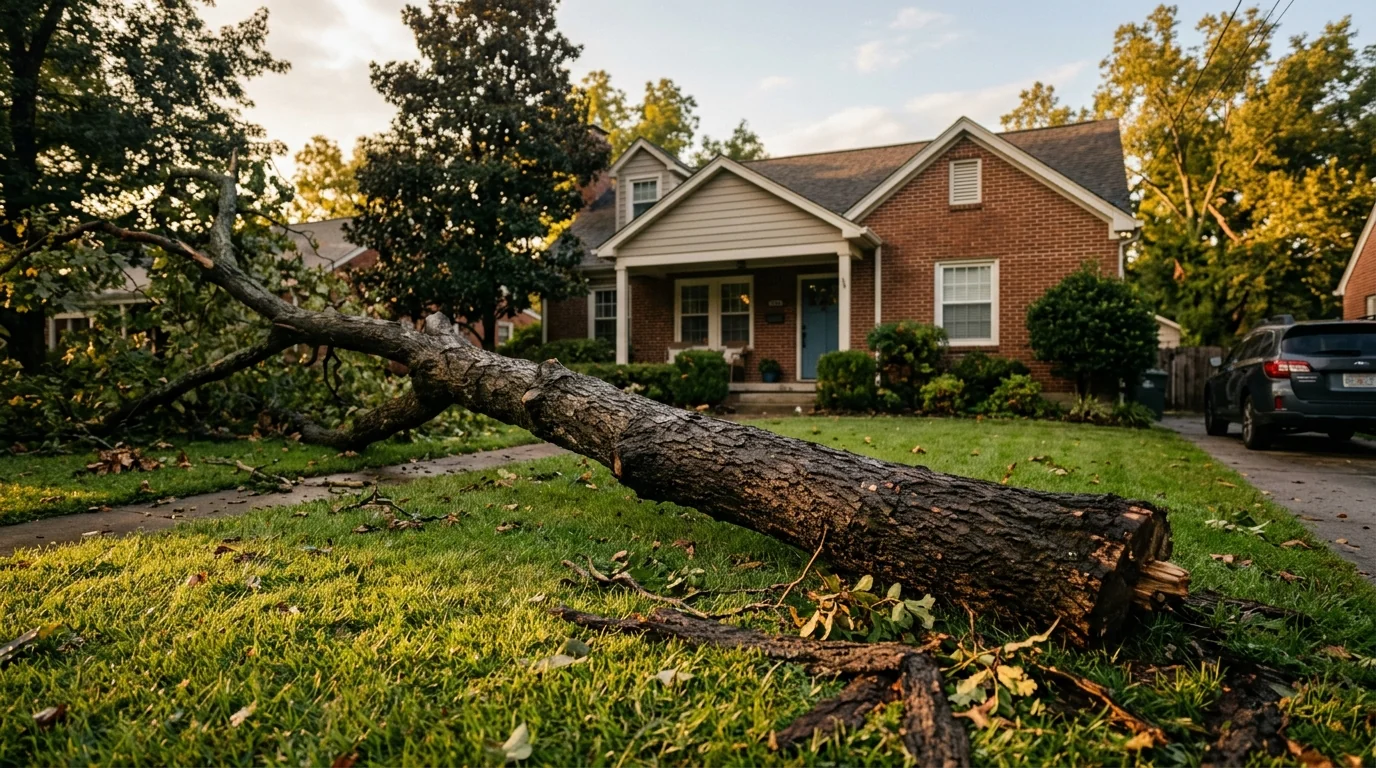
Emergency tree removal is the unscheduled, often same-day dispatch of a trained crew to address a tree or large limb that poses an active threat to people, structures, or utilities. The distinction from a standard scheduled removal is not just speed. The hazard is present right now, which changes the risk calculus, the pricing, and the documentation requirements. Knoxville homeowners call for emergency service most often after severe thunderstorms, ice events, or wind events that topple trees onto roofs, block driveways, or drop branches onto power lines. The right time to make this call is any time a tree has already failed structurally or shows signs of imminent failure.
How it works mechanically
A crew arrives with rigging equipment, chainsaws, and a chipper. The lead climber or bucket truck operator assesses the failure point and determines how to section the tree without letting uncontrolled weight land on the structure beneath. For trees already resting on a roof or fence, rigging lines and careful sequencing of cuts remove that load piece by piece. Ground crew chips or stacks debris as sections come down. The process ends with stump cutting at or near grade, though stump grinding is typically a separate line item scheduled for a later date.
Conditions emergency removal is designed for
Emergency removal fits situations where delay creates additional damage or safety risk: a half-fallen tree still pulling on a fence or structure, a lightning-struck tree with a compromised trunk, a tree leaning at a new angle after soil saturation from heavy rain, or a branch resting on a power line. Knox County’s mix of mature oaks, white pines, and black walnuts, many already stressed by Emerald Ash Borer, Hemlock Woolly Adelgid, or Thousand Cankers Disease, means structurally weakened trees are common throughout the metro. Hurricane Helene’s remnants reached East Tennessee in September 2024, and the resulting wind and soil saturation caused widespread tree failures across Knox County, a reminder of how quickly the demand picture can shift.
Conditions where an alternative is better
If the tree is dead or declining but not actively failing, a scheduled removal is safer, cheaper, and gives you time to collect multiple quotes. Crane-assisted removal may be the better method when a large tree needs to come down over a structure in a controlled, pre-planned operation. Emergency dispatch is not the most economical way to remove a healthy tree you simply no longer want.
Installation process
Emergency tree removal follows a consistent sequence even when time pressure is high.
-
Initial call and dispatch (0-2 hours). A qualified crew confirms the hazard by phone or photo, provides a preliminary price range, and dispatches. Reputable Knoxville contractors answer 24/7 for active hazards. If the tree is on or near a power line, the crew coordinates with Knoxville Utilities Board (KUB) before approaching the drop zone.
-
Site assessment on arrival (15-30 minutes). The lead arborist or crew foreman walks the site, identifies the primary failure point, checks for secondary hazards such as additional hanging limbs or root heave, and confirms the scope of work before cutting begins.
-
Hazard stabilization (variable). If a tree section is already resting on a roof or vehicle, rigging lines are set first to control the next cut before any chainsaw work starts. Temporary tarping of damaged roof areas may happen at this stage to limit water intrusion while the crew works.
-
Sectional removal (1-6 hours depending on tree size and complexity). The crew works top-down, removing limbs and sections in controlled pieces. Ground crew clears each section and feeds debris into the chipper. For trees in tight suburban lots, common throughout Knoxville’s West Hills, Sequoyah Hills, and Farragut neighborhoods, rigging from adjacent trees or an anchor point substitutes for crane access.
-
Documentation for insurance (before full cleanup). Before the site is cleared, the crew or a crew supervisor photographs the damage, the failure point, and the removal process. A written itemized estimate follows. This package goes to your insurance adjuster. The Insurance Information Institute explains fallen-tree coverage in plain terms and is worth reading before you call your carrier.
-
Cleanup and debris removal (30 minutes to 2 hours). Wood is chipped, loaded, and hauled. Logs may be left on request. Stump is cut at or near grade. A follow-up stump grinding appointment is scheduled separately if desired.
-
Post-removal check. The crew walks the site with the homeowner to confirm no secondary hazards were missed and to answer insurance questions.
Emergency tree removal vs. crane-assisted tree removal
The overlap between these two methods is real but limited. Both involve removing a tree that cannot simply be felled with a single cut into open space. The difference is planning time and equipment.
Emergency removal relies on climbing and rigging because there is no runway for crane mobilization. A crane company needs stable ground for outriggers, overhead clearance for the boom, and advance notice to schedule the machine and operator. None of those conditions exist when a tree is actively crushing a carport at 11 p.m. on a Saturday. Emergency crews solve the same problem with ropes, friction devices, and careful sequencing of cuts.
Crane-assisted removal is the better choice when the hazard is recognized in advance, the tree is very large, or the geometry of the site makes rigging impractical. A 90-foot white oak over a finished living space is a job where crane control over each section is worth the scheduling delay and higher base cost. You can read more about when that method makes sense on the crane-assisted tree removal service page.
The honest edge case: after a catastrophic storm like Hurricane Helene’s 2024 pass through Knox County, emergency crews are booked out and a homeowner with a non-imminent hazard may end up calling a crane company anyway just to get a crew on-site faster. In that situation the method choice is driven by availability, not pure technical preference. Either way, getting a same-day quote while the damage is fresh keeps your insurance timeline intact.
Emergency tree removal cost in Knoxville, TN
Bob Vila’s tree removal cost guide puts standard tree removal in the range of roughly $200 to $2,000 for most residential trees, with larger or more complex jobs running higher. Emergency work carries a surcharge on top of that baseline, typically 25-50% above standard rates for after-hours or weekend response. Trees that have already landed on a structure push toward the higher end of any range because crew safety requirements increase and the work takes longer.
Several local variables move the number in Knoxville specifically:
- Tree size and species. A 40-foot Bradford pear in Corryton is a different job than a 70-foot white pine in Hardin Valley. Pines and oaks common to Knox County’s ridge lots tend toward the higher end of the size range.
- Degree of contact with structure. A tree resting against a gutter costs less to remove than one that has punched through a roof deck. The more controlled extraction required, the higher the labor time.
- After-hours and weekend timing. Storm events don’t happen on weekday mornings. Expect a premium for Saturday night or Sunday dispatch.
- Crane requirement. If the lot or tree geometry demands a crane rather than rigging, crane mobilization adds cost regardless of the emergency nature of the call. See the emergency tree removal cost breakdown for a more detailed look at how these variables stack.
- Debris haul-off. Most Knoxville homeowners expect haul-off included. Confirm this when you get your quote, since some contractors price it separately.
For dead tree situations that were spotted before a storm, addressing the hazard proactively through a dead tree removal assessment costs less than emergency dispatch after the tree has already come down.
Warranty and transferability
Emergency tree removal is a service, not a product installation, so warranty terms are different from what you see on pier systems or waterproofing jobs. What a strong contractor offers:
Workmanship warranty. A reputable company will warranty the quality of cuts, cleanup, and site safety for a defined period, typically 12 months at minimum. This covers issues like a stub left too long that creates a secondary hazard or debris missed on a roof.
No warranty on the tree itself. No legitimate contractor warrants that remaining trees on the property won’t fail in a future storm. Be skeptical of any company that implies otherwise.
What to ask before signing. Ask specifically whether the workmanship warranty is in writing, what it covers, and whether it transfers if you sell the home. Transfer matters more for planned removals than emergency work, but it is worth knowing.
ISA Certified Arborist credentials, verifiable through the ISA’s public database, and TCIA accreditation are both signals that a company operates to documented professional standards. These credentials are worth verifying even when you are in a hurry, because emergency conditions attract unlicensed storm chasers following weather events.
Permits and engineering for emergency tree removal in Knoxville
Knox County and the City of Knoxville both have tree ordinances, but active hazard situations carry different treatment than routine removals.
City of Knoxville. The City’s Development Services Division administers its tree protection standards. For emergency situations where a tree is actively damaging a structure or poses imminent risk of injury, removal can often proceed without waiting for a standard permit, but written documentation of the emergency condition is expected. Contact the Development Services Division at 865-215-2000 to confirm current emergency procedures before work begins, especially for trees on or near the public right-of-way.
Knox County (unincorporated areas). County Engineering handles permit questions for properties outside city limits. Requirements for emergency removals follow a similar logic: document the hazard, proceed to eliminate the immediate danger, and file the relevant paperwork promptly. Farragut has its own municipal code and should be contacted separately.
HOA considerations. Roughly 45% of Southeast suburban homes sit in HOA-governed communities, and many Knox County subdivisions in Farragut, Hardin Valley, and Bearden require HOA approval for tree removal visible from the street. Most HOA covenants include a carve-out for genuine emergencies, but notify your HOA board as quickly as possible after emergency work is complete to avoid a covenant dispute.
Engineering reports. For insurance claims involving structural damage, your insurer may request a written assessment from an ISA Certified Arborist explaining why the tree was a hazard. This is not a building engineering report in the structural sense, but it serves a similar evidentiary function. Ask your crew whether they can provide or refer you to someone who can provide that document.
If you are in an active emergency situation right now, the fastest path is to request a same-day quote and have the permit conversation with the crew on arrival. Serve your family’s safety first, then close the paperwork loop the next business day.