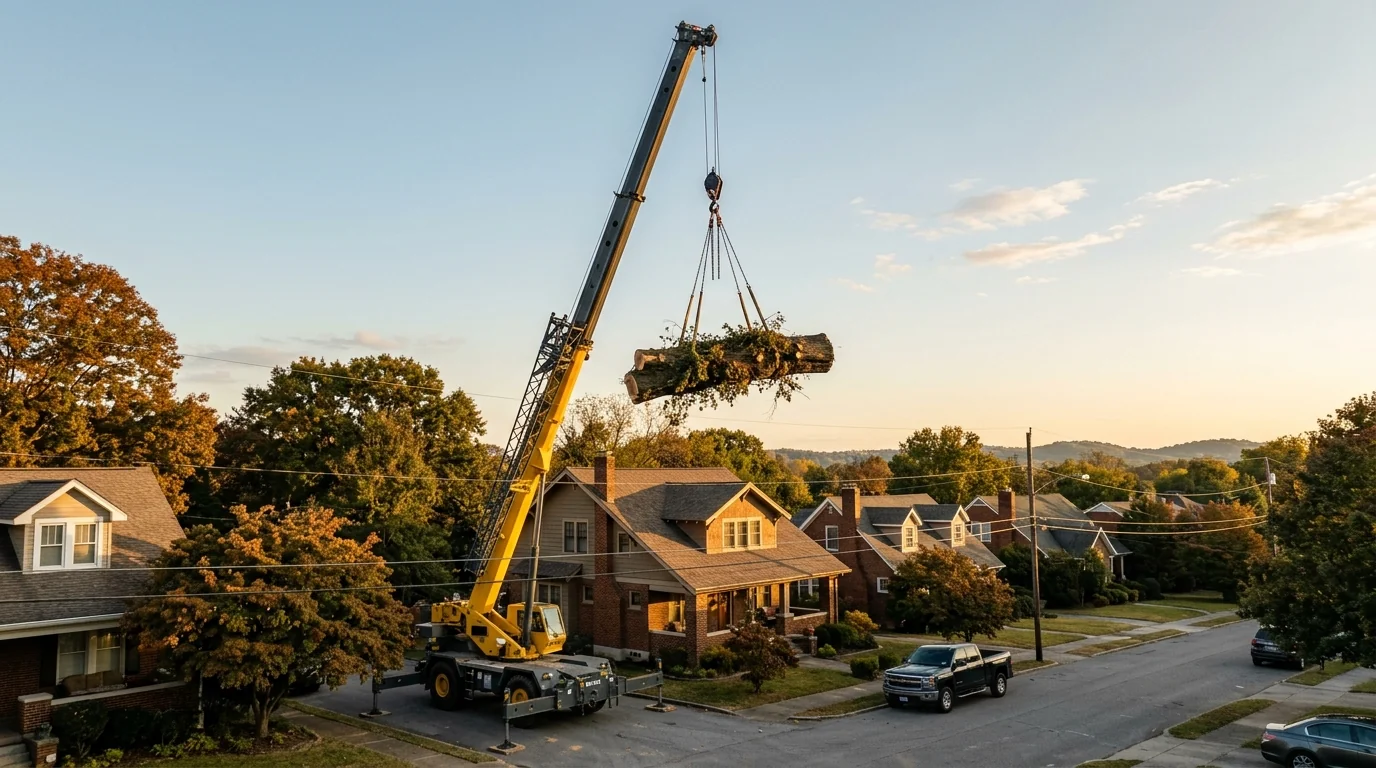
What is crane-assisted tree removal and when is it the right choice?
Crane-assisted tree removal is a method in which a mobile crane, operated from a staging area on the ground, lifts large sections of a tree clear of structures, fences, or other obstacles while a ground-based or minimally-climbing crew cuts those sections free with a chainsaw. The crane carries the load that would otherwise have to be rigged and lowered by rope, which means faster cuts, fewer passes, and far less risk of a section dropping onto a roof or fence. For homeowners in Knoxville dealing with a large storm-damaged oak overhanging the house, or an ash tree killed by Emerald Ash Borer that is no longer safe to climb, crane removal is often the clearest path forward.
How it works mechanically
A tag line attached to the tree section keeps it from spinning as the crane lifts. The climber (or a ground-based cutter using a pole saw for the lowest cuts) makes a release cut once the crane has tension on the section. The crane operator then swings the piece to a drop zone, usually the street or driveway, where the ground crew breaks it down for chipping and haul-off. The process repeats from the top of the tree downward. Because the crane bears the weight at the moment of the cut, the cutter does not have to worry about a section swinging unpredictably into a structure.
The conditions it is designed for
Crane removal is the right call in four situations. First, the tree overhangs a structure and there is no safe drop zone for conventional rigging. Second, the tree is so large (typically 60 feet or taller) that rope-rigging each section would take a full day or more. Third, the tree is structurally compromised to the point where climbing introduces meaningful risk of the climber falling with a broken branch or trunk section. Fourth, the property has a confined layout where a conventional ground crew cannot get equipment close enough to work efficiently.
Knox County’s Valley-and-Ridge terrain and its history of ice storms make the third condition particularly common here. The February 2021 ice storm caused widespread limb breakage in hardwoods and white pines across the county, and many of those trees were still standing in weakened form in subsequent years, becoming candidates for crane removal rather than conventional climbing.
When an alternative is the better choice
Crane removal is not always the answer. If the tree is under 40 feet, has a clear drop zone on at least two sides, and shows no internal decay, a bucket truck removal service in Knoxville will likely cost less and cause less disruption to the driveway or lawn. Crane mobilization adds a day-rate charge that only pencils out when the job complexity justifies it. Similarly, if your lot is steeply sloped or has a narrow driveway that cannot support outrigger loads, a crane may not be physically possible.
How crane-assisted tree removal is installed, step by step
1. Site assessment and rigging plan (day before or morning of the job)
The crew lead walks the property to identify the crane staging position, confirm outrigger pad locations, and plan the drop zone. On a Knoxville city street, this may involve coordinating a lane closure with the City of Knoxville Department of Public Works.
2. Crane mobilization and setup (1-2 hours)
The crane truck travels to the site. Outriggers extend and are set on timber mats if the ground is soft or wet (common after Knox County’s frequent spring rain events, given the area’s 47.9 inches of average annual rainfall). The boom is raised and positioned over the tree.
3. Ground clearance and protection (30 minutes)
The ground crew moves vehicles, covers any garden beds or HVAC units near the drop zone, and strings caution tape around the work perimeter. OSHA tree care safety standards require a clear exclusion zone around the drop area during lifts.
4. Top-down cutting sequence (2-5 hours depending on tree size)
Starting at the crown, the cutter attaches the crane’s choker or sling to a section, gives the crane operator a signal, and makes the release cut once the cable is tight. The operator lifts and swings the section to the drop zone. The ground crew breaks it down and feeds it into the chipper. This sequence repeats every 10 to 20 minutes on a well-run job.
5. Stump section handling
The final butt log is typically too heavy to lift whole. The cutter sections it on the ground. If stump grinding is included in the contract, the grinder crew moves in after the crane is demobilized.
6. Crane demobilization and debris cleanup (1-2 hours)
The crane is broken down, outrigger mats are pulled, and the crew rakes and blows the site. Most Knoxville homeowners expect debris haul-off included in the base quote, and this is the stage where that happens.
Crane-assisted removal vs. bucket truck removal
The core trade-off between these two methods comes down to access, tree condition, and budget.
A bucket truck positions an aerial platform next to the tree, and the climber works from the basket, cutting smaller sections and roping them to the ground crew. The method is highly flexible on lots where the truck can drive within 30 to 40 feet of the trunk. It costs less per hour than a crane crew, and the equipment footprint is smaller, making it a better fit for tighter suburban lots common in Knoxville neighborhoods like Sequoyah Hills or Fountain City.
The crane method earns its higher price when the tree is over a structure, when it is severely decayed, or when the sheer volume of wood means that the speed of crane lifting offsets the mobilization cost. An Emerald Ash Borer-killed ash tree, for example, loses bark rapidly once dead and becomes genuinely dangerous to climb. Keeping the cutter on or close to the ground and letting the crane bear the load is a meaningful safety difference, not just a sales pitch.
One practical consideration in Knoxville is the city’s karst limestone topography. Certain areas of Knox County have subsurface voids that can affect ground bearing capacity, which matters when a crane is applying outrigger loads. A reputable crane operator will ask about soil conditions and may require a mat setup that a bucket truck would not need.
For trees in the 25 to 60 foot range with reasonable access and no structural compromise, a bucket truck removal service in Knoxville is usually the more economical choice. For the big, the sick, or the precariously placed, the crane is the right tool.
Crane-assisted removal cost in Knoxville, TN
Bob Vila’s tree removal cost guide reports that crane-assisted tree removal typically adds $500 to $1,000 or more to a standard removal quote, with total project costs for large or complex trees frequently reaching $1,500 to $5,000 and up. This Old House’s 2026 tree removal pricing guide corroborates that large-tree removal costs can reach the high end of that range before accounting for crane mobilization.
Several local variables move the number in Knox County specifically.
Crane mobilization distance. If the crane yard is across town or in a neighboring county, the mobilization fee goes up. Jobs in West Knoxville or farther-out subdivisions of Knox County may carry higher mobilization charges than work close to the contractor’s base.
Tree height and diameter. A 70-foot white oak with a 36-inch trunk produces a large volume of wood. More lifts, more chipper time, and more haul-off trips all add cost.
Site access difficulty. Steep driveways, soft ground requiring extra mats, or a required lane closure on a busy Knoxville street all add crew time.
Stump grinding. Grinding is typically quoted as a separate line item based on stump diameter. Confirm whether it is included before signing a contract.
For a detailed breakdown by tree size and site conditions, see our crane-assisted removal cost guide for Knoxville. If you are ready to get a number on your specific job, the fastest path is to request a Knoxville tree removal quote.
Warranty and transferability
Crane-assisted tree removal is a one-time service rather than a structural repair, so warranty terms differ from, say, a foundation pier. What a strong contract should cover is workmanship: damage to structures, utilities, or landscaping caused by the crew’s work, and any debris not removed as specified. Ask for this in writing.
On the equipment side, confirm the contractor carries a minimum $1 million general liability policy and that the crane operator is separately insured or covered under the contractor’s policy. Crane lifts are regulated under OSHA standards, and a contractor who resists providing proof of coverage is a contractor to avoid.
If you are selling the home, documentation of a professionally removed hazard tree (with an ISA-certified arborist’s assessment on file) can be a useful disclosure document. The ISA’s arborist verification tool lets you confirm a credential before hiring.
Permits and engineering in Knoxville and Knox County
Permit requirements split depending on where the tree sits and who governs the parcel.
City of Knoxville. The City of Knoxville Development Services Department handles permits for properties within city limits. Tree removal on private residential property does not always require a city tree permit, but removal of a tree from the public right-of-way does. If the crane must occupy a lane on a city street, a separate right-of-way permit or temporary traffic control plan is typically required. Contact Development Services at the City-County Building on Main Street to confirm requirements before scheduling.
Knox County (unincorporated areas). Knox County has its own codes department. The threshold for requiring a tree permit varies by zoning district. Properties in a floodplain or with a conservation easement may have stricter rules.
HOA requirements. Roughly 45% of Southeast suburban homes are HOA-governed, and many Knoxville subdivisions require written HOA approval before any visible tree removal. Check your HOA covenants before the crane shows up, because an unapproved removal can create a dispute even after the tree is gone.
For hazardous trees in Knox County where a tree presents an imminent danger to a structure, most jurisdictions allow expedited or emergency removal. Documentation from an ISA-certified arborist that the tree posed an imminent hazard supports that classification and may also support an insurance claim, as noted by the Insurance Information Institute’s guidance on fallen tree coverage.
Knoxville homeowners dealing with storm-driven hazardous tree removal or emergency tree removal situations after events like the remnants of Hurricane Helene should document the damage with photos before removal and save the arborist’s written assessment for the insurance adjuster. The adjuster will want evidence that the tree was a covered peril, not a pre-existing hazard the homeowner ignored.
For properties in the Knoxville service area with questions about whether a permit is required for a specific parcel, the fastest route is to call the relevant codes office directly and have the parcel address and tree species on hand.