A tree too close to your house is not always an emergency, until it is
Most homeowners notice a tree leaning towards the house and assume the situation has been that way long enough that it must be fine. That assumption gets people into trouble. A tree that has quietly crept toward your roofline over years can become a falling hazard the first time Knoxville gets a saturated spring or a summer thunderstorm with strong wind shear.
This page covers what a proximity problem actually looks like, what drives it in the Knoxville metro, and which repair methods address the specific risk your tree presents.
What a proximity problem looks like exactly
A tree is considered too close when any of the following are true:
- Branches touch or rub the roof, gutters, or siding during normal wind
- The trunk sits within 10 feet of the exterior wall or foundation
- Roots are visibly lifting pavement, siding grade boards, or soil near the foundation perimeter
- The tree leans at any angle directed toward the structure, even slightly
- Canopy shade keeps the roof wet long enough to accelerate moss or shingle deterioration
A tree leaning towards a house is the most urgent visual cue. A lean that develops after heavy rain or appears to worsen between seasons signals root instability, not just cosmetic awkwardness.
Monitor vs. act now
Monitor if the tree is healthy, the trunk is upright, branches overhang the roof by only a few feet, and no structural decay is visible. Scheduling a trim and annual inspection is the right call here.
Act now if the lean has changed measurably in the past year, if you can see deadwood in the crown, if the bark shows cracks or seams, if the root collar shows mushroom growth or soft tissue, or if the tree took damage in a recent storm. Hurricane Helene’s remnants (September 2024) left a significant number of East Tennessee trees with compromised root systems that look stable on the surface but are not.
What NOT to do
Do not top the tree yourself as a quick fix. Topping removes too much canopy, leaves stubs that rot quickly, and creates multiple new points of structural weakness. The International Society of Arboriculture identifies topping as a harmful practice that shortens tree life and increases long-term hazard. Do not wait for the tree to show obvious decline before calling for an assessment. By the time bark is falling off, root decay has typically been progressing for years.
What causes it in Knoxville, TN
Knoxville’s specific combination of soil, rainfall, and species mix creates proximity risks that differ from other Southeast metros.
Knox County sits on the Valley and Ridge province, where residual clay and silty clay soils derived from weathered limestone and dolomite dominate (USDA Web Soil Survey, Knox County). These soils hold water. When Knoxville’s average 47.9 inches of annual rainfall (NWS Morristown, KMRX, 1991-2020 Climate Normals) saturates these soils, root systems lose their mechanical grip. A tree that was perfectly stable in August can shift noticeably after a wet October.
Knox County’s karst-limestone topography adds a risk that most Southeastern metros do not face. Subsurface solution cavities and documented sinkhole activity mean that root systems in some neighborhoods are anchoring into ground that can shift or subside without warning. A tree positioned close to a house on karst terrain deserves more frequent inspection than the same tree on stable fill.
The ice storm problem compounds matters in winter. East Tennessee’s elevation and position make it prone to freezing rain events. The February 2021 ice storm caused widespread limb breakage in Knox County hardwoods and white pines. Ice-loaded branches that overhang a roof can fail under several times their normal weight. Trees that survived the 2021 storm may have internal crack damage that only becomes visible years later.
Disease is a factor too. Emerald Ash Borer, confirmed in Knox County, is pushing native ash trees toward near-total mortality across the region. Ash trees that are already in decline develop brittle wood quickly, and a brittle tree positioned over a roofline is a far more serious problem than a healthy tree of the same size. Hemlock Woolly Adelgid has similarly devastated eastern hemlocks throughout East Tennessee. Dead hemlocks near structures need prompt removal because they lose structural integrity within a few years of mortality.
Repair methods that address a tree too close to your house
Crown reduction and directional pruning
When the trunk position is acceptable but the canopy has grown over the roofline, crown reduction is the first line of response. An arborist removes specific branches to pull the canopy edge back from the structure, reduces weight load on the side facing the house, and improves wind resistance by opening the crown. This approach follows ANSI A300 pruning standards (American National Standards Institute, via TCIA) and preserves the tree when the root system is healthy and the trunk is sound. Read more about professional tree trimming in Knoxville to understand how directional pruning differs from topping.
Full tree removal
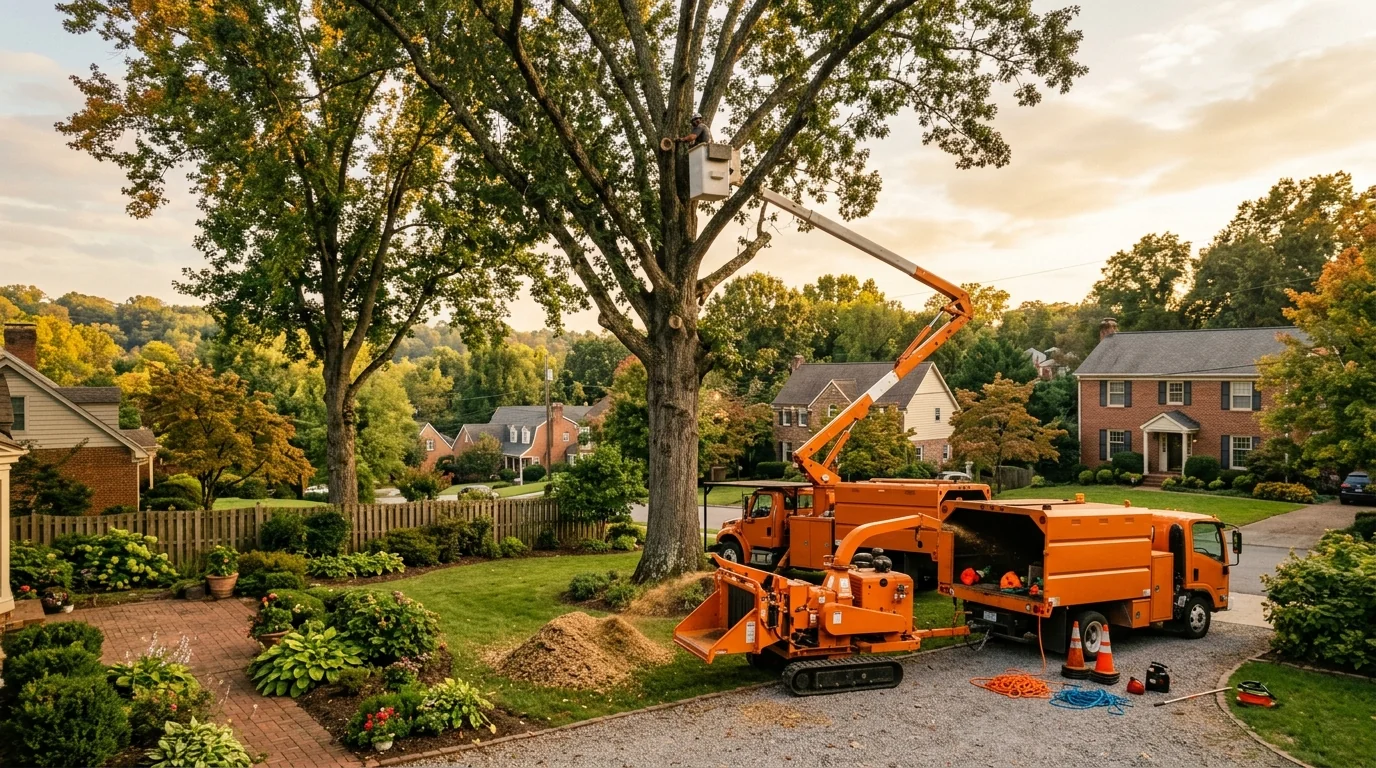
When the trunk is within striking distance of the house, the root system is compromised, or significant decay is present, removal is the appropriate call. Removing a close-proximity tree often requires rigging sections down piece by piece rather than felling the whole tree, because there is no safe drop zone. For very large trees positioned directly over a structure, crane-assisted removal keeps debris controlled and protects the roof during the process. Learn what a full tree removal service in Knoxville involves before you schedule an assessment.
Emergency removal
If a storm has already partially failed a tree leaning towards your house, or if the tree has shifted noticeably after heavy rain, the situation moves from planned removal to emergency response. Emergency crews work around active hazards and can provide documentation useful for insurance claims. The Insurance Information Institute notes that standard homeowners policies typically cover sudden, accidental damage from a fallen tree, but pre-existing hazards that the homeowner knew about may be excluded, which makes prompt response important. See how emergency tree removal in Knoxville works when time is short.
Stump grinding after removal
Once a close-proximity tree comes down, leaving the stump in place near the foundation is not a neutral choice. Decomposing stumps attract wood-boring beetles and fungi. Near the house, they can also allow roots to continue drawing moisture and interacting with foundation material as they decay. Stump grinding in Knoxville eliminates the remaining root mass to a manageable depth and removes the material most likely to cause ongoing subsidence or pest problems.
Typical cost range
Costs for close-proximity tree work vary more than open-yard work because access is constrained and more controlled rigging is required. According to Bob Vila, full tree removal generally runs from $385 to over $1,000 depending on size, with crane-assisted removals for large trees over structures adding significantly to the base cost. Crown reduction pruning is typically less than a full removal for the same tree. Stump grinding adds to the total but is generally a modest incremental cost compared to the removal itself.
For work specifically near your home, always request a written quote that itemizes rigging, haul-off, stump work, and any permit fees. This Old House also notes that complex removals in tight spaces routinely fall at the higher end of published ranges. Review the full breakdown on the Knoxville tree removal cost page before comparing bids.
What an inspection looks for
A free inspection for a tree-too-close situation focuses on specific indicators that differ from a general health check. The arborist will measure the horizontal distance from the trunk to the nearest foundation wall and the canopy overhang over the roofline. They will examine the root collar for soft tissue, mushroom fruiting bodies, or soil heaving that signals root decay below grade.
Crown inspection checks for deadwood percentage, crossing branches, and evidence of past topping or storm damage. The trunk is examined for cracks, seams, co-dominant stems with included bark (a known splitting risk), and any cavities. For trees on Knox County’s karst terrain, the soil immediately around the root zone may be probed for voids or unusual settling.
The output of the inspection should be a written recommendation that distinguishes between prune-and-monitor, scheduled removal, and immediate hazard response. If the inspector cannot provide a written summary, ask for one before authorizing any work.
When to skip removal and monitor instead
Not every tree close to a house needs to come down. A small dogwood or ornamental cherry with a healthy trunk, no decay, and a canopy that stays well above the roofline with routine trimming is a reasonable candidate for annual monitoring rather than removal. The ISA’s homeowner guidance at Trees Are Good makes the point that 64 percent of homeowners prefer to save a tree when possible, and that preference is reasonable when the risk assessment supports it.
Monitoring is appropriate when: the lean is minor and stable across two or more inspection cycles, the crown is healthy with no deadwood, the species is structurally sound, and there is enough clearance that even a partial branch failure would miss the structure. Ask your arborist to document the lean angle and any measurements so you have a baseline to compare against at the next inspection.
If you are not yet sure which category your tree falls into, the right first step is a professional assessment rather than a decision made from the yard. Request a free tree inspection quote and get a written answer based on the actual condition of the tree.