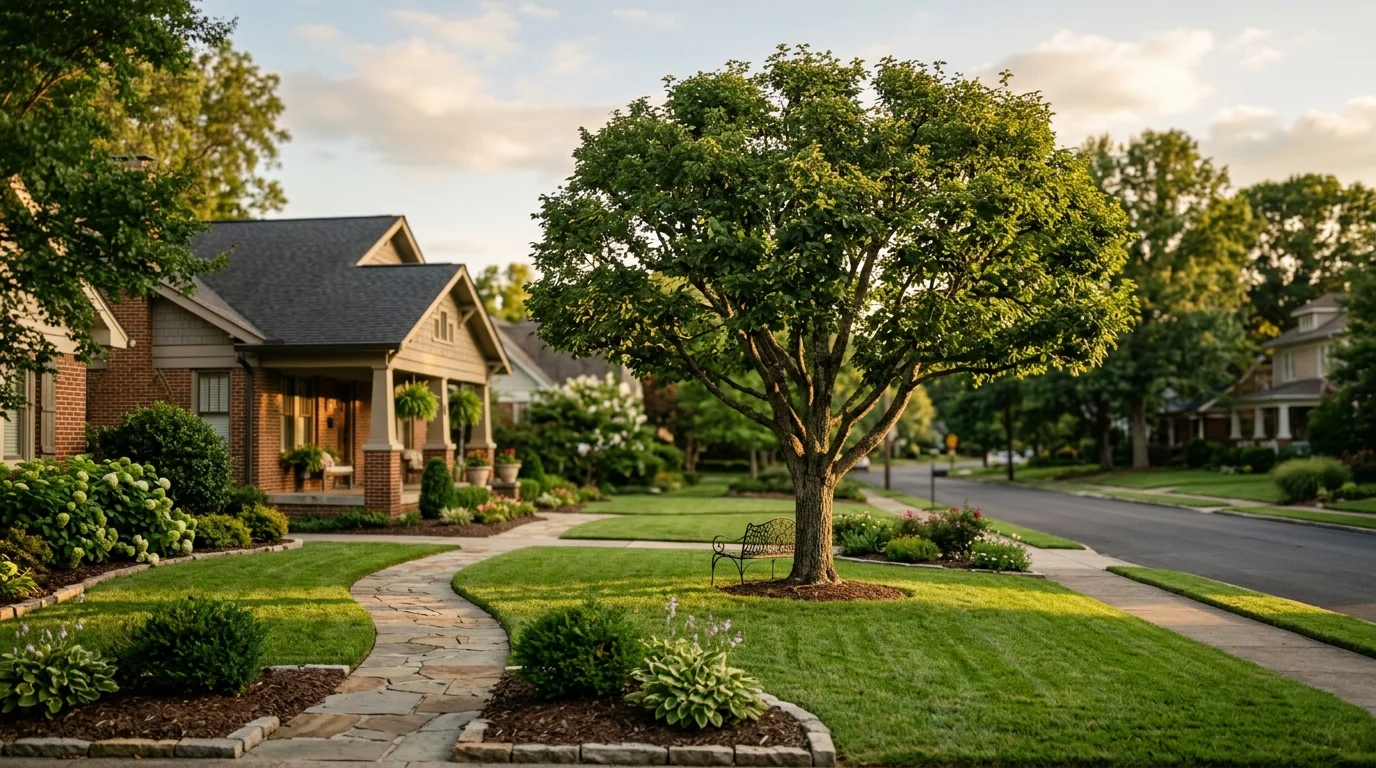
What is tree trimming and when is it the right choice?
Tree trimming is the selective removal of branches to improve a tree’s structure, reduce hazard, and keep it alive. For homeowners in Knoxville, it is often the first and best response when a tree has dead wood, limbs rubbing against a roof or power line, or a canopy that has become dangerously dense after several wet seasons. With 47.9 inches of average annual rainfall soaking Knox County’s clay-loam soils (NWS Morristown KMRX, 1991-2020 Climate Normals), trees here grow fast and vigorously, which means they also create hazards faster than in drier markets.
The goal is not simply cosmetic. A proper trim guided by the ANSI A300 Tree Care Standards removes branches in a way that the tree can compartmentalize and heal, reducing the entry points for disease and insects. That matters a great deal in a county already fighting active threats from Emerald Ash Borer, Hemlock Woolly Adelgid, and Thousand Cankers Disease.
How tree trimming works mechanically
A trained climber or bucket-truck operator makes cuts just outside the branch collar, the slightly swollen tissue where a branch meets the trunk or a larger limb. Cutting there preserves the tree’s natural wound-response chemistry. The International Society of Arboriculture describes this as a foundational principle: the tree does the healing; the arborist only makes the cut location possible. Crown cleaning removes dead, dying, or crossing limbs. Crown raising lifts the lower canopy for clearance. Crown reduction shortens a tree’s spread when it has grown too close to a structure.
The conditions tree trimming is designed for
Trimming is the right call when the tree is structurally sound at its core, and when the problem is isolated to specific branches rather than the whole organism. Common Knoxville scenarios include: ash trees in early EAB decline where the crown can be cleaned while treatment is applied; white pines that have shed lower limbs after shading themselves out; and oaks along ridge lots that have developed long, lever-arm limbs prone to splitting in ice storms. East Tennessee’s ice events, including the February 2021 freeze that caused widespread limb failures across Knox County, make structural pruning a genuine safety service rather than a luxury.
When an alternative is better
If more than roughly 50 percent of a tree’s crown is dead or dying, trimming rarely justifies the cost. A black walnut showing top-down dieback consistent with Thousand Cankers Disease, which was first confirmed in the eastern United States right here in Knox County in 2010 (Tennessee Department of Agriculture), is often a removal candidate rather than a trim candidate. When a tree is dead, leaning at a new angle after soil saturation from a storm like Hurricane Helene’s remnants in September 2024, or has significant root decay, professional tree removal in Knoxville is the more responsible path.
Installation process: how a professional trim works in Knoxville
Step 1, Pre-work site assessment (30-60 minutes)
The arborist walks the tree and property before any equipment is staged. They note overhead utilities, proximity to the house, soil softness, and existing limb failures. For Knox County’s karst terrain, this includes a quick check for visible sinkholes or soft ground near the base that could affect equipment placement.
Step 2, Equipment setup and access (30 minutes, 2 hours)
Smaller trees are typically accessed by a climber with a saddle and throw lines. Trees over 35 feet, or those overhanging structures, generally require a bucket truck or lift. Lot sizes of 0.25 to 1.0 acre are typical in Knoxville suburbs, and tight side-yard access sometimes forces hand-climbing where equipment cannot reach.
Step 3, Crown cleaning and structural cuts (1-4 hours)
The crew removes dead and dying branches first, then addresses crossing or rubbing limbs, and finally handles any clearance cuts specified in the estimate. Each cut is made at the branch collar per ANSI A300. Flush cuts, topping, and lion-tailing (stripping interior branches) are signs of sub-standard work; a reputable contractor will not perform them.
Step 4, Chipping and debris handling (30 minutes, 2 hours)
Limbs are fed through a chipper on site. Many Knoxville crews haul chips away as part of the base price; confirm this in writing before work starts, since haul-off fees are a common complaint point among homeowners.
Step 5, Final walkthrough
The crew lead walks the job with the homeowner, identifies any follow-up concerns such as cavities or additional dead wood found during the climb, and provides recommendations in writing if further work is needed.
Total time for a single residential tree in the 30-60 foot range runs two to six hours under normal access conditions.
Tree trimming vs. tree removal
The choice between trimming and removal comes down to the tree’s core viability. Trimming is worth the investment when a tree has healthy vascular tissue, a stable root system, and a problem that is confined to specific branches. Removal becomes the answer when the defect is in the trunk, the roots, or when disease or insect pressure has crossed a threshold where the tree cannot recover.
Bradford pears are a common Knoxville example where trimming has limits. Their weak branch attachment angles mean that structural pruning can slow decline, but many arborists will tell homeowners honestly that the species is inherently prone to catastrophic splitting regardless of maintenance history. At some point, scheduling a full tree removal makes more financial sense than repeated trimming cycles on a tree that is likely to fail in the next major storm.
By contrast, a mature white oak with 20 percent dead wood scattered through the crown is an excellent trimming candidate. Oaks provide significant property value, canopy cover, and wildlife habitat. Removing healthy oak over minor dead wood is an overcorrection that most ISA-certified arborists will push back on.
The cost difference is also meaningful. Trimming typically costs less per visit than removal, but removal is a one-time expense. A tree that needs professional attention every two years may, over a decade, cost more than removal and replanting would have.
Tree trimming cost in Knoxville, TN
According to Bob Vila’s cost research, tree trimming nationally runs roughly $200 to $760 for most residential trees, with costs rising sharply for very large specimens or difficult access situations. For Knoxville specifically, several local variables move that number.
Tree height. Taller trees require more time, more rope or bucket-truck hours, and carry higher risk. A 25-foot ornamental pear costs far less than a 70-foot white oak on a ridge lot.
Access. Knox County’s residential lots often have narrow side yards, steep terrain, or fencing that prevents equipment from reaching the target tree. Hand-climbing adds labor time. Saturated clay soils after heavy rain can prevent a bucket truck from approaching without damaging the yard.
Number of trees. Crews typically offer a per-additional-tree discount when multiple trees are trimmed in a single visit, since mobilization costs are shared.
Species and condition. Dead wood is heavier and more unpredictable to direct. Ash trees with EAB damage, hemlock with HWA pressure, or any tree with significant internal decay requires more time and more caution, which adds to the total.
Debris disposal. Confirm whether haul-off is included. For comparable regional cost data on full removal, see the tree trimming and removal cost guide for Knoxville.
Warranty and transferability
No legitimate contractor can warranty a living tree’s health. What a strong workmanship warranty covers is the quality of the cuts: that they were made at the correct location, that no flush cuts or topping occurred, and that the crew did not introduce tools carrying disease from a previous job without cleaning them first (a real concern with Thousand Cankers Disease and other fungal pathogens present in Knox County).
One-year workmanship warranties are the industry standard for pruning services. Ask for the warranty in writing before work begins. If a contractor claims to guarantee the tree will not fail, that claim is not credible and should be a red flag.
For homeowners planning to sell, ask whether the contractor’s warranty is transferable to a new owner. Some are; most are not. The documentation of the work, including the arborist’s written assessment and the cut record, has more practical value to a future buyer than a warranty that may not survive the property transfer.
Permits and engineering for tree trimming in Knox County
Routine pruning on private residential property does not typically require a permit in the City of Knoxville or Knox County. The City of Knoxville’s Development Services division handles tree-related inquiries for properties inside city limits; Knox County Zoning handles unincorporated areas.
Permits do become relevant in specific situations. Work on or near the public right-of-way, including street trees, requires coordination with the City of Knoxville Urban Forestry program. Any work touching a tree designated as a Heritage Tree under local ordinance requires advance approval. HOA-governed neighborhoods, which cover roughly 45 percent of Southeast suburban homes, may require written HOA approval before any visible tree work proceeds.
For properties near documented karst features or sinkholes, equipment staging should be discussed with the contractor before work begins. Heavy bucket trucks on soft or karst-underlain ground carry a non-trivial risk of equipment incidents that could damage the yard or, in rare cases, the ground structure beneath it.
If a tree has grown into utility lines, contact KUB (Knoxville Utilities Board) before scheduling any trimming. Utility line clearance work must be performed by line-qualified crews, not standard tree trimming crews, and KUB may handle right-of-way trimming at no charge depending on the situation.
The USDA Forest Service’s urban and community forestry program notes that trees in urban environments provide measurable stormwater, air quality, and property-value benefits, which is one reason municipal programs protect certain trees through permit requirements even on private land.
For homeowners dealing with a tree problem that might go beyond trimming, reviewing what tree problems Knoxville properties face by symptom can help clarify whether trimming or a more involved service is the right starting point. When the scope is unclear, the fastest path to an accurate answer is to request a written estimate from a qualified Knoxville crew.
The Knoxville service area page has additional detail on response times, crews serving specific ZIP codes, and what to expect from a first visit across Knox County.