What this symptom looks like (and when to act)
An overhanging branch hazard is any limb that extends over a structure, vehicle, driveway, fence, or utility line and carries a realistic chance of failing under load. The word “overhang” does the heavy lifting here: the danger is not that the branch exists, but that it is positioned so that a failure drops weight onto something you care about.
What it looks like exactly
Look for branches that cross the drip line of a roof or park directly above a vehicle. Watch for cracks at the attachment point where the limb meets the trunk, bark inclusion (a seam of bark wedged into the crotch rather than a clean collar of wood), deadwood along the limb, or a noticeable downward sag that was not there a year ago. Diameter matters: a dead branch of two inches is an annoyance; a live branch of ten inches hanging over a bedroom is a structural event waiting to happen. Fungal conks or shelf mushrooms on the limb or near its base are a firm signal that internal wood decay is reducing the branch’s load-bearing capacity.
When to monitor vs. when to act now
Monitor when the branch is less than four inches in diameter, shows no cracks or deadwood, and does not hang directly over a structure or walkway. A healthy limb of modest size that grazes a gutter may need pruning but is not an emergency.
Act now when any of the following apply: the branch has visible cracks at the union, it is dead or dying, it contacts or is within ten feet of a power line, it exceeds six inches in diameter, or it hangs over a roof, car, or area where people walk. The same urgency applies any time a storm forecast is within 48 hours and the branch has not been assessed. Knoxville’s spring severe-weather window (March through May) and its recurring winter ice events make pre-season action the standard, not the exception.
What NOT to do
Do not attempt to cut any limb over six inches in diameter, over a roofline, or near a utility line with a chainsaw from a ladder. The branch does not fall in a straight line, and the consequences of a miscalculated drop are severe. Do not use rope or cable to “tie back” a failing limb as a substitute for removal: it shifts load without eliminating it and can fail suddenly. Do not ignore a branch simply because it has not fallen in previous storms. Wood decay is cumulative, and a branch that survived last winter with 30% internal decay may fail this winter at 60%.
What causes it in Knoxville, TN
Several factors specific to the Knoxville metro push overhanging-branch hazards above the national baseline.
Knox County’s urban tree canopy is dense. Neighborhoods like Sequoyah Hills, Holston Hills, and the older suburbs of West Knoxville are lined with mature white oaks, red oaks, and silver maples that were planted close to structures decades ago or were simply never cleared during subdivision development. As those trees matured, their canopies expanded over rooflines and driveways in ways the original planting did not anticipate.
Storm patterns amplify the risk. Knoxville sits in the Tennessee Valley, and the Valley-and-Ridge terrain that protects Knox County from the worst tornado formation also funnels wind through valley corridors in ways that load canopy unevenly. The NOAA Storm Events Database records repeated high-wind events across Knox County each spring. Then there is ice. East Tennessee’s elevation and its position relative to the Cumberland Plateau make freezing-rain events a recurring winter hazard. The February 2021 ice storm is well-documented locally: heavy ice loading snapped limbs from hardwoods and white pines across the county that had shown no prior warning signs, because ice multiplies branch weight faster than most homeowners realize.
Disease compounds the structural problem. Knoxville holds the unfortunate distinction of being the site of the first eastern United States detection of Thousand Cankers Disease, confirmed in Knox County in 2010 (Tennessee Department of Agriculture, TCD Quarantine). Black walnut trees already weakened by that disease are among the most common overhang hazards in older Knoxville yards. Emerald Ash Borer, confirmed in Knox County, is killing native ash trees throughout the metro; ash that dies in place becomes brittle within a season and sheds large limbs with little warning (Tennessee Department of Agriculture, EAB Pest Alert). Eastern hemlocks affected by Hemlock Woolly Adelgid, widespread across East Tennessee (USDA Forest Service), become skeletal and shed structural limbs as the tree declines.
Finally, Bradford pears planted throughout 1980s and 1990s Knoxville subdivisions are reaching the age at which their notoriously weak branch unions fail. A Bradford pear in full leaf is particularly prone to catastrophic splitting during summer thunderstorms, often with no visible prior warning.
Repair methods that address it
Four service approaches address overhanging-branch hazards, and the right choice depends on the branch, the tree, and the underlying cause.
Crown reduction pruning removes or shortens the branches creating the overhang while preserving the tree’s overall structure and health. This is the preferred method when the tree itself is healthy and the problem is simply that it has grown beyond its safe footprint relative to nearby structures. A trained crew follows ANSI A300 pruning standards to make cuts that promote compartmentalization rather than leaving stubs that decay inward. For oaks, maples, and pines in otherwise good condition, crown reduction pruning is the most cost-effective long-term solution.
Canopy thinning reduces the total leaf and branch density of the crown, which lowers wind resistance and reduces the sail effect that causes otherwise sound branches to fail in high-wind events. This is often combined with hazard-limb removal in a single visit. Canopy thinning is particularly useful for Knoxville’s mature oaks before spring storm season.
Hazard tree removal becomes the appropriate method when the tree itself is the problem rather than a single branch. A diseased or structurally compromised tree that overhangs a structure cannot be made safe by pruning alone. Ash trees killed by Emerald Ash Borer, black walnuts in late-stage Thousand Cankers decline, and Bradford pears with split unions are frequent candidates for full removal in Knox County. Hazard tree removal eliminates the source rather than managing symptoms.
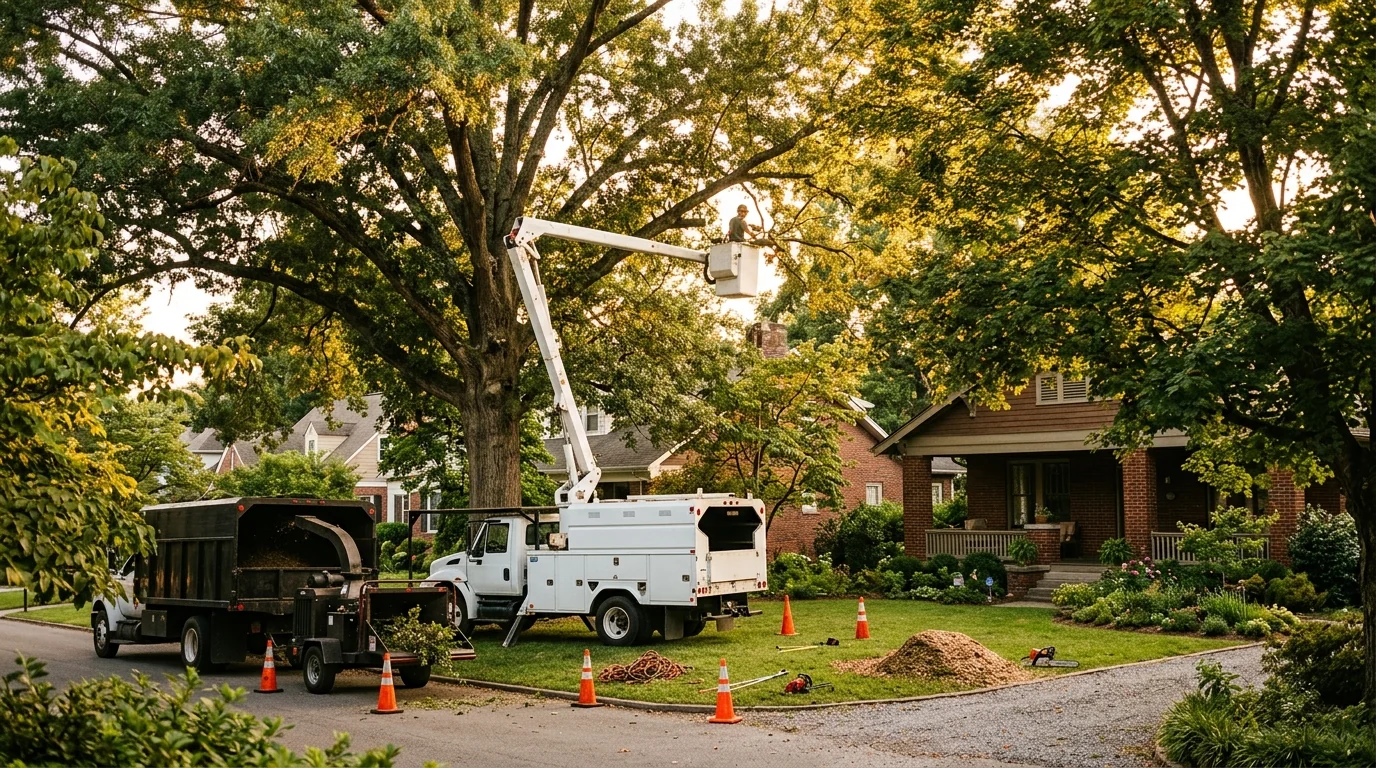
Emergency tree service is the appropriate response when a branch has already partially failed, is resting on a roof or power line, or when a storm is imminent and the branch has not been addressed. Emergency tree service involves rigging and controlled lowering rather than simple cutting, because the branch’s position above a structure means a free fall is not an option.
Typical cost range
Costs for branch and crown work vary by tree size, branch diameter, height, proximity to structures, and whether debris haul-off is included. According to Bob Vila’s tree removal cost guide (bobvila.com), professional tree trimming and pruning nationally ranges from roughly $200 to $760 for smaller trees, with larger trees and hazard situations carrying substantially higher costs. Emergency work, particularly involving a crane or rigging over a structure, adds a significant premium above routine pruning rates.
For the full breakdown of what drives pricing in the Knoxville market, including size-based ranges for removal and pruning, see the Knoxville tree removal cost guide. If you are ready to get a specific number for your situation, the fastest path is a free quote.
Inspection process
A professional inspection for overhanging-branch hazards follows a systematic pattern. The arborist begins with a ground-level visual assessment of the branch itself: checking the attachment point for included bark, looking for cracks, measuring approximate diameter, and noting whether any deadwood is present. Binoculars are standard for upper-canopy assessment before any climbing occurs.
Next comes the trunk evaluation directly below the overhanging limb. Fungal fruiting bodies, soft wood, seams, or cavities at the base of the attachment reduce the structural rating of the branch even if the limb itself looks sound. Mallet tapping can reveal hollow sections audibly.
The arborist then documents the target zone: exactly what is below the branch, how far the drop zone extends, and whether rigging points exist that would allow a controlled lowering rather than a freefall cut. For branches near power lines, this assessment includes whether utility coordination is required before work can begin.
Finally, a written assessment should note the branch’s current risk level, the recommended method, and whether the parent tree warrants a broader health evaluation. The International Society of Arboriculture (treesaregood.org) publishes guidance on what a homeowner should expect from a professional tree hazard assessment, including the credentials to look for in the arborist conducting it.
When to skip repair (or wait)
Not every overhanging branch requires immediate action. A healthy limb of modest diameter that extends slightly past a fence line but does not position itself over any structure, vehicle, or walkway may be a “monitor” situation rather than an emergency. If the tree is young and still in active growth, a single pruning visit now may need to be repeated in three to five years, and waiting until the branch reaches a size worth the setup cost is a legitimate choice.
Similarly, if a branch is over the property line on a neighbor’s tree but is not yet creating a measurable hazard, documenting its condition in writing and communicating with the neighbor is often the right first step before calling a crew.
The situations where waiting is the wrong call: any branch over a sleeping area, any dead limb regardless of size or position, any branch showing bark inclusion on a tree known to be species-prone to splitting (Bradford pear, silver maple), and any limb within ten feet of a power line. Those do not get a monitoring period. The tree problems resource hub covers additional warning signs that indicate a tree or branch has moved from a “watch” category into one that warrants a service call.