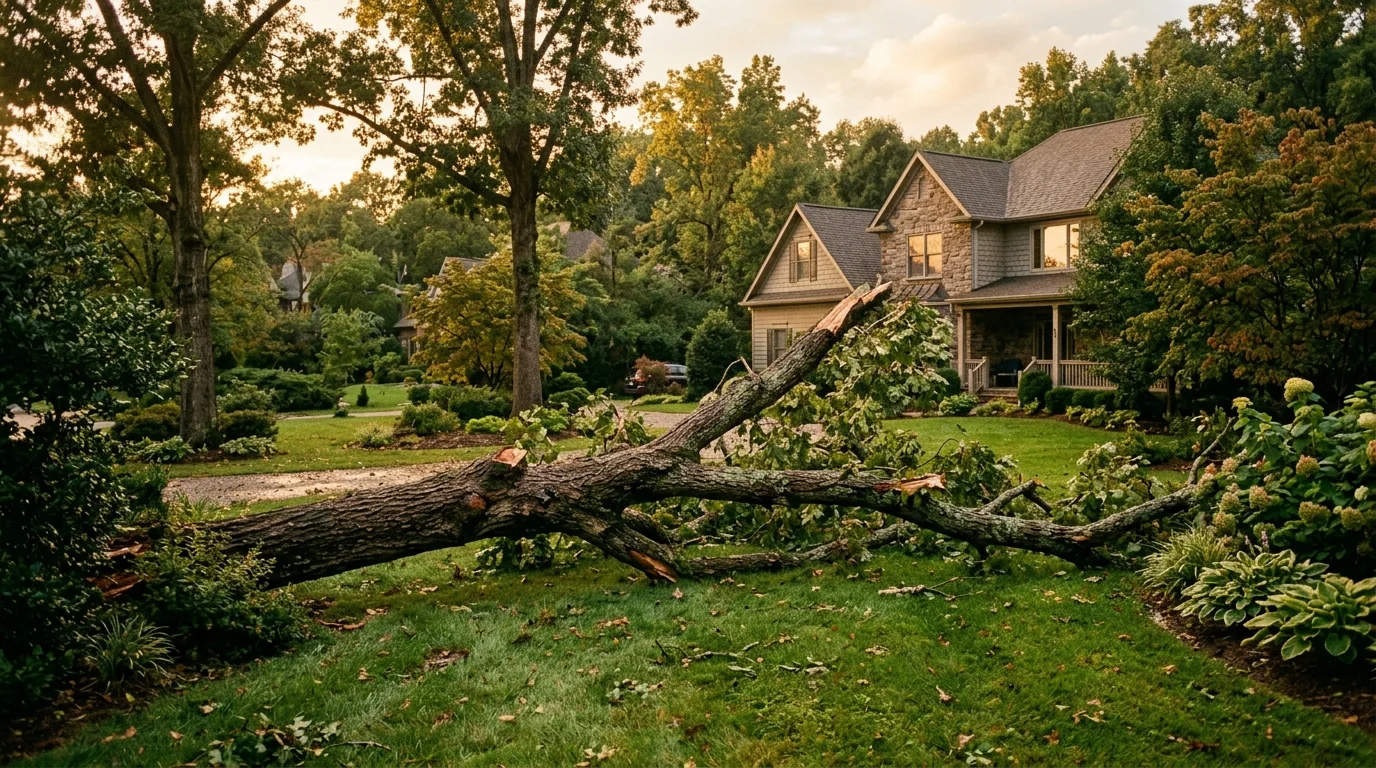
What a Storm-Damaged Tree Looks Like (and When to Act)
A storm-damaged tree is not always a tree on the ground. Sometimes the damage is a fresh crack running halfway through the trunk, a main limb hanging by a strip of bark, or a root system that has partially heaved out of the soil. Each of those conditions is an active hazard. Knowing how to read the signs, and how fast to act, determines whether the situation stays manageable or becomes catastrophic.
What it looks like exactly
The most obvious cases are trees that have fallen onto a structure, vehicle, or fence. More dangerous are the partially failed trees: a trunk split partway through at a major branch union, limbs suspended in the canopy by other branches (called “widow makers”), a trunk that has developed a new lean since the storm, or soil that has cracked and bulged in a circle around the base of the tree. Crown damage ranging from minor limb loss to 50 percent or more of the canopy can also indicate structural compromise that is not visible from the ground.
When to monitor versus when to act now
Monitor if: a small limb (under 2 inches in diameter) broke cleanly from a healthy tree with no wound to the main trunk, the tree shows no new lean, and the damage poses no direct path to a structure or traffic area.
Act now if: any of the following are present: a new lean that was not there before the storm, a visible trunk split or crack, soil heaving at the base, roots pulled from the ground on one side, bark torn from the trunk in long strips, or any part of the tree touching a power line. Knoxville’s high-clay soils become nearly fluid after heavy rainfall, which means root anchorage can fail silently. After significant rain events like the remnants of Hurricane Helene in September 2024, saturated soil made tree failures occur days after the storm had passed.
What NOT to do
Do not attempt to cut a hanging limb from a ladder. The tension stored in a partially broken limb can release violently when cut, and the outcome is unpredictable. Do not ignore a tree because it is still standing. Do not assume that because a tree “looks fine” from the street it is structurally sound. And do not let a contractor remove a tree before you have documented the damage with photographs for your insurance adjuster.
What Causes Storm Tree Damage in Knoxville, TN
Knoxville sits in the Valley and Ridge physiographic province, a landscape of parallel ridges and valleys running northeast-to-southwest. While this terrain provides some protection from tornado formation compared with the open plains of Dixie Alley, it does not shelter the area from straight-line wind events, microbursts, and ice loading, all of which cause tree failure in distinct ways.
Spring storms from March through May bring the highest tornado risk Knox County faces, with the NWS Storm Prediction Center archive showing one to three tornado events per year. Summer thunderstorms deliver sudden wind shear that snaps trunks rather than uprooting trees. Tropical remnants, including Hurricane Helene in 2024, have proven capable of catastrophic damage across East Tennessee through sustained wind combined with saturated soils.
Winter ice events may be the most underestimated hazard. East Tennessee’s elevation and geography make freezing rain a recurring threat. The February 2021 ice storm caused widespread limb breakage across Knox County’s hardwoods and white pines. Ice adds weight that compound-bends limbs past their breaking point, and because ice storms happen overnight, homeowners often discover the full extent of damage at first light.
Knox County’s primary soils are residual clay and silty clay from weathered limestone and shale, soils with moderate-to-high shrink-swell potential (USDA Web Soil Survey, Knox County). When these soils are saturated, the frictional resistance holding tree roots in place drops sharply. A tree with a compromised root system from prior drought stress, mechanical damage from construction, or disease pressure becomes a toppling risk after any significant rain. Ash trees already weakened by Emerald Ash Borer (confirmed in Knox County by the Tennessee Department of Agriculture) and black walnuts affected by Thousand Cankers Disease are especially prone to storm failure because internal wood decay precedes any visible external symptom.
Knoxville’s urban and suburban tree canopy includes a high proportion of Bradford pears, a species notorious for splitting at branch unions due to narrow attachment angles and brittle wood. These trees can fail even in moderate wind events with no prior warning.
Repair Methods That Address Storm Damage
Not every storm-damaged tree needs to come down. The right response depends on species, age, the location of the damage, and what the tree is near. A qualified arborist evaluating a Knoxville property after a storm will typically consider the following options.
Emergency tree removal is appropriate when a tree poses an immediate risk to a structure, person, or utility line, or when structural damage is severe enough that saving the tree is not viable. This includes trees with split trunks below the major branch unions, trees with more than half the root plate lifted, and trees that are actively resting on a roof or vehicle. Emergency tree removal in Knoxville requires specialized equipment, often including bucket trucks and cranes for over-structure work, and should be performed only by crews with liability insurance and documented training. OSHA standards for tree care work classify over-structure removal as a high-hazard operation (OSHA Tree Care Industry Standards).
Crown restoration pruning addresses trees where the trunk and major scaffold branches remain intact but limbs have broken, bark has stripped, or the canopy is unbalanced. Proper pruning removes the damaged material at the correct cut location to encourage compartmentalization and new growth. This work should follow ANSI A300 standards, the industry benchmark for tree care practice maintained by the Tree Care Industry Association. Professional tree pruning in Knoxville after storm events is fundamentally different from routine trimming. It requires assessing wound response capacity and predicting how the tree will respond structurally over the next several seasons.
Cabling and bracing is an option for trees with included bark at a major branch union or a split that has not fully separated. Steel cables or high-strength synthetic systems installed by a certified arborist can redistribute load and reduce movement at a weak point, extending the functional life of a tree that would otherwise need removal. Cabling and bracing is a supplemental measure, not a substitute for removing a tree that is fundamentally compromised. The ISA provides guidance on when supplemental support systems are appropriate through its tree owner resources at Trees Are Good.
Stump grinding is the final step after any removal. Leaving a stump creates a tripping hazard, can harbor fungal pathogens that spread to nearby healthy trees, and in Knoxville’s clay soils can continue to produce root suckers for years. Stump grinding after storm removal is usually scheduled immediately following the removal and is often bundled into the same job.
Typical Cost Range
Storm removal is priced at a premium over standard removal because of hazard complexity, after-hours response, and the equipment demands of working around damaged structures. According to Bob Vila’s tree removal cost guide, standard tree removal runs roughly $385 to over $1,000 for most residential trees, with emergency work commonly running 25 to 50 percent above standard rates. Crane-assisted removal, often required when a tree has fallen onto or is leaning against a roof, falls at the higher end of the pricing spectrum. Stump grinding typically adds a separate line item.
For a full breakdown of what drives cost in the Knoxville market, including size, species, and access factors, see the Knoxville tree removal cost guide.
If your tree damaged a covered structure, your homeowners insurance policy may cover some or all of the removal cost. The Insurance Information Institute notes that most standard policies cover removal when a tree damages an insured structure, but not when the tree fell in an open yard without causing structural damage. Document everything before work begins and ask your tree service for an itemized written estimate formatted for an adjuster.
What an Inspection Covers for Storm Damage
A professional post-storm inspection in Knoxville covers more than what is visible from the ground. An ISA-certified arborist will evaluate:
- Root zone disturbance. Soil heaving, cracks radiating from the base, or one-sided soil mounding indicate partial root failure.
- Trunk integrity. Sound testing (tapping the trunk and listening for hollow resonance) and visual assessment of cracks, included bark, and wound size relative to trunk diameter.
- Crown assessment. Percentage of crown lost, location of remaining live wood, and whether the remaining structure is mechanically stable.
- Wound evaluation. Whether bark-stripped wounds are within the tree’s likely capacity to compartmentalize, which varies by species and tree age.
- Hang points. Identification of any limbs suspended in the canopy that are not visible from ground level but would be released by wind or additional rain.
The inspection should produce a written report you can share with your insurance adjuster. You can verify an arborist’s ISA certification at Trees Are Good’s Find an Arborist tool before scheduling.
Request a free storm damage inspection in Knoxville to get a written assessment from a certified crew.
When to Skip Removal (or Wait)
Not every storm-damaged tree is a removal job. A tree that lost a small limb cleanly, shows no wound larger than one-third of the trunk’s diameter, has a fully intact root plate, and poses no risk to structures or foot traffic may only need pruning and monitoring. Trees with minor bark scarring from lightning that struck a limb rather than the main trunk sometimes recover fully with proper wound care.
Wait on removal if: the tree’s overall crown is more than 50 percent intact, the root zone shows no visible disturbance, and an arborist confirms that the wound is within the tree’s compartmentalization capacity for its species and age. Schedule a follow-up inspection three to four months after the storm to verify that the tree is responding to damage as expected.
Monitoring is the appropriate response for trees on the margin. Document the wound size, take photographs at regular intervals, and note any changes in foliage color, canopy density, or new lean. If the tree is a species with known vulnerability in Knoxville, such as an ash showing Emerald Ash Borer symptoms or a black walnut in an area with Thousand Cankers Disease pressure, factor that into the decision. Trees already in structural decline from disease or pest damage fail faster and more unpredictably after storm stress.
For trees on the tree problems overview that combine storm damage with an underlying health condition, removal is usually the right answer sooner rather than later.