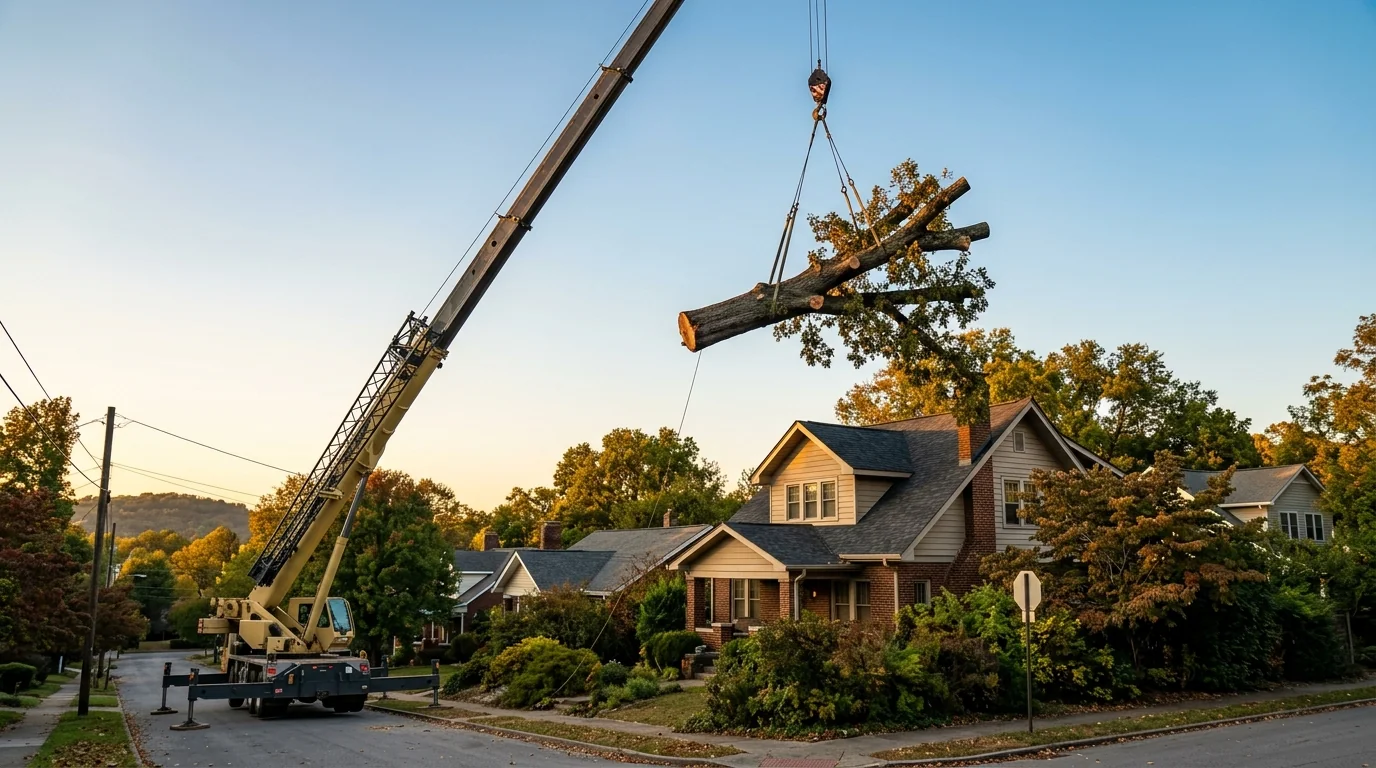
Crane-Assisted Tree Removal Cost in Knoxville TN
Crane-assisted tree removal in Knoxville costs more than standard removal because a crane adds mobilization fees and specialized labor on top of the base job. National figures from Bob Vila put total removal in the $200 to $2,000 range, with crane work pushing complex jobs well above that ceiling. Knoxville lots, soil conditions, and storm exposure all shape the final number.
Updated Jul 11, 2025 · 9 min read
What Crane-Assisted Tree Removal Actually Costs in Knoxville, TN
Crane-assisted tree removal is the method crews reach for when a tree cannot be climbed, when the fall zone points straight at a roofline, or when a storm has left a massive trunk leaning in an impossible direction. It is also the line item that surprises homeowners the most when the invoice arrives.
Bob Vila’s tree removal cost guide puts the national average for tree removal at $871, with a typical range of $200 to $2,000. Crane-assisted jobs sit at the upper end and often exceed it. Complex removals involving large trees near structures can reach $5,000 or higher once crane rental, a specialized rigging crew, and debris hauling are all on the same invoice.
Knoxville adds its own cost pressures. The city’s Valley-and-Ridge terrain means many residential lots have slopes, narrow drives, or soft residual clay soils that complicate crane placement. A crane that would park easily on a flat Nashville suburban lot may require ground protection mats, a smaller-tonnage unit, or a longer boom to clear a ridgeline in West Hills or Sequoyah Hills. Each of those adjustments costs money. Knoxville’s heavy urban canopy, fed by 47.9 inches of annual rainfall (NWS Morristown KMRX, 1991-2020 Climate Normals), also means trees grow large before homeowners realize removal is warranted.
For a localized range relevant to the Knoxville market, plan on $1,500 to $5,000 for a crane-assisted removal of a mature oak or white pine near a structure, with larger or more complex jobs going higher. Get a free Knoxville tree removal quote before assuming any figure in this guide applies to your specific tree.
What Drives the Cost of Crane-Assisted Removal
Several variables move the number significantly, and understanding them helps you read a quote rather than just react to the total.
Tree size. Taller trees require a larger crane with a longer boom. Larger cranes cost more to rent and to transport. A 60-foot oak and a 100-foot white pine are not remotely the same job even if they are growing in adjacent yards. Bob Vila notes that tree height is one of the primary drivers of removal cost across all methods.
Crane mobilization and rental. The crane itself is a separate line item from the climbing and cutting crew. Crane rental in the Southeast typically runs $300 to $600 per half-day, plus a mobilization charge for transport from the rental yard to your property. If the nearest crane capable of handling your job is in Maryville or Oak Ridge rather than a few miles away, that transport cost shows up in your quote.
Crew size and rigging complexity. Crane work requires a crane operator, a qualified rigging crew to attach sections of the tree, and ground workers to move and chip debris. A minimum crew of four to five people is common. More complex jobs add a climber who stays in the tree to cut sections while the crane holds them. Each additional crew member adds to the hourly labor cost.
Site access and ground conditions. Knox County’s karst limestone geology and clay soils mean many Knoxville yards cannot support a full-size crane without ground protection. Mats or timber cribbing protect lawns and prevent crane legs from sinking, and they add $200 to $500 to the job. A narrow driveway or a gate that requires the crane to set up in the street triggers a right-of-way permit and may require a traffic control plan.
Tree condition. A dead or storm-damaged tree is more unpredictable to cut. Brittle wood, unexpected cavities, or root failure risk all raise the hazard level and the price. Knoxville’s Emerald Ash Borer epidemic (confirmed Knox County, Tennessee Department of Agriculture) has left many ash trees in advanced decay that complicates removal logistics significantly.
Debris volume and haul-off. A large crane job produces an enormous volume of wood and brush. Some companies include haul-off in the base quote; others charge by the load. Clarify this in writing before signing anything.
Stump grinding. Crane removal addresses the trunk and canopy but leaves the stump. Adding stump grinding to the scope typically costs $150 to $450 depending on stump diameter. You can review stump-specific pricing on the Knoxville stump removal cost page.
Cost by Tree Type and Problem Severity
Large Canopy Trees Near Structures
This is the most common crane scenario in Knoxville. A mature white oak or willow oak growing within 10 to 15 feet of a roofline cannot be felled without crane control of each cut section. Expect $2,000 to $5,000 for a tree in this category, with the higher end applying to trees over 80 feet or trees positioned over multiple structures.
Storm-Damaged or Leaning Trees
Hurricane Helene’s remnants in September 2024 caused widespread wind and saturation-driven tree failures across Knox County, leaving many trees leaning at angles that made standard climbing dangerous. A partially uprooted tree or a trunk split mid-canopy is a more complex crane job than a standing healthy tree because the weight distribution is unpredictable. These jobs often carry a hazard premium of 25 to 50 percent above a comparable standing-tree removal.
Dead Trees with Decay
Knox County’s Thousand Cankers Disease outbreak (first confirmed in the eastern United States in Knoxville in 2010, per the Tennessee Department of Agriculture) has produced a significant population of dead and dying black walnut trees. Hemlock Woolly Adelgid has similarly killed hemlocks throughout East Tennessee. Dead wood is brittle and sheds limbs without warning during cutting, which requires slower, more controlled crane work. Budget toward the upper end of any range for confirmed dead trees.
Multi-Tree Projects
If you have several large trees needing removal at once, you may be able to negotiate crane-day pricing rather than per-tree pricing. The crane is already mobilized and on-site; the marginal cost of an additional tree is lower than the first. This is worth discussing directly with the crew before they schedule the job.
Insurance and Financing
Homeowners insurance is the first funding source many Knoxville homeowners reach for after a storm takes down a large tree, but coverage is narrower than most people expect. The Insurance Information Institute explains that if a tree falls and damages a covered structure, your dwelling coverage typically pays for both the structure repair and a portion of removal costs, subject to your deductible. If the tree falls in the yard without hitting anything, most standard policies treat removal as a maintenance expense and do not pay.
Crane-assisted removal is expensive enough that out-of-pocket costs can be significant even with a partial insurance payment. A few financing paths are worth knowing.
A home equity line of credit (HELOC) lets you borrow against your home’s equity at a variable rate. The Consumer Financial Protection Bureau notes that a HELOC gives you flexible access to funds as needed, which suits a staged project where you might remove trees over more than one season. The tradeoff is that your home secures the line, and rates fluctuate with the market.
Contractor financing is offered by some larger Knoxville tree services, typically through a third-party lender. Rates and terms vary widely. Compare the APR carefully before choosing contractor financing over a HELOC if you have sufficient home equity.
Payment plans direct from the company (not a third-party lender) are less common for crane jobs given the equipment costs involved, but they are worth asking about, especially for non-emergency projects where the company has scheduling flexibility.
Permits and Engineering
Crane-assisted removal does not by itself require a separate building permit in most Knox County jurisdictions, but the tree removal may require one depending on tree size and location. Knox County and the City of Knoxville maintain separate ordinances. Check with Knox County Code Enforcement or the City of Knoxville’s Development Services before scheduling work on trees near property lines or in easements.
A crane parked on a public street does require a right-of-way permit from the City of Knoxville. Reputable companies pull this permit before mobilizing. If a contractor does not mention this step and the tree is close to the street, ask explicitly.
Engineering letters are not standard for residential crane tree removal the way they are for structural foundation work, but they occasionally come into play when a property owner needs documentation for an insurance claim or when a tree’s root system is close to a foundation or utility line. If your adjuster or lender requests a written assessment, an ISA Certified Arborist can provide one. Finding a credentialed arborist in the Knoxville area is straightforward through the ISA’s arborist search tool.
OSHA standards apply to all tree care work performed by commercial crews. OSHA’s tree care standards set minimum requirements for personal protective equipment, hazard communication, and equipment operation. A company that cannot name its safety program or that skips a pre-job site walk is not one you want operating a crane over your house.
Getting an Accurate Quote
A written, itemized quote is the minimum acceptable standard for any crane-assisted job. The quote should list the crane rental and mobilization fee as separate line items from labor, stump grinding (if included), debris haul-off, and any permit fees. If a contractor gives you a single total with no breakdown, you have no way to compare it against other bids or verify what is included.
Watch for these patterns in quotes that signal problems. A verbal-only estimate for a job that will cost $2,000 or more should be declined. A quote that pressures you with “today only” pricing is a red flag in any service industry, and crane tree removal is no exception. A contractor who dismisses the need for a site walk before quoting has not actually priced your job; they have guessed.
A legitimate inspection includes walking the property to assess crane access routes, measuring or estimating tree height and diameter, checking for utility lines within the drop zone, and confirming ground conditions. The crew should be able to tell you the crane size they plan to use and why.
For context on what full-scope tree removal costs with and without crane assistance, the Knoxville tree removal cost overview breaks down pricing by tree size and condition. If you are not certain a crane is necessary, reviewing tree problem diagnosis resources first can help you understand what the crew should be assessing before they recommend any removal method.
When you are ready for a site assessment, request a written Knoxville tree removal quote from a crew that will walk your property before putting a number on paper.
Free written estimate
Worried about a tree? Get a free estimate.
On-site assessment and a written estimate. Same-day for emergencies. No obligation.
Questions
Crane-Assisted Tree Removal Cost in Knoxville TN FAQs
How much does crane-assisted tree removal cost compared with standard removal?
Does homeowners insurance cover crane-assisted tree removal in Knoxville?
When is a crane actually necessary for tree removal?
How long does crane-assisted removal take in a typical Knoxville yard?
Can a crane access my Knoxville property if the yard is narrow or on a slope?
Is a permit required for crane-assisted tree removal in Knox County?
What credentials should a Knoxville crane tree removal crew hold?
Free estimate
Talk to a Knoxville tree pro
On-site assessment and a written estimate, often same day. No obligation.