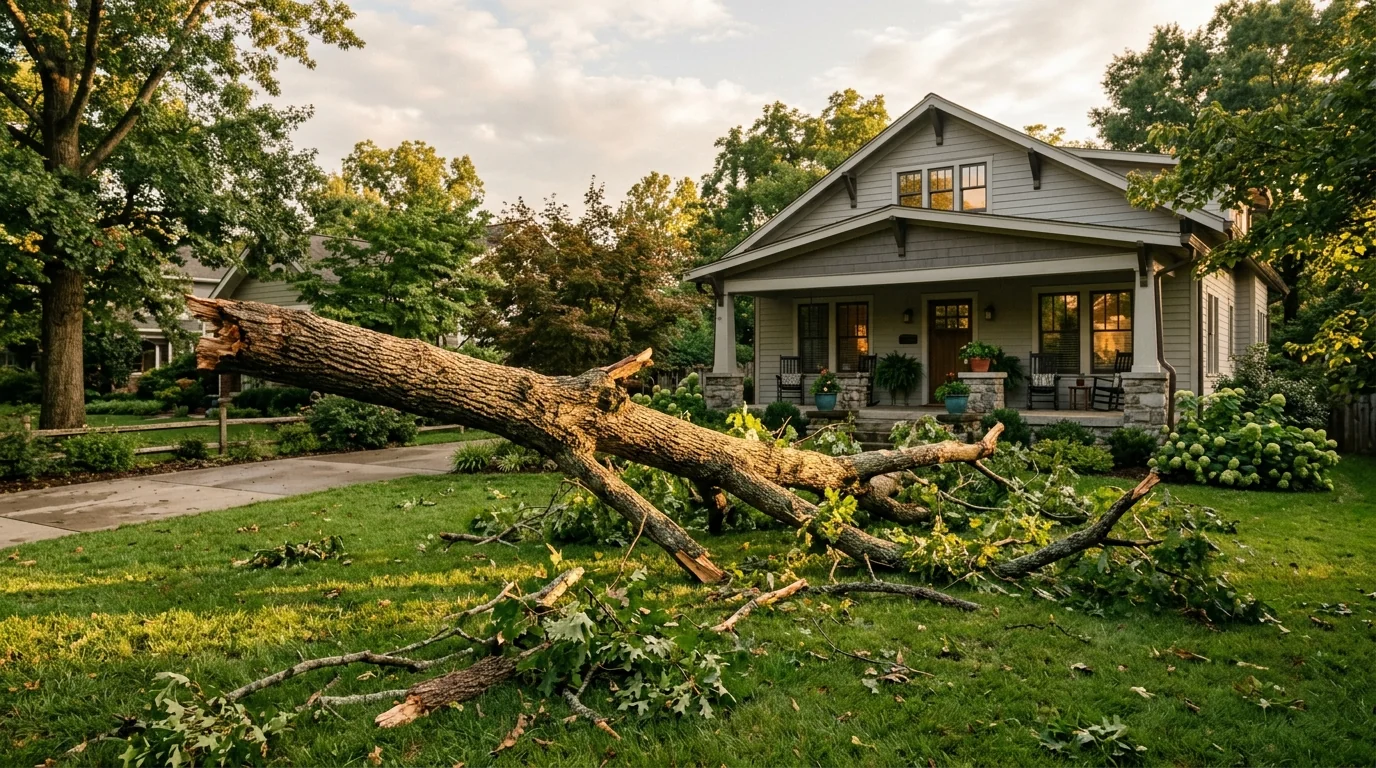
Dead Tree Removal: What Knoxville Homeowners Need to Know
A dead tree is not just an eyesore. It is a liability that compounds with every rain event, every ice storm, and every summer thunderstorm that rolls through the Tennessee Valley. In Knox County, where annual rainfall averages 47.9 inches (NWS Morristown KMRX, 1991-2020 Climate Normals) and active insect infestations are killing thousands of trees right now, a standing dead tree can go from inconvenience to catastrophe in a single season.
This page explains what a dead tree looks like in your yard, what is killing trees across Knoxville specifically, how removal works, and when you can hold off versus when you need to act fast.
What It Looks Like (And When to Act)
Identifying a Dead Tree
The clearest signs are a bare crown during the growing season, bark sloughing off in large plates, and fungal conks (shelf-like bracket fungi) growing from the trunk or at the base. Secondary signals include woodpecker excavation concentrated on one section of trunk, cracks running vertically through the main stem, and a visible lean that has progressed over a few months. On ash trees, look for S-shaped galleries visible when bark is peeled back, plus D-shaped exit holes the size of a pencil eraser tip. Those are the calling cards of Emerald Ash Borer (EAB), confirmed in Knox County by the Tennessee Department of Agriculture.
For hemlocks, the diagnostic is white woolly egg masses clustered at the base of needles on the underside of branches. That is Hemlock Woolly Adelgid (HWA), which has been widespread across East Tennessee for years. An HWA-killed hemlock can look deceptively intact for a season or two, but the wood is already compromised.
Monitor vs. Act Now
A dead tree with no lean, solid root plate, and no structure within its fall radius can be monitored for one season with quarterly checks. That window is short. A dead tree within striking distance of a roof, fence, vehicle, power line, or neighbor’s property is an “act now” situation. Knox County’s wet winters and the saturating remnants of storms like Hurricane Helene (September 2024) can destabilize a root plate overnight.
What NOT to Do
Do not attempt to cut a dead tree yourself with a chainsaw unless it is a very small, isolated specimen with zero fall-zone hazards and you have formal training. Dead wood behaves unpredictably. Bark and limbs fall without warning. Do not spike-climb a dead tree, even to assess it. Do not use a rope to pull a dead tree in a desired direction without understanding loading angles. These are the situations that send homeowners to the emergency room.
What Causes Dead Trees in Knoxville, TN
Knoxville occupies a specific position in the tree-disease landscape of the eastern United States, and not a favorable one.
Emerald Ash Borer is confirmed in Knox County and is killing native ash throughout the region. Untreated ash trees die within three to five years of infestation and then rapidly become brittle. Because ash wood dries out and loses tensile strength faster than most hardwoods, an ash dead for even one full season can fail unexpectedly during modest wind events.
Hemlock Woolly Adelgid has devastated eastern hemlocks across the Great Smoky Mountains region adjacent to Knoxville (USDA Forest Service, Hemlock Woolly Adelgid in the Southern Appalachians). Dead hemlocks in proximity to homes are a particularly serious removal challenge because the root systems decay at a different rate than the trunk.
Thousand Cankers Disease has a singular and grim connection to Knoxville: it was first detected in the eastern United States right here in Knox County in July 2010, triggering a statewide quarantine by the Tennessee Department of Agriculture. Black walnut trees are the primary victim. Infected trees show progressive crown dieback from the top down, yellowing foliage, and tiny beetle entry holes with numerous small cankers underneath the bark. Mortality follows within two to three years.
Oak Decline Complex is a recurring concern on Knox County’s dry ridgeline positions. Drought stress weakens mature oaks and opens the door to secondary fungal pathogens and wood-boring beetles (University of Tennessee Extension SP395-I). After consecutive dry summers, oak mortality on elevated terrain accelerates.
Beyond disease, Knox County’s Valley-and-Ridge geology plays a role. The karst limestone and residual clay soils (USDA Web Soil Survey, Knox County) create wet-dry shrink-swell cycles that stress root systems. Waterlogged roots in low-lying areas die back, weakening anchoring and accelerating whole-tree decline. A tree that looks structurally sound from above may have severely compromised root architecture below grade.
Repair Methods That Address a Dead Tree
Removal is the only correct response to a confirmed dead tree near any structure or high-traffic area. The method depends on size, location, and site conditions.
Standard dead tree removal covers trees that can be felled or rigged in sections without a crane. The crew works from the crown down, removing branches and then taking the trunk in manageable sections. For dead tree removal in Knoxville, proper rigging and controlled lowering are essential because dead wood can snap or split without warning.
Crane-assisted removal is the appropriate method when a dead tree is positioned close to a structure, over a roof, or in a tight urban lot where directional felling is impossible. A crane holds the tree’s weight while the groundwork crew makes cuts, then lifts each section clear. Crane-assisted tree removal costs more per hour but eliminates the collision risk that makes tight-lot removals otherwise uninsurable. Knox County suburban lots in neighborhoods like Farragut, Powell, and Halls frequently require this approach.
Emergency tree removal applies when a dead tree has already partially failed, is actively leaning against a structure, or has become an immediate safety threat after a storm event. Emergency tree removal prioritizes rapid response, often same-day, and typically involves additional rigging complexity because the tree’s center of gravity is already unpredictable.
Stump grinding addresses the remaining stump after the above-grade work is complete. A dead stump left in place continues to decay and can host the same wood-boring beetle populations that may threaten adjacent live trees. Stump grinding is usually most cost-efficient when scheduled at the same time as removal rather than as a separate visit.
Typical Cost Range
According to Bob Vila’s tree removal cost guide, standard residential tree removal runs approximately $200 to $2,000 depending on tree size, with larger trees and difficult access points commanding the higher end. Crane-assisted removal adds a significant premium, often $500 or more for the crane setup alone, and can reach $5,000 or higher for large-canopy trees over structures. Emergency removal carries an after-hours or response-priority surcharge on top of base removal costs.
Stump grinding typically adds $100 to $400 per stump depending on diameter and root complexity (Bob Vila).
For a full picture of what removal costs in the Knoxville market, see the Knoxville tree removal cost guide.
What a Free Inspection Looks For
A qualified inspection for a dead tree goes beyond eyeballing the crown. The arborist will assess root plate stability by probing the soil around the base and looking for fungal activity, heave, or root decay. Trunk integrity gets checked with a mallet test: hollow sections produce a different resonance than solid wood. The lean angle and direction are measured relative to the nearest structure or fall target.
For EAB-killed ash specifically, the inspection documents how long the tree has been dead and how brittle the wood has become, which directly determines whether the crew needs additional rigging or crane support. For a tree killed by Thousand Cankers Disease, the inspection checks whether the root zone shows structural compromise separate from the crown dieback.
An ISA-certified arborist follows assessment standards established by the International Society of Arboriculture, which include evaluating the probability of failure, the consequences of failure, and the target zone. You can verify any arborist’s credentials through the ISA’s Find an Arborist tool. That 10-minute check protects you from unqualified crews making high-stakes cutting decisions.
Get a free inspection and removal quote before a dead tree’s condition deteriorates further.
When to Skip Removal (or Wait)
Not every dead tree requires immediate removal. A standing dead snag that is well away from any structure, has no credible fall target within its height radius, and sits on a large lot with no foot traffic can serve as valid wildlife habitat. Woodpeckers, cavity-nesting birds, and numerous insect predators rely on dead wood. If you want to explore this, the tree problems resource hub covers the assess-and-monitor framework in more detail.
The honest qualifier: Knox County’s rainfall, active beetle populations, and karst soil conditions mean root decay progresses faster here than in drier climates. A tree that is safely distant from structures today may shift that risk profile within a year as root anchoring continues to fail. A brief annual re-assessment by a credentialed arborist is the responsible approach if you choose to retain a dead snag.
What does not make sense is waiting on a dead tree that has any realistic chance of contacting a roof, power line, fence, or neighboring structure. That tree is not a question of whether it falls, only when.