Fungal Conks at the Tree Base: A Serious Warning Sign in Knoxville, TN
A shelf-like bracket or cluster of mushroom-like growths emerging from the base of a tree is one of the clearest distress signals a tree can send. If you spot this in your Knox County yard, the concern is not cosmetic. What you see on the outside represents decay that has been progressing inside the wood, possibly for years. Understanding what these growths mean, why they appear in Knoxville’s specific environment, and which repair or removal options apply can protect your property and your family.
What This Symptom Looks Like (and When to Act)
What It Looks Like Exactly
Fungal conks are the fruiting bodies of decay-causing fungi. They emerge from bark, exposed root flares, or soil immediately surrounding a tree’s base. Depending on the species, they may appear as:
- Hard, woody, fan-shaped brackets with a brown or reddish varnished top and cream-white pore surface underneath (Ganoderma species, common on Knox County oaks and maples).
- Honey-colored clustered caps on short stems, appearing in fall (Armillaria, or honey fungus, which attacks living root tissue).
- Soft, white to pale-gray shelves that bruise or discolor easily.
The critical detail in all cases: the fruiting body is only the visible portion. The mycelial network and wood decay extend deep into the trunk, often throughout the root system, by the time any surface growth appears.
Monitor vs. Act Now
Most basal conks push this symptom straight into “act now” territory. Treat it as urgent when:
- Conks are growing directly from the trunk or buttress roots, not from a cut stump nearby.
- The tree overhangs a structure, parked vehicle, fence, or area where people walk or gather.
- The trunk sounds hollow when struck with a rubber mallet.
- The tree has already shown crown thinning, dieback from the top down, or early leaf drop.
A “monitor” stance may be appropriate only when conks appear on a surface root that is clearly separated from the main trunk, the trunk itself tests structurally sound by a certified arborist, and the tree poses no target risk if it fails. That scenario is the exception.
What NOT to Do
Do not knock conks off and assume the problem is resolved. Removing the fruiting body does not affect the fungal colony inside the wood. Do not fill visible cavities at the base with concrete or foam. That practice, long abandoned by the arborist community, traps moisture, hides ongoing decay from view, and contributes nothing to structural strength. Do not delay assessment because the tree “still has green leaves.” A severely decayed tree can leaf out normally right up until catastrophic failure.
What Causes It in Knoxville, TN
Knoxville’s environment creates conditions that encourage both fungal establishment and rapid spread.
Knox County receives close to 47.9 inches of rainfall annually (NWS Morristown KMRX, 1991-2020 Climate Normals). That persistent moisture, combined with the silty clay soils of the Valley and Ridge province, keeps root zones wet for extended periods. Saturated soil is the primary entry point for root-rot fungi like Armillaria, which infect living roots directly and spread via underground rhizomorphs from tree to tree. A yard with one Armillaria-affected tree can see adjacent trees infected within a few seasons.
Knox County’s karst limestone geology adds another factor. Subsurface drainage through solution cavities means some root zones experience cycles of waterlogging followed by rapid drying. That stress weakens a tree’s natural wound-response chemistry, making it less able to compartmentalize decay after injury. A tree wounded by a lawn mower nick, a construction grade change, or even a previous pruning cut becomes an open door for Ganoderma and similar pathogens.
Knoxville also holds a specific and sobering distinction in regional tree disease. In July 2010, Knox County became the site of the first confirmed eastern United States occurrence of Thousand Cankers Disease, a condition caused by the fungal associate Geosmithia morbida carried by the walnut twig beetle (Tennessee Department of Agriculture Thousand Cankers Disease Quarantine; University of Tennessee Extension W-277). While Thousand Cankers primarily affects black walnut and manifests as cankers beneath the bark rather than surface conks, its presence confirmed that Knoxville’s urban forest faces active, serious fungal pressure that distinguishes it from many other Southeastern metros. Black walnuts showing progressive crown dieback alongside any basal growth should be assessed with this disease in mind.
East Tennessee’s winter ice events compound the picture. The February 2021 ice storm and recurring freezing-rain events cause widespread bark splitting and limb wounds across Knox County hardwoods and white pines. Each wound site is a potential fungal entry point. Trees that survived ice damage structurally may show conks two to five years later as decay takes hold in the wounded tissue.
Repair Methods That Address Fungal Conks
There is no chemical treatment that reverses existing internal wood decay. The methods that address basal conks are structural and focused on either safe removal or risk reduction.
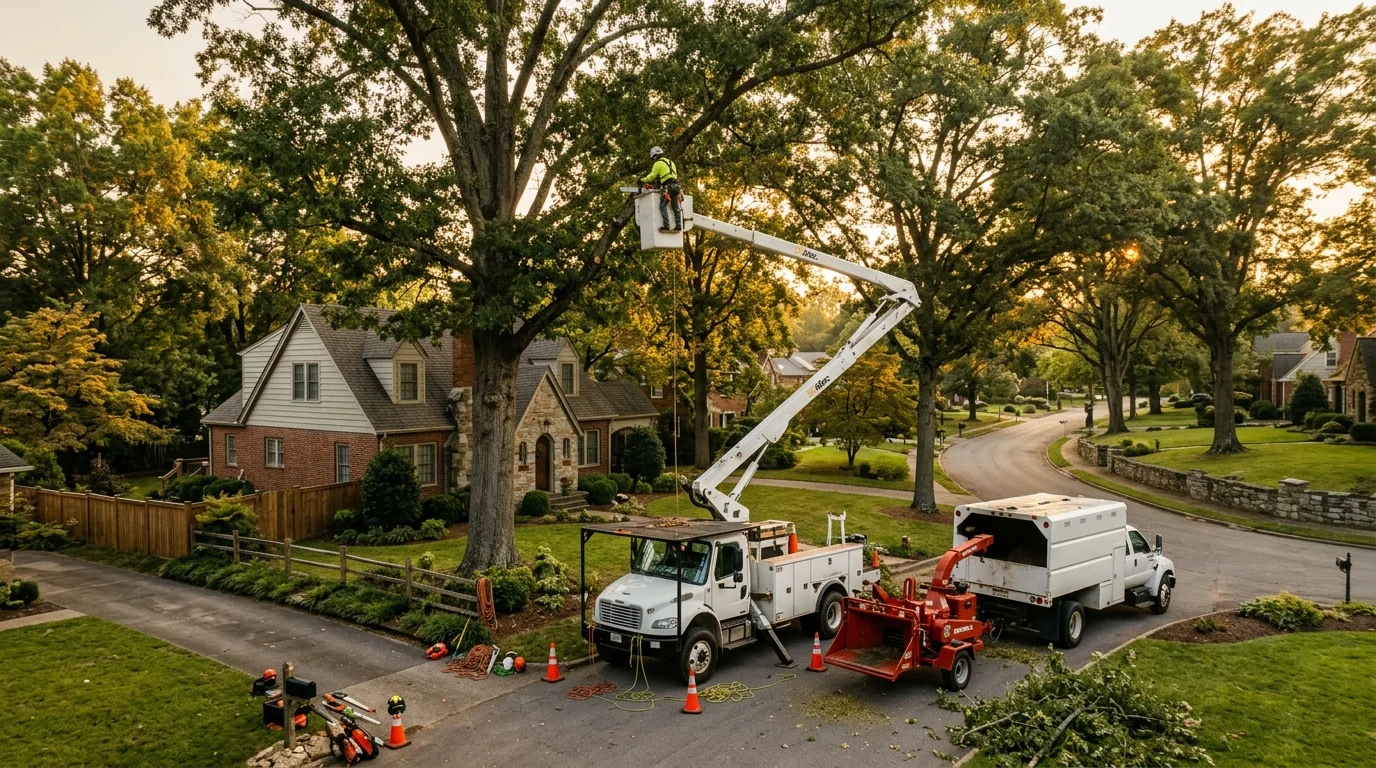
Professional Tree Removal. For most trees with basal fungal conks, removal is the recommended outcome. A professional tree removal addresses the hazard completely. For trees near structures or with compromised root plates, removal requires careful rigging or sectional dismantling. The presence of decay changes how a tree responds to cutting forces, so experienced crews plan each cut sequence before work begins.
Emergency Tree Removal. When a conk-bearing tree is already leaning, has suffered root plate lift, or is in imminent danger of failure, emergency tree removal is the appropriate service. Waiting for a scheduled appointment is not a safe option for a tree that is actively failing. Many Knoxville homeowners discover advanced basal decay after a storm has shifted the root plate or opened a cavity, and same-day response is essential.
Tree Risk Assessment. For trees where the severity of decay is uncertain, a formal tree risk assessment by a certified arborist uses probing tools, mallet testing, and sometimes resistograph drilling to quantify how much sound wood remains. The International Society of Arboriculture’s tree-owner guidance (available at ISA Trees Are Good) recommends professional assessment for any visible decay before a removal decision is made. This is the right first step when you want an honest save-or-remove answer rather than an automatic removal pitch.
Stump Grinding. After a decayed tree is removed, the remaining stump and root system can continue to harbor Armillaria and other root-rot fungi, which then spread through the soil to neighboring healthy trees. Stump grinding removes the primary reservoir of fungal inoculum and reduces the risk of spread. In a yard with multiple mature trees, this step is not optional.
Typical Cost Range
According to Bob Vila’s tree removal cost guide, most residential tree removals fall between $385 and $1,070. Large trees, trees close to structures, or trees with compromised root systems that require extra rigging typically push costs toward the high end or above that range. Emergency removals carry a premium above standard rates. Stump grinding is typically a separate line item.
For a detailed look at what drives pricing in the Knoxville area, see our tree removal cost guide.
Inspection Process
A proper inspection for fungal conks covers more than a visual check of the fruiting bodies themselves.
An arborist will begin at ground level, examining the root flare and buttress roots for soft spots, weeping wounds, or soil displacement that signals root plate movement. The trunk is struck with a rubber mallet in a grid pattern; hollow sounds indicate internal voids. On significant trees, a resistograph or Picus tomograph can map the cross-section of sound versus decayed wood without invasive coring.
Crown condition is evaluated alongside the basal findings. Thinning canopy, dead branch tips that have persisted for more than one season, and early fall color on isolated limbs all correlate with root and trunk decay. A tree can lose 40 to 50 percent of its structural wood before the crown shows obvious distress, which is why basal symptoms often appear before visible canopy problems.
The arborist will also assess the target zone: what is directly in the tree’s likely fall path, and how frequently people or vehicles occupy that space. A decayed tree over a seldom-used fence line is a different risk calculation than one over a driveway used daily.
To schedule a no-obligation inspection, request a quote and describe the conk location, approximate trunk diameter, and what is in the tree’s fall zone.
When to Skip Repair (or Wait)
Honest assessment sometimes leads to a monitoring recommendation rather than immediate removal.
If conks are growing from an old cut stump within a few feet of a healthy tree, and the healthy tree’s roots test sound, the stump can be ground and the healthy tree monitored without removal. If a small conk appears on a surface root that is visually separated from the trunk, and an arborist finds no interior decay on probing, a six-month monitoring interval with documented photographs is reasonable.
Trees with sentimental value and uncertain structural status are also candidates for a second opinion before removal. The ISA’s find-an-arborist tool lets Knoxville homeowners locate credentialed arborists who can provide an independent assessment. The 49 percent of homeowners who have received conflicting “remove it” vs. “save it” advice from different contractors are not imagining the disagreement. Decay assessment involves judgment, and a second professional opinion on a large, valuable tree is money well spent.
What is not appropriate is indefinite waiting when conks are on the main trunk, the trunk sounds hollow, and the tree hangs over an occupied area. The ISA’s tree-owner resources are clear that visible decay signs combined with a significant target zone constitute an elevated risk that warrants prompt professional action, not watchful waiting.
For a full picture of tree health problems common in the Knoxville area, visit our tree problems resource hub.