What This Symptom Looks Like (and When to Act)
Root damage rarely announces itself all at once. More often, you notice something slightly off, a sidewalk panel that was not cracked last spring, a toilet that drains a little slower each month, a basement wall crack that seems to grow a quarter inch per season. By the time the damage is obvious, roots have usually been working for years.
What It Looks Like Exactly
Foundation damage from roots shows up as horizontal or diagonal cracks along basement walls, especially near corners closest to a mature tree. You may notice doors that no longer latch properly or floors that feel slightly uneven near an exterior wall. On sidewalks and driveways, the classic sign is a heaved or buckled panel with the high side pointing toward the tree. Septic root intrusion presents as slow drains throughout the house, gurgling sounds after flushing, soft wet patches over the drain field, or sewage odors near the tank access.
When It Is a “Monitor” vs. “Act Now” Situation
A hairline crack in a sidewalk panel near a young tree, and no change over two seasons, is a monitor situation. The same crack widening by more than one-eighth inch per year, or any crack paired with a door that no longer closes, moves into act-now territory. Septic symptoms are always act-now. A partially blocked drain field can fail completely within one season, and replacement of a full septic system in Knox County typically costs far more than tree removal ever would.
What NOT to Do
Do not fill foundation cracks with hydraulic cement or caulk before identifying whether root pressure is still active. Cosmetic patching over an active root intrusion gives false reassurance while the underlying pressure continues. On the septic side, do not use chemical root killers as a first response. Foaming herbicide treatments pushed through the drain line can temporarily clear roots but rarely address the source, and they can damage older clay pipe if overused.
What Causes Root Damage in Knoxville, TN
Knoxville’s specific combination of geology, rainfall, and tree species makes root damage a more pressing problem here than in many other southeastern metros.
Knox County receives an average of 47.9 inches of rainfall per year (NWS Morristown KMRX, 1991-2020 Climate Normals). That level of consistent moisture means tree roots near foundations and septic systems have a reliable water source, which reduces the need for roots to grow deep and encourages lateral spread near the surface, right where infrastructure sits.
The underlying geology compounds the problem. Knox County rests on Valley and Ridge limestone and dolomite, topped by residual clay and silty clay soils (USDA Web Soil Survey, Knox County, Tennessee). Clay soils shrink in summer drought and swell with fall and winter rains. That shrink-swell cycle creates micro-gaps along foundation footings, and roots exploit those gaps for moisture. Once a root tip finds a gap, root growth accelerates toward the water source.
Knoxville’s karst limestone topography adds another layer of complexity. Subsurface voids and solution cavities documented across the county can channel water in unpredictable paths. A tree root following an underground moisture gradient in karst terrain can travel farther from the trunk than standard root-spread estimates predict, sometimes appearing under a foundation or within a septic system that looks far enough from the tree to be safe.
Species choices in Knox County’s older subdivisions matter too. Bradford pears, planted aggressively across Knoxville neighborhoods through the 1990s and 2000s, develop wide, shallow root systems as they age. Willow oaks common on the city’s west side, and silver maples planted near older ranch-style homes, have documented histories of heaving sidewalks and infiltrating older septic tanks. The USDA Forest Service’s urban forestry guidance identifies species with high surface-root tendency as priority candidates for buffer planting away from infrastructure.
Repair Methods That Address Root Damage
Tree Removal
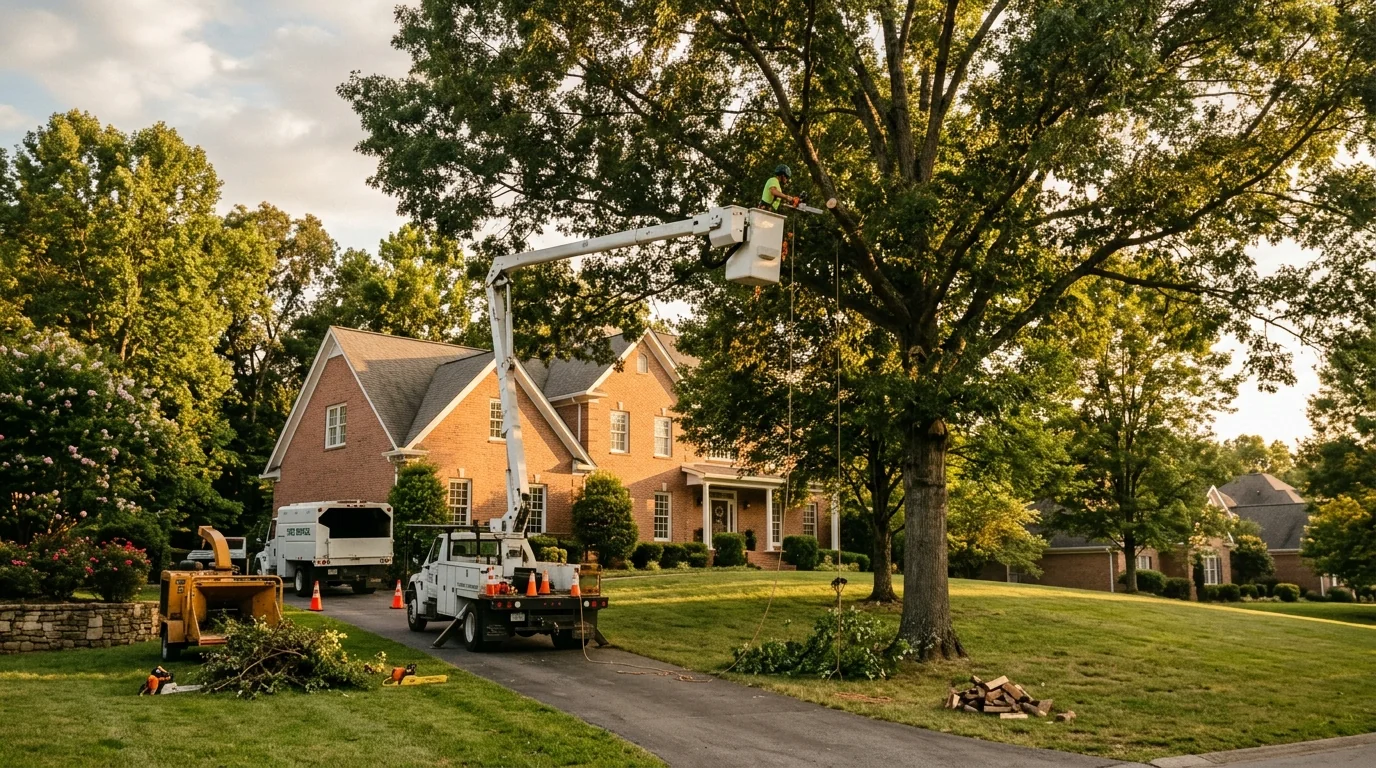
For active root intrusion into a foundation or septic system, professional tree removal is often the most direct solution. Removing the tree stops new root growth toward the affected structure. Existing roots will decay over two to five years depending on species and soil conditions, gradually releasing the pressure they exert on footings and pipe joints. Removal makes the most sense when the tree is already showing signs of decline, when it sits within ten to fifteen feet of the foundation, or when septic system repair or replacement is required.
Stump Grinding
After removal, stump grinding goes one step further by eliminating the root crown below grade. A stump left in place can continue to support root activity for a year or more while it decays, and it can sprout aggressively in species like sweetgum and willow oak. Grinding the stump down six to twelve inches removes the primary energy source for remaining roots and accelerates their breakdown.
Root Barrier Installation
When a tree is healthy and worth preserving, root barrier installation offers a way to redirect root growth without removing the tree. A physical barrier, typically a high-density polyethylene panel installed vertically in a trench between the tree and the structure, deflects roots downward and away from the foundation or septic line. Barriers work best when installed proactively or early in the damage progression. They are less effective once roots have already penetrated the foundation.
Emergency Tree Removal
When a root-compromised tree has also developed structural hazards, such as a root-girdled trunk that has begun to lean toward the house, emergency tree removal may be the appropriate entry point. A compromised root plate can cause a tree to topple during wet soil conditions, which is particularly common in Knox County after heavy spring rains or saturation events like the remnants of Hurricane Helene in September 2024, which caused widespread saturation-driven tree failures across East Tennessee.
Typical Cost Range
According to Bob Vila, residential tree removal typically ranges from $200 to $2,000 depending on tree size, with trees over 60 feet often reaching $1,500 or more. Crane-assisted removal for trees close to structures runs higher. Stump grinding generally adds $100 to $450 as a line item.
Root barrier installation costs vary by linear footage of barrier required and trench depth. This Old House cites tree service costs broadly, and root barrier projects are typically priced on a per-project basis after a site assessment.
For a full breakdown of what factors affect pricing in the Knoxville market, see tree removal cost information. For a no-obligation on-site estimate specific to your tree and structure, request a free quote.
Inspection Process
A proper inspection for root damage covers three distinct areas: the tree itself, the soil between the tree and the structure, and the structure.
On the tree, an inspector evaluates species, trunk diameter, and proximity to the foundation or septic system. Root flare exposure, surface root visibility, and any girdling roots are documented. ISA-certified arborists (verifiable through the ISA Find an Arborist directory) follow standardized assessment protocols that include canopy health scoring and trunk defect evaluation.
In the soil, an inspector probes between the tree and the structure to locate major lateral roots. In clay soil typical of Knox County, this often involves soil probing rods or hand excavation near the foundation wall.
At the structure, the inspection maps crack locations, measures crack widths, and looks for patterns consistent with root pressure versus settlement from other causes. For septic concerns, a camera inspection of the drain line is the definitive diagnostic tool.
Elevation measurements taken inside the home establish whether the foundation has moved, and crack-width records establish whether movement is ongoing or historical.
When to Skip Repair (or Wait)
Not every root situation demands immediate action. A tree with a surface root crossing a patio but not within fifteen feet of the foundation, with no visible cracking in the home’s structure, is a candidate for annual monitoring rather than removal. Documenting crack widths with a simple pencil mark and date twice a year tells you whether the situation is static.
If a foundation crack is clearly old, has been stable for more than two seasons, and the tree in question is small or a species known for compact root systems, a structural engineer’s assessment may confirm that no intervention is needed beyond sealing the crack against water infiltration.
Similarly, a sidewalk panel heaved by a surface root in a low-traffic area, with no structural implications for the home, can sometimes be addressed by grinding down the high edge of the panel for safety while monitoring the root spread over subsequent seasons. See the tree problems overview for additional guidance on how arborists weigh tree value against structural risk before recommending removal.
The decision to remove a healthy, mature tree is significant. Knoxville’s urban canopy provides real storm, temperature, and property-value benefits. When root containment methods can genuinely protect the structure, they are worth pursuing before committing to removal.