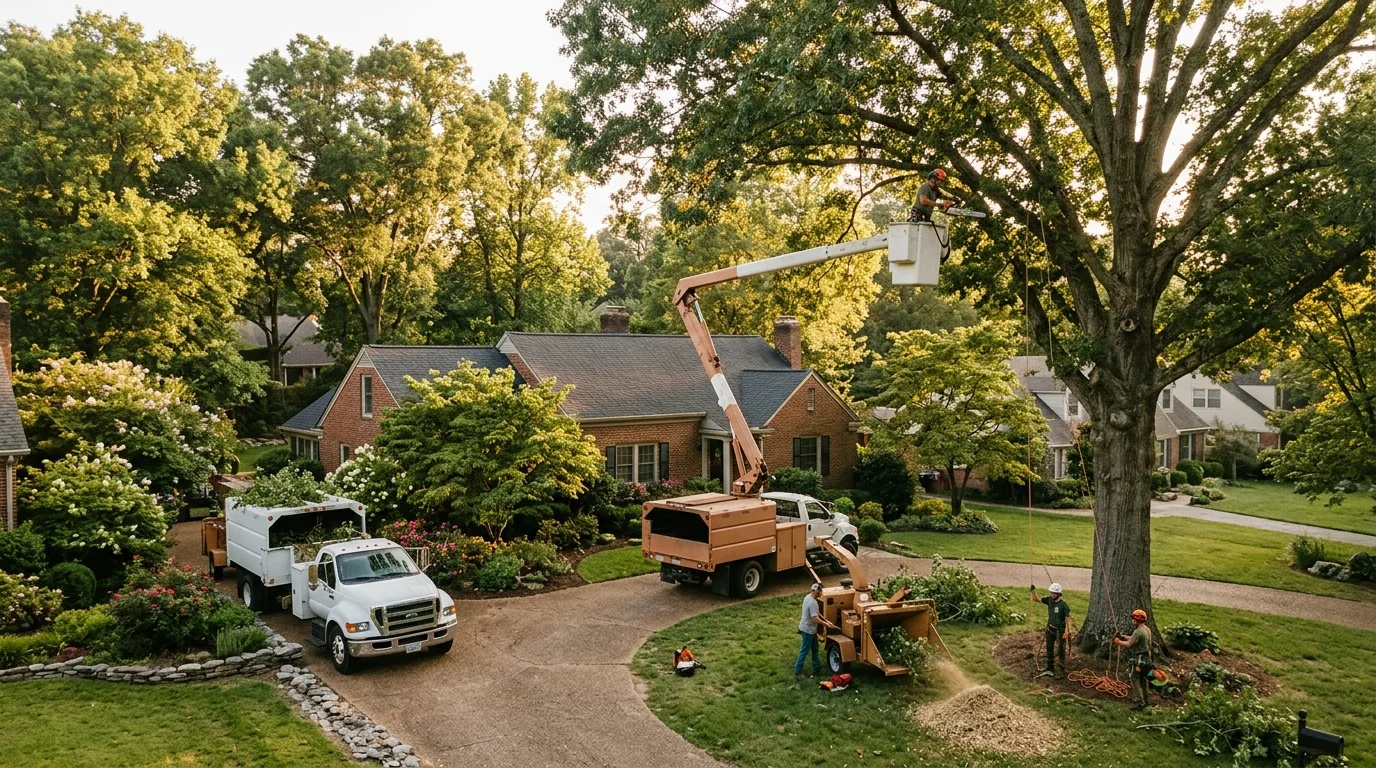
Tree on Power Line: Who to Call and What to Do Right Now
A tree touching a power line is not a yard maintenance problem. It is an electrical emergency, and the sequence of calls you make in the next ten minutes matters more than anything a tree crew does afterward. This page explains exactly what to do in Knoxville, why local storm patterns put so many homes at risk, and how professional removal works once the hazard is controlled.
What It Looks Like (and When to Act)
The physical signs
A tree-on-power-line situation can range from a single branch resting lightly on a low-voltage service drop to a full trunk across a high-voltage distribution line. Common presentations in Knoxville neighborhoods include:
- A leaning tree whose canopy has grown into or is pressing against overhead wires
- A branch that snapped during a storm and is now draped over a line
- A whole tree that uprooted or snapped at the base and pulled the line down toward the ground
- A service drop to your house that is visibly sagging because a limb is weighing on it
Any of these can be energized. Wet wood, wet bark, and wet ground all conduct electricity. Visual silence, no sparks, no buzzing, does not mean the line is safe.
Monitor vs. act now
There is no “monitor” category for a tree on an active power line. If a tree or branch is contacting, or is within a few feet of, any overhead conductor, treat it as act-now. The only partial exception is a tree that is leaning toward a line but not yet touching it, with documented slow movement. In that case, an arborist assessment within the week is warranted, not a wait-and-see of months.
What NOT to do
Do not attempt to pull the tree or branch away from the line with a rope, vehicle, or your hands. Do not let children or pets approach the area. Do not assume the line is de-energized because your power is out, parallel circuits may still be active. Do not call a tree service before calling the utility. A crew cannot legally or safely begin work until KUB or the appropriate provider has assessed and either de-energized the conductor or confirmed it is already dead.
What Causes This in Knoxville, TN
Knox County’s storm calendar creates repeated tree-on-line events throughout the year. Spring severe weather from March through May brings microbursts and straight-line winds that can snap mature oaks and Bradford pears with little warning. Summer thunderstorms drive sudden wind shear. The remnants of Hurricane Helene reached East Tennessee in September 2024, causing catastrophic, widespread tree failures across Knox County, including numerous power-line contacts that overwhelmed both KUB crews and tree services for days.
Winter ice events add a separate risk. East Tennessee’s elevation and Valley-and-Ridge geography make Knox County moderately to highly vulnerable to freezing-rain accumulation. The February 2021 ice storm is a clear local example: ice loading on white pines and hardwoods caused widespread limb breakage, and many of those limbs fell across service drops and distribution lines in west Knoxville and Farragut neighborhoods.
Beyond storm events, gradual canopy encroachment is a chronic problem. Utility corridors through established Knoxville neighborhoods, especially in areas with mature white oaks, tulip poplars, and silver maples, can close the gap between canopy and conductor over two or three growing seasons. Homeowners often do not notice until a storm accelerates the contact.
Tree disease also contributes. Emerald Ash Borer has been confirmed in Knox County, and native ash trees that go untreated die within three to five years, becoming brittle hazard trees. A dead ash losing bark and branch attachment near a utility line is an accident on a timeline. Hemlock Woolly Adelgid, widespread across East Tennessee, has killed eastern hemlocks throughout the region; dead hemlocks near lines represent the same category of risk. Both threats are documented by the Tennessee Department of Agriculture and the USDA Forest Service respectively.
Repair Methods That Address a Tree on a Power Line
Emergency tree removal
When a tree has already made contact with a line and the utility company has cleared the scene, emergency removal is the standard response. Crews work with the line either de-energized and locked out or covered with insulating blankets coordinated with the utility. The work moves fast, usually the same day the utility clears access, because the hazard window is open. Emergency tree removal in Knoxville covers what to expect from that process, including insurance documentation.
Crane-assisted removal
When the tree is large, close to a structure, or positioned so that conventional rigging would require swinging sections near the line, a crane changes the geometry of the job. The crane lifts cut sections straight up and away from the conductor rather than lowering them through the danger zone. This approach costs more but dramatically reduces the risk of a secondary contact during the removal itself. See how crane-assisted tree removal works for difficult situations.
Utility-zone tree trimming
For trees that are growing toward a line but have not yet made contact, directional pruning can restore and maintain clearance without removing the tree. This only applies when the tree’s structure is sound and the encroachment is limited to specific scaffold limbs. The pruning must follow ANSI A300 standards to avoid creating large open wounds that invite decay and future structural failure. Tree trimming in Knoxville describes how this works for canopy management near structures and utilities.
Standard removal (non-emergency)
When a tree’s proximity to a line is identified before a failure occurs, a scheduled removal during dry, calm conditions is safer and less expensive than emergency work after the fact. Full tree removal is the right path for trees that are dead, declining from disease, or structurally compromised near a utility corridor.
Typical Cost Range
Cost for any utility-adjacent tree work depends on tree size, species, degree of contact with the line, access for equipment, and whether the job is emergency or scheduled.
According to Bob Vila, standard tree removal ranges from roughly $200 for a small tree to $2,000 or more for a large one, with emergency removal typically running 25 to 50 percent above standard pricing. Crane-assisted jobs add a further premium because of the equipment mobilization cost. Get a written estimate after the utility company has assessed the scene. For a broader overview of what drives pricing, see the Knoxville tree removal cost guide.
What a Free Inspection Covers
A professional arborist inspecting a tree near a utility line looks at several things that are not visible from the street.
Root zone integrity is the first concern. A tree that has heaved or shifted since the last rain may have compromised lateral roots, making a future tip-over likely even without high wind. The arborist will look for soil cracking, root ball movement, and exposed roots on the tension side of any lean.
Crown structure matters because a tree with a heavy unbalanced canopy directed toward a line presents a different risk than one with symmetrical growth. Dead wood in the crown, co-dominant stems with included bark, and previous topping cuts all reduce the time a tree can survive near a conductor.
Trunk and bark condition reveals whether the tree is alive, actively declining, or already dead. An ash with D-shaped exit holes from Emerald Ash Borer, a hemlock with white woolly masses at the needle bases, or a black walnut with progressive top-down dieback consistent with Thousand Cankers Disease are all candidates for removal rather than trimming.
The arborist will also measure or estimate the horizontal distance from the canopy to the nearest conductor and evaluate whether directional pruning can realistically achieve and maintain safe clearance over multiple seasons.
When to Skip Removal (or Wait)
Not every tree near a line needs to come down immediately. A structurally healthy tree whose canopy is still several feet from the nearest conductor, in a location where growth is slow and annual trimming is practical, may be maintainable for years with a consistent pruning schedule.
If the utility company has already assessed the situation and confirmed the line is a low-voltage service drop rather than a distribution line, the risk profile changes somewhat, though contact with any energized conductor is still serious.
Waiting is appropriate only when: the tree has not made contact, a qualified arborist has confirmed the structure is sound, and a trimming plan is in place and actively scheduled. Waiting is never appropriate when contact has already occurred or when the tree is dead or severely declining. For guidance on whether a specific tree is worth saving, the ISA Trees Are Good resource for homeowners offers a useful framework for thinking through the save-vs-remove decision.
If you have any doubt after reading this, the cost of a free inspection is zero and the cost of a wrong call is not. Request a same-day assessment so a trained eye can look at your specific situation before the next storm makes the decision for you.