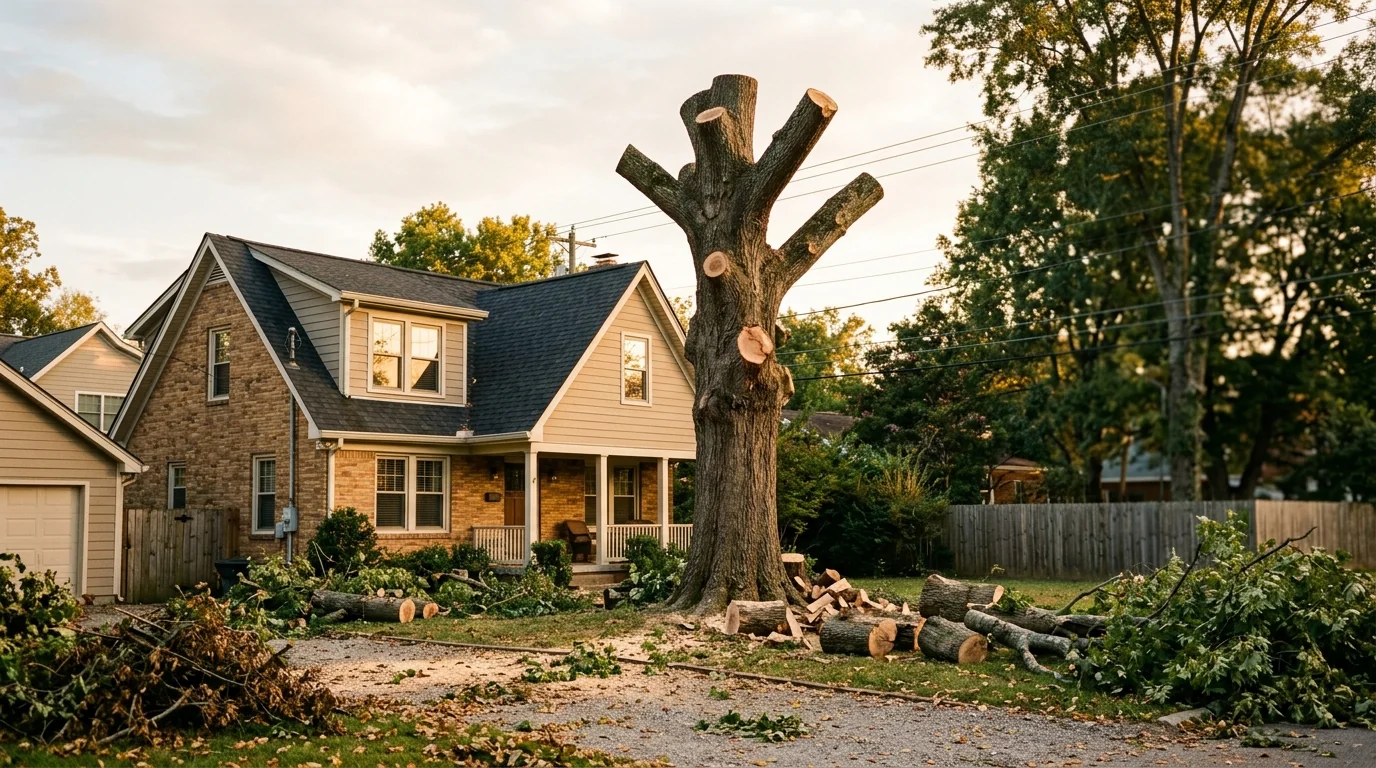
What is tree removal and when is it the right choice?
Tree removal in Knoxville is the controlled felling and full extraction of a tree from a residential or commercial property, typically followed by stump grinding and debris haul-off. It is not always the right call. Because roughly 64 percent of homeowners prefer to save a tree when possible, a responsible contractor will tell you when trimming or treatment is a legitimate alternative before recommending removal. That said, several conditions make full removal the only practical answer, and Knoxville’s specific tree disease pressures mean more of those situations are turning up in Knox County yards than homeowners expect.
How tree removal works mechanically
A trained crew assesses the tree’s lean, root plate stability, proximity to structures, and the available drop zones before touching a chainsaw. On open lots, a tree can often be felled in one controlled direction. On the tight suburban lots common in West Knoxville, Farragut, and North Knoxville’s older neighborhoods, crews climb and remove the tree in sections from the top down, lowering each piece on a rigging line to avoid damage to the house, fence, or neighboring property. Large or over-structure removals sometimes require a crane to lift sections straight up and place them in the street or driveway. Each extracted piece is then bucked, chipped, or staged for haul-off.
Conditions where removal is the right answer
Several tree health crises are active in Knox County right now, and each one generates removal candidates. Emerald Ash Borer (EAB) has been confirmed in Knox County; untreated native ash trees die within three to five years and become brittle hazard trees. Hemlock Woolly Adelgid has devastated eastern hemlocks throughout East Tennessee, leaving dead standing hemlocks near homes that pose a genuine fall risk. Thousand Cankers Disease holds particular significance here: it was first detected in the eastern United States in Knox County in 2010, according to the Tennessee Department of Agriculture, and black walnut trees showing crown dieback and tiny beetle entry holes have a poor prognosis. Beyond disease, structural failure, root plate heave visible after heavy rain, and confirmed cavity rot at the base are all clear removal triggers. Knoxville’s average 47.9 inches of annual rainfall (NWS Morristown KMRX, 1991-2020 Climate Normals) keeps soils saturated for extended stretches, which accelerates root rot in already-stressed trees.
Conditions where an alternative is better
If the tree is healthy and the problem is crown size, branch encroachment on a roofline, or a single damaged limb after a storm, tree trimming and pruning in Knoxville is the appropriate scope of work. Removal of a living tree that could be managed by pruning wastes a landscape asset and, on many Knox County lots, reduces the shade that keeps summer cooling bills in check.
Installation process
Tree removal follows a repeatable sequence regardless of tree size, though the time at each step scales with the job.
Step 1: Site assessment and planning (30-60 minutes)
The lead climber or arborist walks the site before any equipment is staged. They evaluate the lean of the trunk, any visible decay, root plate condition, proximity to power lines, and available drop zones. On jobs near structures, they also assess whether a crane is needed. This step determines the cutting strategy and the equipment required.
Step 2: Equipment staging and ground prep (30-90 minutes)
Chipper truck, aerial lift or crane (when required), and rigging equipment are positioned. Access to the site is often the limiting factor on Knoxville’s older in-fill lots, where gate widths can be tight and underground utility lines require hand-digging staging trenches to protect them. Ground crew marks the drop zones and establishes a safety perimeter.
Step 3: Tree removal (1-6 hours depending on method)
For a straightforward felling job, the crew notches the tree, places a back-cut, and brings it down in a controlled direction. For a sectional removal, a climber ascends and works from the top down, cutting limbs and trunk sections and lowering them on rigging lines. Crane-assisted work involves the crane operator and a climber coordinating each lift. Large sections are bucked into manageable rounds at ground level.
Step 4: Stump handling (30-90 minutes, if included)
The stump is typically left at ground level after removal unless stump grinding is in the scope. A stump grinder reduces the stump and surface roots to mulch a few inches below grade. If you are planning a lawn repair or replanting, confirm the grind depth in writing. Knox County’s clay-heavy soils mean stump debris does not decompose quickly on its own.
Step 5: Debris cleanup and haul-off (30-120 minutes)
Brush goes through the chipper. Large rounds are staged for pickup or left as firewood if requested. The crew blows or rakes the area and performs a final walkthrough with the property owner before leaving. Confirm in writing that haul-off is included. Missing that line item is one of the most common complaint patterns in the region.
Tree removal vs. tree trimming and pruning
These two services address different problems. Removal eliminates the tree entirely. Tree trimming and pruning manages the tree’s size and structure while keeping it alive and contributing to the landscape.
The clearest case for removal is a tree that cannot be saved. A Knox County ash tree showing D-shaped Emerald Ash Borer exit holes and significant crown dieback, or a hemlock bearing the white woolly egg masses of Hemlock Woolly Adelgid across its needles, is a mortality candidate regardless of how much pruning is done. Similarly, a tree with more than 50 percent of its crown dead, significant trunk decay, or a root plate that has visibly shifted after the kind of soil saturation Knoxville’s high-rainfall years produce, should come down.
Trimming is the better call when the tree is structurally sound but has grown into power lines, is shading a solar panel installation, or has one or two storm-damaged limbs that can be removed without compromising the crown. Many homeowners in Knox County hear “the tree needs to come down” from one contractor and “we can manage this with pruning” from another, and the trust gap is real. The International Society of Arboriculture’s homeowner guidance provides a useful independent framework for thinking through that decision.
The honest edge case is the tree that is not quite dead but declining. For a large oak on a dry ridge lot showing moderate crown thinning after consecutive dry summers, a single pruning visit to remove deadwood and reduce wind load may extend the tree’s life several years. For the same tree with confirmed root rot at the base, removal is the only safe answer.
Tree removal cost in Knoxville, TN
According to Bob Vila’s tree removal cost guide, most residential tree removals fall between $300 and $2,000, with large or hazardous removals running considerably higher. Emergency work after a storm typically carries a premium above the standard range. For a detailed breakdown of what drives Knoxville-specific pricing, see the tree removal cost guide for Knoxville.
Several local variables move the number:
Tree height and trunk diameter. A 30-foot ornamental tree near a clear drop zone costs far less than a 70-foot white pine on a Fountain City lot adjacent to a house. Height adds time; girth adds saw and chipper time.
Access. Tight gate widths on older neighborhoods in North or East Knoxville may require hand-carrying equipment, which adds crew hours. Steep terrain, common on the ridge-and-valley lots throughout Knox County, slows ground operations and may require additional rigging.
Proximity to structures, power lines, and neighboring property. Any job where the tree cannot simply be felled requires sectional climbing work or crane assistance. Crane day-rates are a significant cost driver and are quoted separately by most contractors.
Stump grinding. Most base quotes cover removal to ground level. Stump grinding is typically a separate line item. Confirm whether it is included before signing.
Emergency or after-hours work. Knoxville’s storm seasons, including the spring tornado window and the ice storm risk in February and March, generate demand spikes. Remnants of Hurricane Helene in September 2024 caused widespread tree failures across Knox County. During those demand spikes, response speed commands a premium.
Warranty and transferability
Tree removal itself does not carry a product warranty in the way a manufactured good does. What you are contracting for is labor, equipment, and the liability coverage that protects your property if something goes wrong during the job. A well-run contractor will provide a written scope of work before the job starts, carry current general liability insurance with limits sufficient to cover the replacement value of your home, and carry workers compensation coverage so you are not exposed if a crew member is injured on your property.
Ask for the actual certificates of insurance before work begins, not just a verbal assurance. Verify that the policy is current and that the coverage limits match the risk. For large or crane-assisted removals over a structure, confirm the contractor’s policy explicitly covers the work scope. Some general liability policies exclude crane operations or aerial work without an endorsement.
There is no industry-standard transferable warranty for removal work because the job is complete when the tree and debris are gone. What transfers to a new owner when you sell is the condition of the property itself. A properly removed tree with the stump ground flush and the area graded will not create new problems for a buyer. An improperly removed tree with surface roots left to decay under a lawn can create ground settlement issues over several years.
Permits and engineering in Knox County
Permit requirements for tree removal in Knoxville depend on where you are and the size of the tree.
City of Knoxville limits. Within the City of Knoxville, a permit is generally required before removing any tree six inches or greater in diameter measured at breast height on residential property. Applications go through the City of Knoxville Development Services department. Processing time for a standard residential permit is typically a few business days, though it is worth calling ahead because enforcement priorities and processing times shift seasonally.
Knox County unincorporated areas. Removal of trees on unincorporated Knox County property may fall under different rules administered by Knox County Codes Enforcement. If you are not sure whether your address is inside or outside City of Knoxville limits, the City’s GIS portal can confirm your jurisdiction in minutes.
Right-of-way trees. Any tree rooted in the public right-of-way, the strip of land between your property line and the street, requires a separate permit regardless of size. The City of Knoxville Public Works department handles right-of-way removal requests. These sometimes require an arborist’s written assessment before the permit is approved.
HOA requirements. Approximately 45 percent of Southeast suburban homes are HOA-governed, and roughly 70 percent of those require approval before removing a tree visible from the street. Check your HOA covenants before scheduling work. A contractor showing up without HOA sign-off can put you in violation and delay the job.
Engineering. Most residential removals do not require a structural engineer’s report. The exception is a tree that has already damaged or is suspected of damaging a foundation, retaining wall, or utility line. Knox County’s karst limestone geology means that root intrusion or soil movement near documented sinkhole zones occasionally warrants a geotechnical review before a large root system is disturbed. If your tree is near a known drainage feature or a low area with a history of subsidence, mention that to your contractor before work begins.
To schedule an assessment with a Knoxville-area crew, request a tree removal quote for your property and include the tree’s approximate size, its distance from any structures, and whether you are inside or outside City of Knoxville limits.
You can verify a contractor’s ISA Certified Arborist credential directly through the ISA Find an Arborist tool before committing to any contract. The Tree Care Industry Association also maintains a directory of accredited companies that have passed third-party safety and business reviews, which is a reasonable starting filter when you are comparing bids for a large or hazardous removal job in the Knoxville metro.
For information on what the Knoxville service area covers and which neighborhoods fall inside typical crew response zones, see the local service area page before requesting a quote.